Walk into any Costco and you’ll notice something immediately: there’s no small jar of mayonnaise, no single roll of paper towels, no travel-size anything. Everything comes in twos, fours, or industrial-sized tubs. This isn’t an accident of warehouse logistics. It’s one of the most deliberately engineered psychological systems in modern retail and once you understand how it works, you’ll never shop there the same way again.
The Bulk Strategy Isn’t About Convenience It’s About Behavior
The core mechanic is simple, but its effect on your spending is anything but.
By selling products in bulk, Costco entices customers to buy large quantities of items upfront even if the customer cannot possibly finish all of the product before the expiry date. Then once the expiry date passes, customers go through the entire process all over again until the next time.
A pack of 36 toilet paper rolls is simply cheaper per unit than buying rolls one at a time and that mathematical truth is exactly what makes the strategy so effective. Once a customer tries a product sample, likes it, and buys it, they have enough of it for months if they’re buying in bulk. One good first impression locks in a months-long habit.
The Hidden Math: Why Your Brain Loves This Deal
There’s a real economic principle backing up why this strategy works so consistently on shoppers.
Costco’s customer behavior mirrors the Economic Order Quantity (EOQ) model used by companies to minimize ordering and inventory costs except here, the customer becomes the one optimizing. Customers purchase larger quantities on each visit to reduce the frequency of trips, lowering their total time and travel costs.
Costco’s membership fee acts as a fixed cost for customers, creating a psychological incentive to make larger, less frequent purchases just to “get their money’s worth” out of that annual fee.
In other words: the moment you pay your membership fee, your brain quietly starts treating every cart as a math problem to justify that cost and buying just one item never feels like it adds up.
Price Anchoring: The Trick Hiding in Every Aisle
This is the psychological mechanism doing the heaviest lifting, and most shoppers never notice it happening.
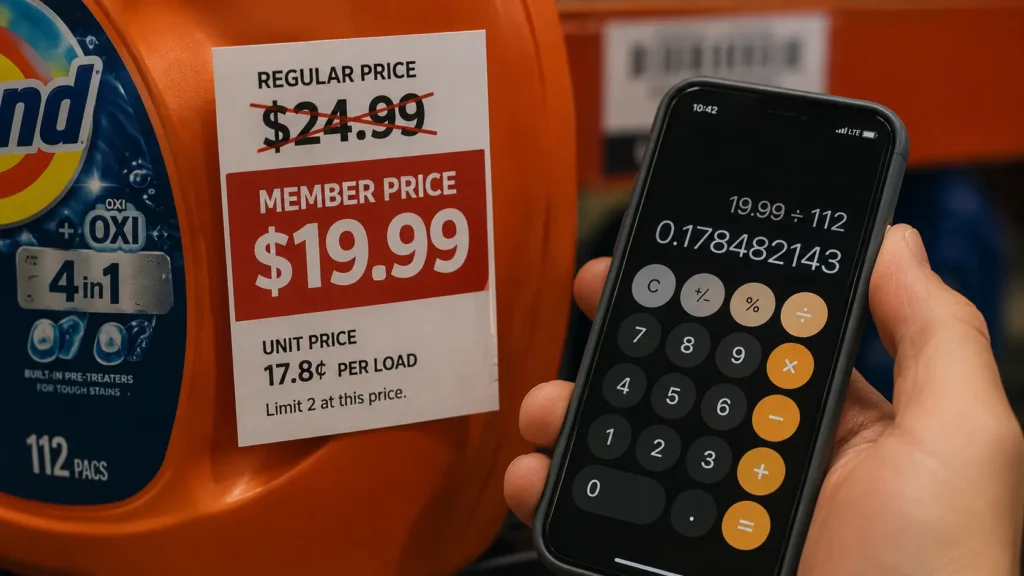
By establishing a high reference price for a familiar item like the regular retail price for a specific brand of detergent Costco can make its bulk price appear exceptionally attractive. Even if the anchor price is exaggerated, the comparison still shapes how much you perceive yourself as saving.
Costco strategically deploys loss leaders on high-visibility staples to create the perception that “everything at Costco is a great deal.” This perception increases trust and reduces price resistance across the rest of the basket.
When shoppers encounter an item priced far below expectation, they recalibrate what they consider a “good deal” and this anchoring effect makes every adjacent or unrelated product feel more reasonably priced by comparison, causing shoppers to spend more across categories.
The $1.50 Hot Dog That Loses Money on Purpose
This is the most famous example of the entire strategy in action and Costco has never hidden it.
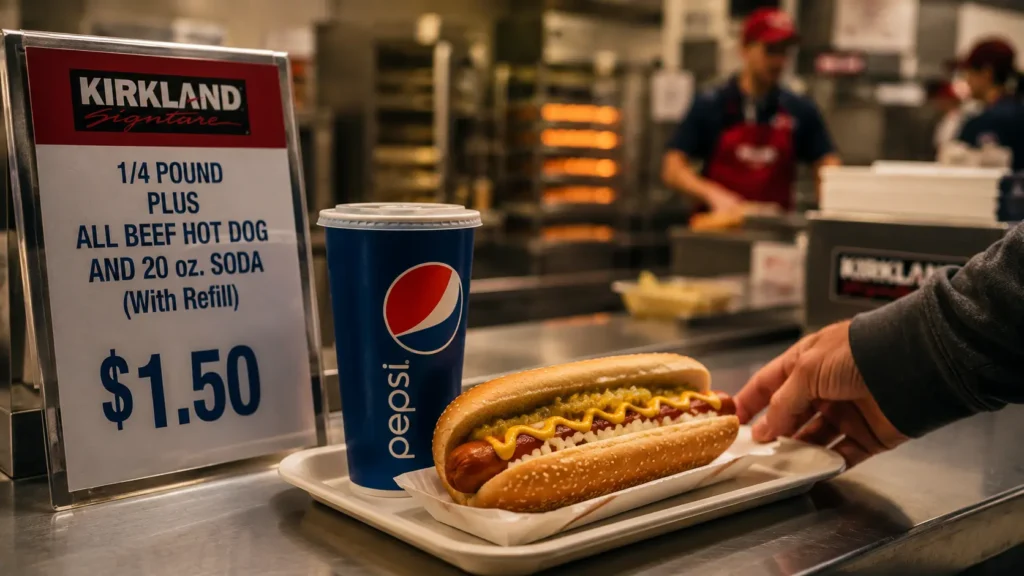
Costco sells items like its $1.50 hot dog combo, which they lose millions of dollars on every single year, as part of their strategic pricing and “doorbusters.”
They’ve explicitly stated they will never raise the price, even though they lose money on each one sold and the same is true for their rotisserie chicken, kept at $4.99 despite losing somewhere between $30 and $40 million a year on it alone.
These aren’t generous accidents. Loss leaders aren’t meant to make money directly they’re meant to increase trip frequency, basket size, and brand trust. That $1.50 hot dog exists purely to get you walking through the door, and everything after it is designed to make sure you don’t leave with just that.
Where Costco Actually Makes Its Money
Here’s the part that explains why none of this needs to feel risky for the company.
Nearly 80% of Costco’s profits come from membership fees alone. In 2023, Costco made over $242 billion in total revenue, with Costco running on a deliberately low-profit margin while selling enormous volume bringing in many customers looking for deals, which keeps prices low and keeps shoppers coming back.
This is precisely why Costco can afford to lose money on hot dogs and chickens. The product floor is the lure the membership is the actual business model.
Why Buying One Item Feels Wrong, Even When It’s Allowed
The retail layout itself is designed to make the “just one item” trip feel almost impossible.
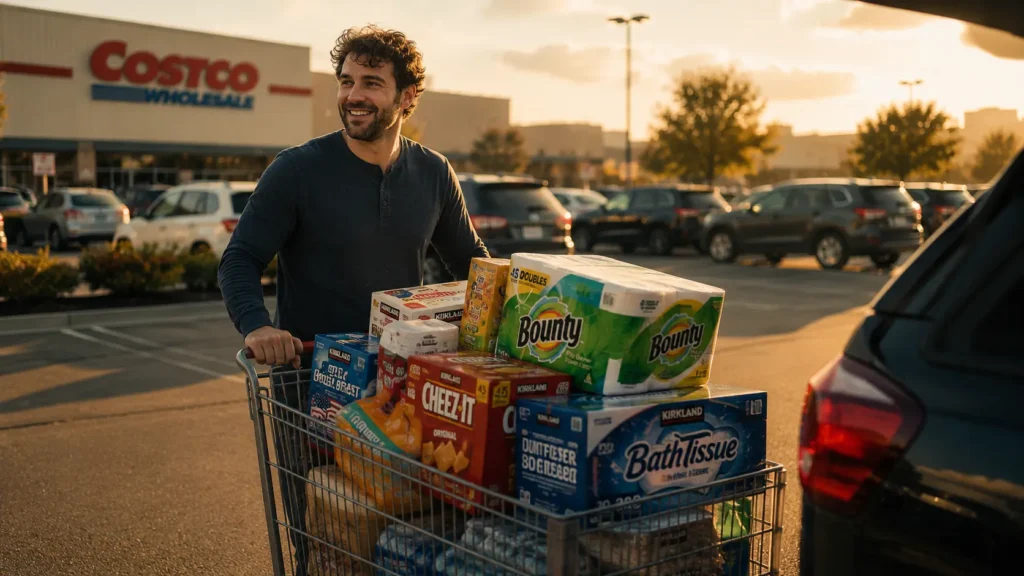
The cavernous aisles of Costco represent a carefully orchestrated environment designed to influence consumer behavior a symphony of strategic pricing, curated product selection, and environmental design, all aimed at fostering a particular mode of consumption.
The fundamental appeal of Costco lies in its promise of value, largely facilitated by the significant quantities in which products are offered a strategy that taps into the endowment effect, the tendency for individuals to place a higher value on something they own or believe they own.
This shift in consumer behavior is not merely a reflection of economic necessity it speaks to deeper psychological motivations, tapping into the human instinct for savings and value, while also playing on the emotions of security and abundance.
The Real Risk: Loss Aversion in Reverse
It’s worth noting that the bulk strategy doesn’t always work perfectly in Costco’s favor and the research is honest about that tension too.
The high upfront cost of bulk items can trigger a fear of “losing out” if the purchase proves to be a mistake or the item isn’t used as intended leading to a prolonged decision-making process for shoppers who grapple with the potential for wasted money.
That hesitation is exactly why sampling stations exist throughout the store they’re designed to overcome that exact resistance before it stops a sale.
How to Actually Shop Costco Without Overspending
Understanding the psychology doesn’t mean you have to fall for it every time.
1. Always check the unit price, not the sticker price.
Since Costco sells in bulk or larger sizes, comparing the unit price to other stores is the only honest way to know if it’s actually cheaper Costco almost always comes ahead, unless you catch a BOGO sale elsewhere.
2. Look for the asterisk on clearance tags.
A price tag with an asterisk in the top right corner means the item is near its sell-by date or end-of-season clearance often the real savings hiding in plain sight.
3. Remember: the deal you’re seeing isn’t always the deal you’re getting.
The anchored “regular price” comparison is designed to make you feel like you’re saving more than you actually are calculate the real per-use cost before committing to a bulk size you may not finish.
The Bottom Line
Costco didn’t accidentally end up selling everything in bulk. As the third-largest retailer globally, Costco has not only changed the way Americans shop, but has fundamentally shaped their purchasing psychology making bulk buying and the acquisition of large quantities feel like the norm, not the exception.
The $1.50 hot dog was never really about the hot dog. It was always about getting you through the door and once you’re inside, the entire layout has already decided that “just one item” was never really on the table.
Read Also:
- 🔗 The Invisible Companies Buying and Selling Your Data Every Day
- 🔗 Why Your Neighbor Pays Less for Car Insurance Than You
© AiwalaNews | Global Tech & Privacy Edition | June 2026
