
The protest hasn’t started. The crowd hasn’t gathered. The signs haven’t been made. The AI already knows.
Somewhere inside a government data center, an algorithm is watching. Not for criminals. Not for terrorists. For patterns. The specific, measurable, digital patterns that appear in a population 72 hours before people decide they’ve had enough.
China has built it. It is operational. And the implications stretch far beyond China’s borders.
What the System Actually Does
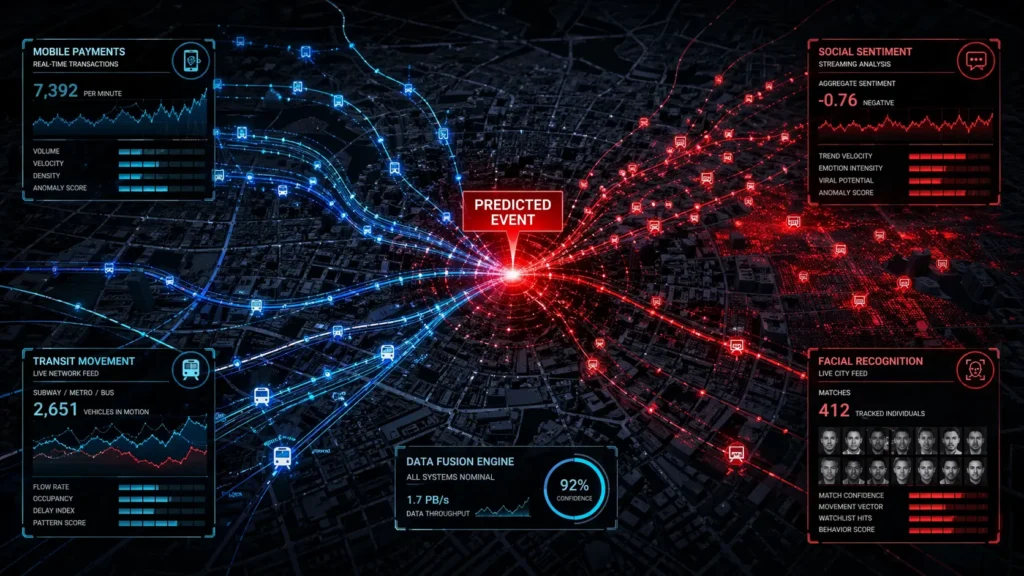
The system developed under China’s Social Stability Prediction Platform framework aggregates data from sources most governments don’t even have unified access to: social media activity, mobile payment behavior, public transit usage, facial recognition feeds, electricity consumption patterns, and citizen complaint filings.
It doesn’t look for specific people. It looks for specific conditions the precise combination of economic stress indicators, communication pattern shifts, and public sentiment signals that historically precede collective action.
When those conditions align, the system flags the region. Authorities are notified. Before anyone has done anything.
This is not science fiction. Chinese state media has referenced the system’s deployment across multiple provinces. Researchers at the Australian Strategic Policy Institute documented its integration with existing Smart City infrastructure across dozens of Chinese municipalities by 2024.
The Data It Feeds On
To understand why this system works, you need to understand what it watches and how much of modern life is now legible to an algorithm.
Mobile payment data reveals economic anxiety in real time. When populations begin hoarding cash, delaying purchases, or shifting spending patterns away from discretionary items, these signals appear in transaction data days before they appear in any economic survey.
Public transit patterns show population movement and congregation behavior. Unusual gathering of people in non-routine locations particularly near government buildings, factories, or public squares registers as an anomaly worth flagging.
Social media linguistic analysis tracks not just what people say but how they say it the specific vocabulary shifts, the emotional temperature of posts, the spread of particular phrases through networks. Certain linguistic patterns reliably precede organized dissent.
Facial recognition feeds from China’s estimated 700 million surveillance cameras cross-reference individuals flagged by other data streams creating a system where digital signals and physical presence are tracked simultaneously.
Citizen complaint portals government platforms where citizens file grievances provide perhaps the most direct signal of all. A spike in complaints from a specific region about a specific issue is one of the strongest predictors the system uses.
Together, these streams create what researchers call a “pre-crime social portrait” a statistical picture of a population moving toward breaking point, rendered visible before the break happens.
Why 72 Hours Is the Number
Seventy-two hours is not arbitrary. It reflects the documented mobilization window for organic civil unrest the period between when collective grievance reaches critical mass privately and when it manifests publicly.
During this window, people make calls. They share information. They coordinate. They move money. They change routines. Every one of these actions leaves a digital trace and the system is designed to read those traces as a unified signal rather than isolated noise.
By the time people are in the streets, the window for quiet intervention has passed. At 72 hours out, it hasn’t.
What Happens When the System Flags a Region
This is the part the technical papers don’t dwell on — but it is the part that matters most.
When the system predicts instability, the documented response includes: increased police presence deployed quietly, local officials dispatched to address grievances before they escalate, internet throttling in flagged regions, targeted outreach to identified community organizers, and in some documented cases, preemptive detention of individuals identified as likely coordination nodes.
The intervention is designed to be invisible. The goal is not to respond to unrest. The goal is to ensure unrest never becomes visible to dissolve the conditions before the match is struck.
In several documented cases in Xinjiang and Inner Mongolia, researchers noted that protests that had historical precedent in specific locations simply stopped occurring following the system’s deployment not because the underlying grievances were resolved, but because the organizational capacity was disrupted before it could coalesce.
This Is Not Only China’s Story
Here is the part that makes this a global conversation rather than a China-specific one.
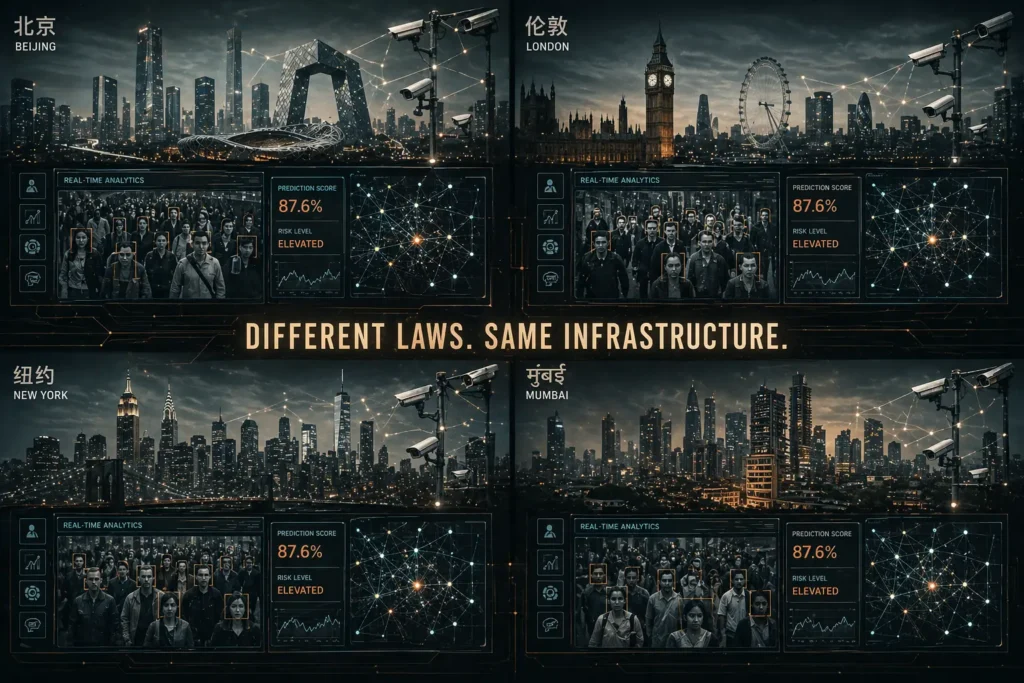
The technology is not proprietary to authoritarianism. Every data stream China’s system uses exists in democratic societies. Mobile payment data, social media linguistic patterns, transit behavior, facial recognition infrastructure, citizen complaint portals — the United States, United Kingdom, India, and the European Union all have versions of these data streams, held by a combination of government agencies and private corporations.
The difference is not capability. The difference is currently legal framework and political will.
Palantir the US data analytics firm has contracts with law enforcement agencies across America and Europe that involve predictive social analytics at scale. The UK’s Home Office has invested heavily in algorithmic risk assessment tools. India’s Smart Cities Mission has integrated surveillance infrastructure across 100 cities with data aggregation capabilities that parallel China’s framework.
The question is not whether Western governments could build what China built. The question is whether the legal, democratic, and institutional guardrails currently preventing it will hold and for how long.
The Philosophical Problem Nobody Wants to Answer
Predictive systems don’t just observe reality. They change it.
When an algorithm flags a region as pre-revolt and authorities intervene — dispersing the conditions before unrest occurs the system records a successful prediction. But there is no way to verify whether the unrest would actually have happened. The intervention makes the counterfactual unknowable.
This creates a self-validating loop. The system predicts. Authorities act. Unrest doesn’t occur. The system is credited with accuracy. The suppression is never recorded as suppression only as prevention.
In a democracy, the right to assemble, to protest, to collectively express grievance is not a threat to be predicted and neutralized. It is the mechanism by which democracy corrects itself.
A system that prevents unrest before it happens doesn’t just predict the future. It forecloses it.
What This Means for Every Person Reading This
If you live in China, this system is already watching the conditions around you.
If you live anywhere else, the infrastructure for a version of this system almost certainly already exists in your country assembled piece by piece under different justifications: crime prevention, traffic management, public health, counterterrorism.
The architecture of prediction is already built. What remains is the political decision about what to predict and what to do when the prediction comes back positive.
That decision is not being made by the algorithm.
It’s being made by whoever controls it.
