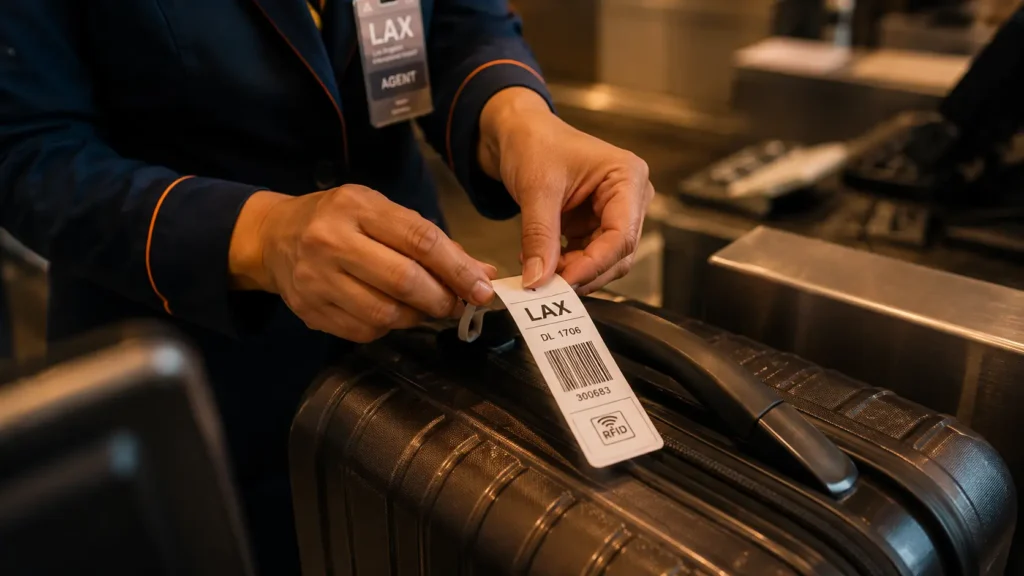
Every time you check a bag at an airport, you’re handing over something valuable to a system you’ve never seen a network of conveyor belts, underground tunnels, sorting machines, and scanning equipment that processes thousands of bags per hour without stopping.
At a major hub like Atlanta’s Hartsfield-Jackson the world’s busiest airport over 100,000 bags move through the baggage handling system on a peak travel day. Somehow, almost all of them arrive exactly where they’re supposed to. The reason isn’t luck. It’s a technology most passengers have never thought about and it’s been quietly revolutionizing aviation behind the scenes.
It Starts With a Tag That Does More Than You Think
The moment you check your bag, a tag gets attached that looks like a simple paper label. It isn’t.
An airport luggage tag is an identification and tracking label that links each bag to a specific passenger, flight, and destination within the airline’s baggage handling system. Traditionally, luggage tags were printed with a barcode but increasingly, they are embedded with RFID chips for real-time tracking and automation.
In airports, RFID labels are placed on luggage, containing information that allows for unique identification of the passenger, origin, and destination of that suitcase. These tags emit radio signals that are captured by strategically located RFID readers throughout the airport, enabling real-time tracking of luggage as it moves through checkpoints such as check-in counters, conveyor belts, and loading areas.
The critical difference from a barcode: RFID doesn’t require line-of-sight scanning. Thousands of tags can be read at once, delivering accuracy rates above 99% and reducing manual work and human error.
A barcode scanner needs to be physically aimed at a label, one bag at a time. An RFID reader can scan hundreds of bags simultaneously, even when they’re stacked, tilted, or partially obscured at full conveyor belt speed.
The Journey: What Actually Happens After the Rubber Flap
Once your bag disappears from check-in, it enters one of the most precisely engineered logistics systems in the world.
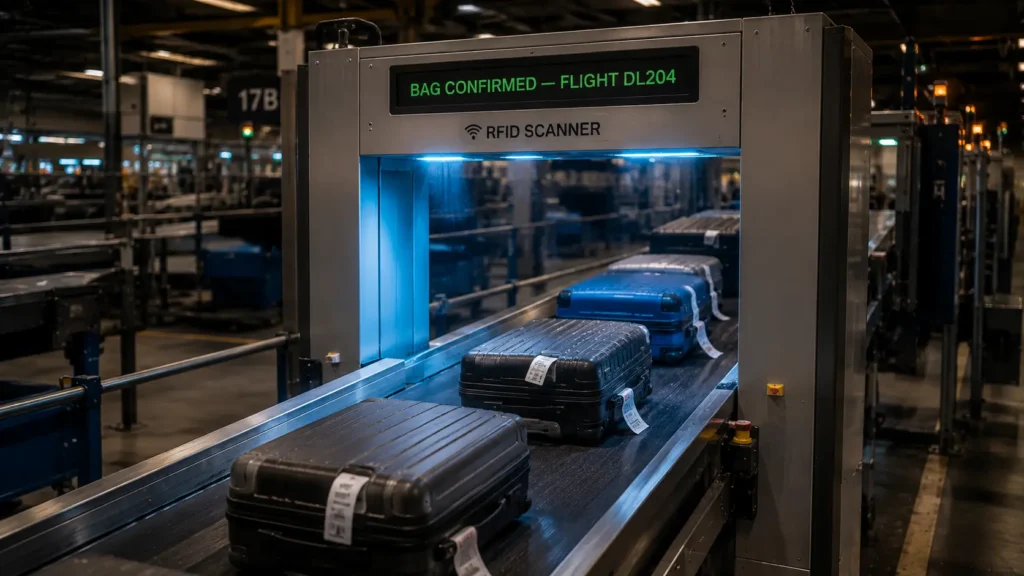
After check-in, an RFID tag is attached to the baggage. The luggage then enters the conveyor system. As the baggage moves through the airport, RFID antennas installed at various checkpoints continuously read the tag information. Once the system identifies the assigned flight, automated sorting equipment directs the baggage to the correct loading area.
This automated sorting process happens without a single human making a routing decision. The system reads the tag, cross-references the flight database, and physically diverts the bag onto the correct belt all in seconds, for thousands of bags simultaneously.
As a bag moves through the airport, strategically placed RFID readers capture its location automatically. This real-time visibility allows staff to detect misrouted or delayed bags before they leave the airport or enter the wrong flight.
That last point is the most important one: the system catches mistakes before they become lost luggage not after.
The Technology: UHF RFID Why It Works at Airport Scale
Not all RFID is equal. The version airports use is specifically chosen for large-scale, high-speed environments.
UHF RFID operates between 860–960 MHz and enables long-range scanning. UHF readers can detect baggage across conveyor belts, loading areas, and storage zones without line-of-sight. Many large international airports, including Amsterdam Schiphol and Singapore Changi, have implemented UHF RFID systems to monitor luggage movement across multiple terminals and handling areas.
UHF RFID tags offer a long read range and high data transmission rate, making them generally suitable for baggage tracking needs. The read range of UHF tags can exceed 10 meters, and they can read multiple tags simultaneously ideal for high-traffic airport environments. Furthermore, UHF RFID tags are passive, requiring no built-in batteries; they rely on electromagnetic waves emitted by the reader for energy, making them more cost-effective and having a longer lifespan.
A passive tag with no battery, readable from 10 meters away, through stacked luggage, at full belt speed that’s the hardware doing the heavy lifting inside every modern baggage hall.
Delta’s $50 Million Bet And What It Proved
The clearest proof of what this system can achieve comes from the airline that went all-in first.
Delta Air Lines invested approximately $50 million to launch an advanced RFID-based baggage tracking system that significantly enhances the air travel experience for passengers. The initiative aims to reduce baggage mishandling incidents at 25 airports in the United States, targeting up to 99.9% tracking accuracy. The RFID system can process up to 1,500 bags per hour, greatly exceeding the 350–400 bags per hour capacity of traditional barcode scanning methods.
The results were measurable almost immediately. At Delta, RFID baggage tracking improved the baggage loading rate by 10%, reduced mishandling rates by 13%, and reduced the bag-handling injury rate by 21%.
The injury reduction is a detail most people miss fewer mishandled bags means fewer workers manually searching for and rerouting lost luggage in tight, fast-moving spaces.
What You See on Your Phone And What’s Happening Behind It
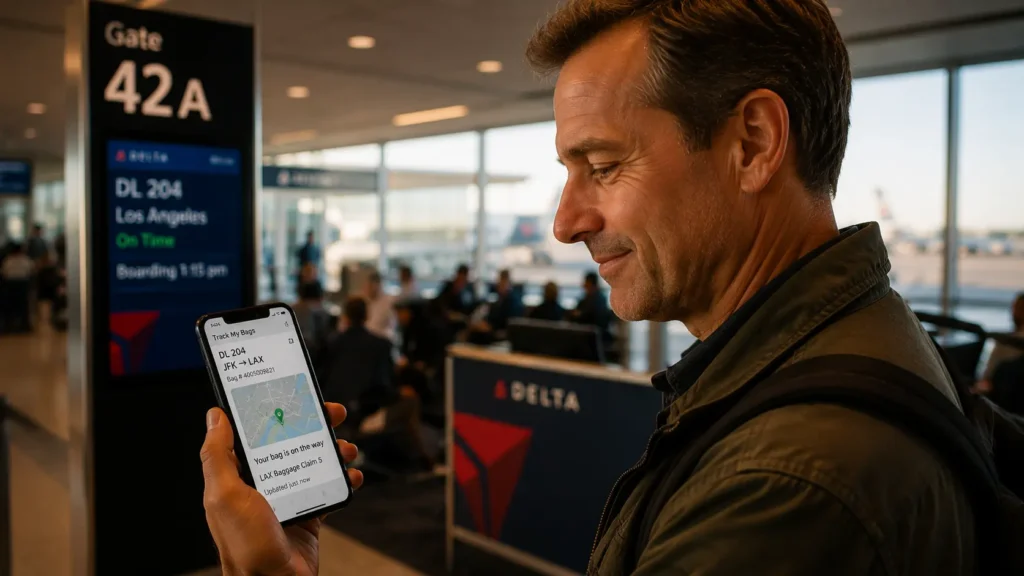
The passenger-facing part of this system is the real-time tracking notification many travelers now take for granted.
The passenger receives notifications via a mobile app, SMS, or email of the location of their bag once the plane lands and as the bag passes key checkpoints.
At Brussels Airport, passengers can track their bags through a mobile app instead of waiting at the carousel, they get real-time notifications about when and where their luggage will arrive. The result is smoother arrivals, fewer misplaced bags, and a better overall experience.
This transparency does something beyond convenience: it reduces the pressure on airline service desks, eliminates the anxiety of watching an empty carousel, and gives passengers actionable information exactly which belt, exactly when.
The Cost of Getting It Wrong
The scale of this problem before RFID explains why the industry invested so heavily in solving it.
The global airline industry loses 25.4 million bags each year, costing airlines more than $2.3 billion in compensation and operational disruptions. Globally, 6.3 bags are mishandled for every 1,000 passengers, surging to 15–20 during peak season. Sixty-five percent of lost bags occur during transfers, especially on international flights with tight connections.
The IATA projects RFID baggage tracking will save the airline industry $5 billion by 2026. Initial deployments have already reduced mishandled baggage by 25% and driven faster loading and unloading of baggage, leading to fewer delayed flights.
What’s Coming Next: Biometrics Meets Baggage
The system is already evolving well beyond what most airports currently have deployed.
By 2026, airports plan to combine RFID with biometric systems such as facial recognition to link bags to passengers via contactless check-in kiosks and automatically reroute bags in case of missed connections using real-time RFID data.
The near-future version of this system would work like this: your face scans at check-in, automatically associates your RFID-tagged bag with your biometric identity, and the system monitors both you and your bag independently if you miss a connection, your bag gets rerouted before you even reach the gate agent.
The Bottom Line
The next time your bag slides down the belt at baggage claim right on time, exactly as expected the invisible system that made that happen processed your luggage through dozens of checkpoints, sorted it by flight, loaded it onto the correct aircraft, and tracked it across every stage of the journey without a single human manually scanning a label.
RFID technology reduces the time required for baggage processing, leading to faster response times for flights. Automated tracking minimizes the risk of errors and lost luggage, streamlining operations and reducing costs. RFID enables better security measures by providing real-time visibility into the location of each piece of luggage — any unauthorized movement can be quickly detected.
It’s one of the most complex logistics systems in everyday life and it works so well that you only think about it when it doesn’t.
Read Also:
- 🔗 The Secret Buildings That Keep America’s Internet Running
- 🔗 How Banks Move Billions of Dollars Every Day Without Losing Track
© AiwalaNews | Global Tech & Privacy Edition | June 2026
