Every day, millions of Americans make calls, send messages, stream videos, and use navigation apps without thinking about the invisible network making it all possible. Whether you’re driving across the country or sitting in your living room, your smartphone is constantly communicating with nearby cell towers.
Most people assume GPS is responsible for telling the network where their phone is.
It isn’t.
Even with GPS turned off, your mobile carrier usually knows which general area your phone is in because it continuously communicates with nearby towers. This hidden process happens in the background, takes only seconds, and is one of the most important technologies powering modern mobile networks.
So how does it actually work?
Your Phone Is Always Listening for Nearby Towers
Whenever your smartphone is switched on and has cellular service enabled, it constantly searches for the strongest available tower.
In the United States, major carriers such as AT&T, Verizon, and T Mobile operate tens of thousands of cell sites that together provide nationwide coverage.
Every tower broadcasts a unique identifier.
Your phone listens for these signals and decides which tower offers the strongest and most reliable connection at that moment.
This entire process happens automatically without requiring any action from the user.
The Network Knows Your General Location
Your phone does not tell the carrier your exact street address every second.
Instead, it regularly reports which cell tower or group of towers it can hear.
This allows the network to estimate your location within what engineers call a cell.
The size of that coverage area depends on where you are.
In a busy city, a single tower may cover only a few hundred meters.
In rural America, one tower can cover several miles because fewer users share the network.
This is why emergency responders can often determine the approximate location of a mobile phone even if GPS is unavailable.
Triangulation Makes Location More Accurate
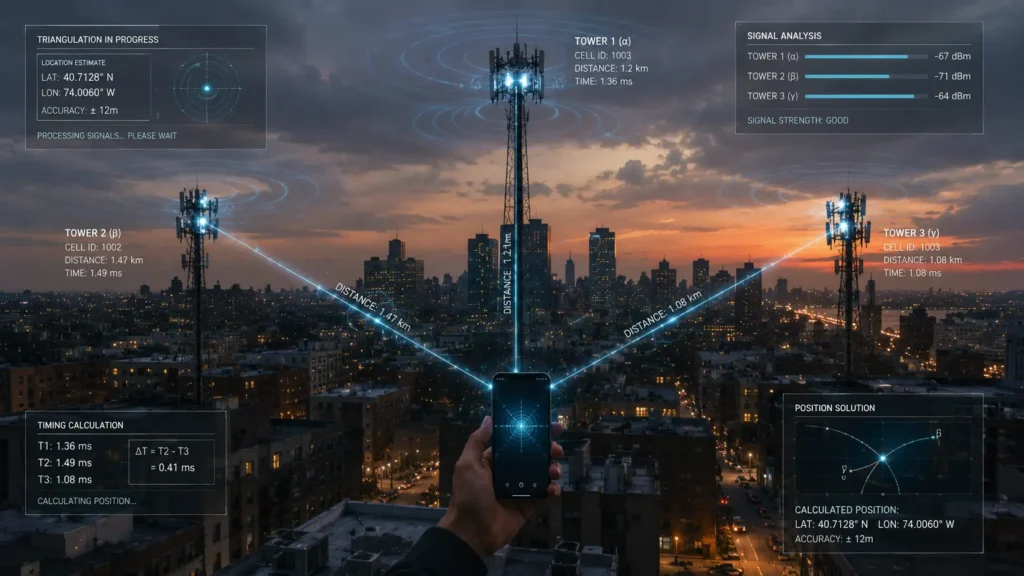
One tower alone only tells the network that your phone is somewhere within its coverage area.
For greater accuracy, networks often compare signals from multiple nearby towers.
This technique is commonly called triangulation, although modern systems frequently use more advanced multilateration methods.
The network measures factors such as:
- Signal strength
- Signal timing
- Distance estimates
- Arrival time differences
By combining these measurements from several towers, the carrier can narrow your phone’s estimated position much more precisely than using a single tower alone.
Modern Networks Use Timing Measured in Millionths of a Second
Radio waves travel at the speed of light.
Even tiny differences in arrival time contain useful information.
Modern 4G LTE and 5G networks measure signal timing with extraordinary precision.
The network calculates how long radio signals take to travel between your phone and nearby towers.
Those tiny timing differences help estimate your distance from each tower, improving overall positioning accuracy.
This technology works so quickly that the calculations are completed almost instantly while you continue browsing or making a phone call.
Why Your Phone Keeps Switching Towers
Have you ever noticed that a phone call continues without interruption while driving down the highway?
That happens because your smartphone performs what engineers call a handover.
As you move, your current tower gradually becomes weaker while another tower becomes stronger.
Instead of dropping the connection, the network transfers your call or data session to the better tower in a fraction of a second.
You usually never notice it happening.
Without these seamless handovers, mobile communication simply would not work while traveling.
GPS and Cell Towers Work Together
Many people believe GPS and cellular networks perform the same job.
They do not.
GPS receives signals from satellites orbiting approximately 20,200 kilometers above Earth and can determine your position with remarkable accuracy.
Cell towers, on the other hand, are ground based communication systems designed primarily to provide voice and data connectivity.
Modern smartphones intelligently combine:
- GPS
- Cell tower positioning
- Wi Fi location databases
- Bluetooth beacons
- Motion sensors
This combination often delivers faster and more reliable location services than GPS alone, particularly inside buildings where satellite signals become weak.
What Happens During an Emergency Call
When someone dials 911 in the United States, locating the caller quickly becomes critical.
Federal Communications Commission regulations require wireless carriers to provide increasingly accurate location information for emergency responders.
Modern smartphones often combine GPS, nearby Wi Fi networks, and cellular tower information to improve emergency location accuracy.
This layered approach helps dispatchers locate callers faster, especially in dense urban environments where seconds can save lives.
Can Cell Towers Read Your Personal Data?
A common misconception is that cell towers can see everything stored on your phone.
They cannot.
A tower functions primarily as a secure communication relay between your device and your carrier’s core network.
The content of calls and mobile data is protected using encryption technologies built into modern cellular standards.
However, carriers do maintain network information such as:
- Device identifiers
- Connection times
- Serving tower information
- Network performance data
Privacy laws and carrier policies govern how this information may be stored and shared.
Why More Towers Mean Faster Service
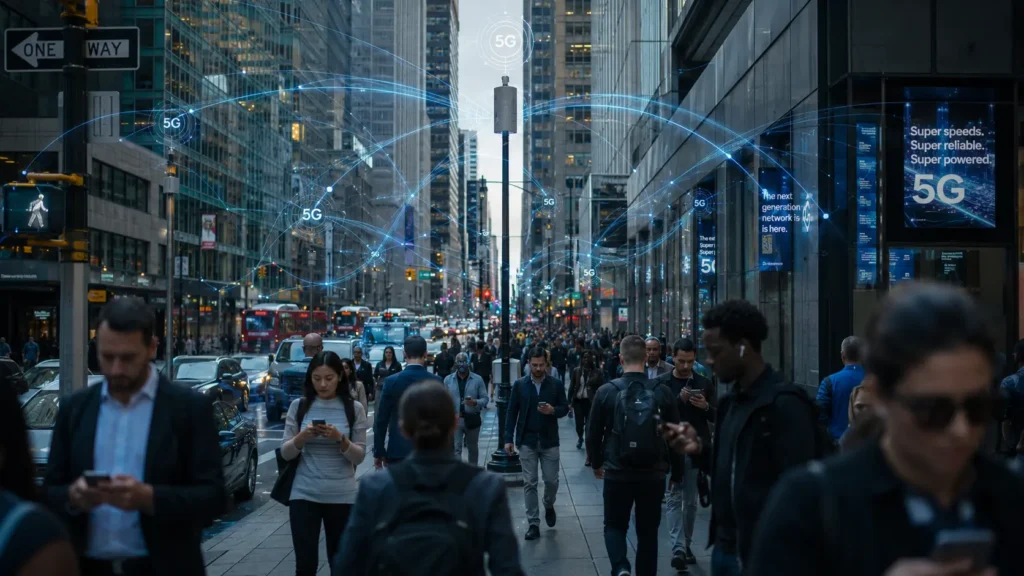
The rollout of 5G has significantly changed network design.
Instead of relying only on large towers, carriers increasingly deploy small cells, compact radio units mounted on streetlights, utility poles, and buildings.
Because each small cell covers a shorter distance, networks can:
- Support more users.
- Deliver higher speeds.
- Reduce congestion.
- Improve indoor coverage.
- Lower connection delays.
This dense network architecture is one reason modern cities can support millions of connected smartphones simultaneously.
The Future of Mobile Positioning
Researchers are already developing technologies beyond today’s cellular positioning.
Future networks may combine:
- Artificial Intelligence
- Satellite communications
- Ultra wideband radios
- Advanced beamforming
- Next generation 6G positioning
Instead of simply determining where a phone is, future systems could provide centimeter level accuracy for autonomous vehicles, smart factories, and augmented reality applications.
The technology behind mobile networks continues evolving far beyond making phone calls.
The Bottom Line
Every time your smartphone connects to a network, an invisible conversation begins between your device and nearby cell towers. By measuring signal strength, timing, and connections to multiple towers, carriers can estimate your location within seconds while seamlessly keeping calls and data flowing.
Combined with GPS, Wi Fi positioning, and advanced 5G technology, this hidden infrastructure has become one of the most sophisticated communication systems ever built. Most people never notice it, yet it quietly powers nearly every mobile experience in modern life.
Read Also
➡️ Inside the GPS Backup Systems the U.S. Uses During Jamming
https://aiwalanews.com/inside-the-gps-backup-systems-the-u-s-uses-during-jamming/
➡️ How Undersea Internet Cables Carry 99 Percent of Global Data
https://aiwalanews.com/how-undersea-internet-cables-carry-99-of-global-data/
© AiwalaNews | Global Tech & Privacy Edition | April 2026
