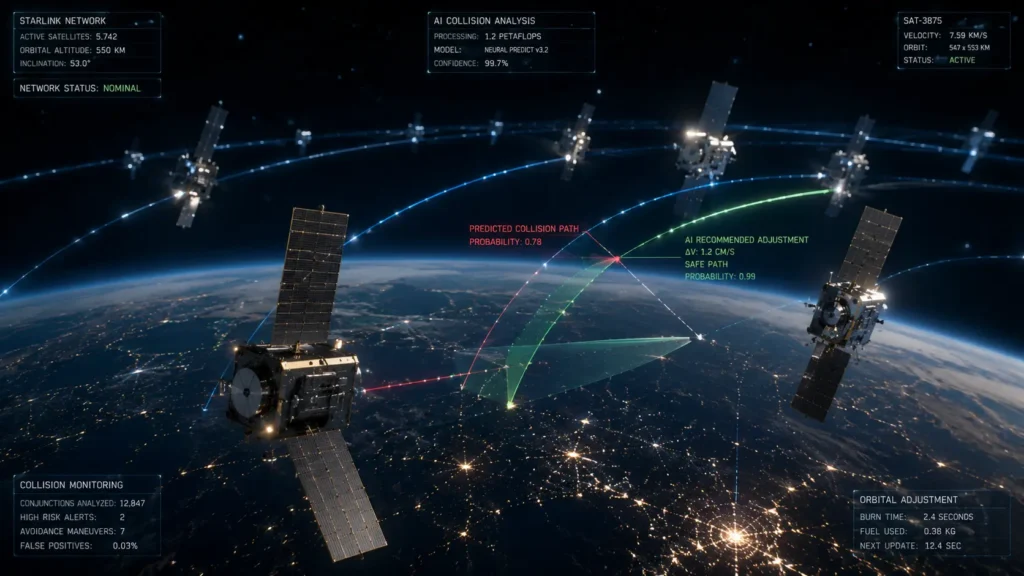
Imagine driving thousands of cars around the world at more than 17,000 miles per hour with no traffic lights, no roads, and no police. Now imagine trying to make sure none of them ever collide.
That challenge is remarkably similar to what SpaceX faces every day.
With more than 7,000 Starlink satellites in orbit and plans to expand the constellation further, SpaceX operates the world’s largest satellite network. Every satellite shares space with thousands of active spacecraft and millions of pieces of orbital debris.
Yet catastrophic collisions remain extremely rare.
Behind the scenes, an advanced combination of Artificial Intelligence, autonomous navigation, ground based tracking, and continuous orbital calculations quietly works around the clock to keep satellites safely separated.
Here is how one of the most complex traffic management systems ever created actually works.
Space Is Far More Crowded Than Most People Realize
Many people imagine space as empty.
The reality is very different.
According to publicly available tracking data, Earth orbit contains:
- More than 10,000 active satellites
- Tens of thousands of trackable debris objects
- Millions of smaller fragments too tiny to monitor continuously
Every object moves at speeds approaching 27,000 kilometers per hour.
At those velocities, even a small metal fragment can seriously damage a satellite.
This growing congestion makes collision avoidance one of the biggest engineering challenges in modern spaceflight.
Every Satellite Is Tracked Continuously
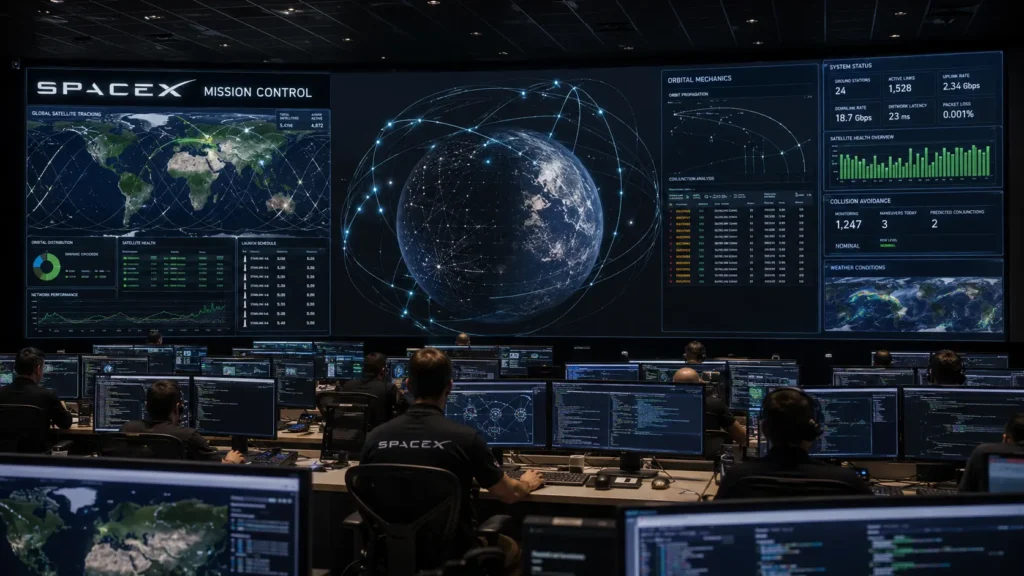
SpaceX does not rely on luck.
Government agencies such as the U.S. Space Force’s 18th Space Defense Squadron continuously monitor objects in Earth’s orbit using powerful radars and optical telescopes.
Their tracking data is combined with SpaceX’s own orbital models.
Every satellite’s position is constantly updated.
Powerful computers predict where every tracked object will be minutes, hours, and even days into the future.
Millions of Collision Predictions Every Day
Every day, sophisticated software performs millions of orbital calculations.
The system asks one simple question repeatedly:
Will two objects come dangerously close?
When the probability exceeds established safety thresholds, engineers receive automatic alerts.
For Starlink satellites, many of these decisions are handled automatically without waiting for human intervention.
This allows the network to react much faster than traditional satellite operations.
Autonomous Collision Avoidance
One of Starlink’s most advanced capabilities is autonomous collision avoidance.
Instead of waiting for commands from Earth, satellites can independently calculate small course adjustments.
Using onboard navigation software and electric ion thrusters, they gently raise or lower their orbit.
These adjustments are often tiny, sometimes only a few hundred meters, but they are enough to safely avoid another spacecraft.
Most users never realize these maneuvers are happening.
Electric Ion Thrusters Make Tiny Adjustments
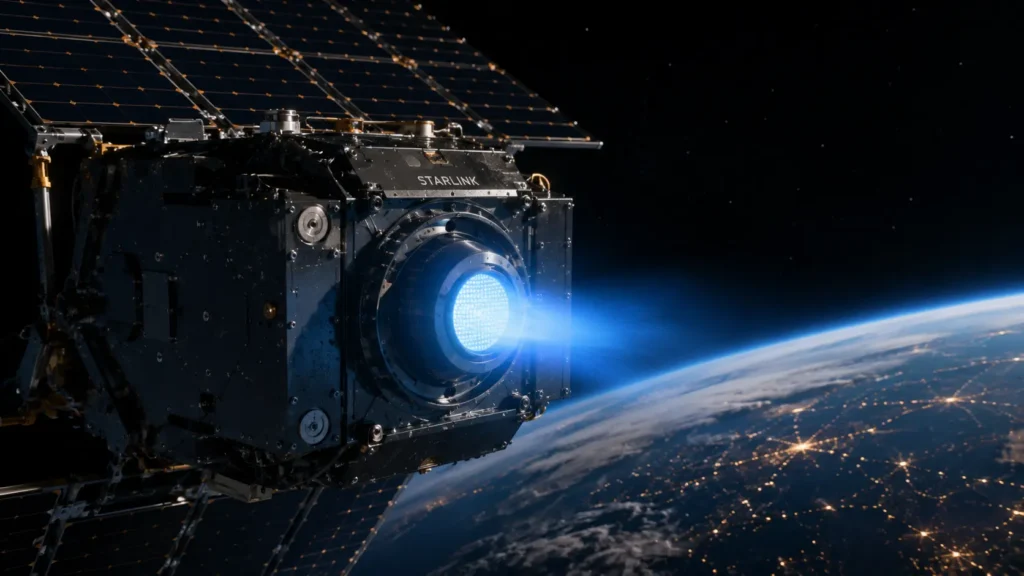
Unlike rockets used during launch, Starlink satellites rely on Hall effect ion thrusters.
These engines generate low but continuous thrust using ionized noble gas.
Although far less powerful than chemical rockets, they are extremely efficient.
This allows satellites to perform hundreds of small orbital corrections throughout their operational lifetime.
Artificial Intelligence Helps Prioritize Risks
Thousands of satellites generate enormous amounts of tracking information.
Not every close approach requires action.
Advanced software helps analyze:
- Relative speed
- Distance
- Orbital uncertainty
- Future trajectory
- Collision probability
This helps engineers focus only on situations requiring intervention.
As satellite constellations continue expanding, AI plays an increasingly important role in managing orbital traffic efficiently.
What Happens If a Satellite Stops Working?
SpaceX designs Starlink satellites with built in safety measures.
If communication is lost, satellites are designed to naturally leave orbit over time because of atmospheric drag in low Earth orbit.
Most satellites are also capable of controlled deorbit maneuvers at the end of their mission.
This reduces the amount of long term space debris.
Avoiding the Kessler Syndrome
Scientists have long warned about a scenario known as the Kessler Syndrome.
In this theoretical chain reaction, one collision creates debris that triggers additional collisions, eventually making parts of Earth’s orbit extremely hazardous.
Collision avoidance systems are one of the most important defenses against this possibility.
Every successful maneuver helps reduce future risks.
The Future of Space Traffic Management
The number of satellites continues growing rapidly.
Future traffic management may include:
- AI powered collision prediction
- International space traffic coordination
- Automated satellite to satellite communication
- Improved orbital debris monitoring
- Advanced onboard navigation systems
As space becomes busier, avoiding collisions will increasingly depend on intelligent automation rather than human operators alone.
The Bottom Line
Every day, thousands of SpaceX satellites travel around Earth at extraordinary speeds while quietly avoiding collisions through Artificial Intelligence, autonomous navigation, electric ion thrusters, and continuous orbital tracking.
It is one of the largest hidden technology systems ever built. Most people simply enjoy fast internet from Starlink without realizing that behind every connection is an invisible network constantly calculating, predicting, and adjusting to keep thousands of satellites safely moving through space.
Read Also
➡️ Inside the GPS Backup Systems the U.S. Uses During Jamming
https://aiwalanews.com/inside-the-gps-backup-systems-the-u-s-uses-during-jamming/
➡️ The Hidden Technology That Lets Fighter Jets Share Data Mid Air
https://aiwalanews.com/the-hidden-technology-that-lets-fighter-jets-share-data-mid-air/
© AiwalaNews | Global Tech & Privacy Edition | April 2026
