You wake up one morning and find an email from your bank saying your password has been changed.
A few minutes later, another notification arrives from your social media account.
Then your email provider warns that someone has signed in from another country.
Your first thought might be that a skilled hacker spent hours breaking into your accounts.
In reality, that is rarely how it works.
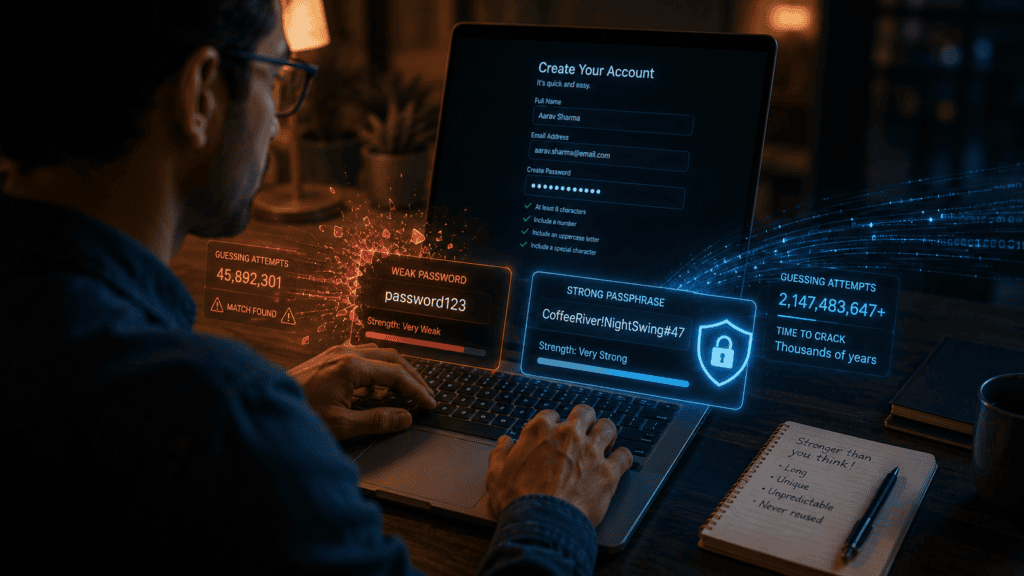
Most online accounts are not compromised because hackers are computer geniuses typing mysterious commands on a dark screen. They are compromised because people continue using passwords that modern computers can guess almost instantly.
Every day, automated software attempts billions of password combinations across websites around the world. The vast majority fail, but even a tiny success rate is enough to fuel cybercrime worth billions of dollars each year.
Understanding how password guessing works is one of the easiest ways to strengthen your digital security.
Your Password Is Often More Predictable Than You Think
People naturally create passwords they can remember.
Birthdays.
Pet names.
Favorite sports teams.
Children’s names.
Simple number patterns.
Words followed by 123.
Unfortunately, these are exactly the combinations attackers expect.
Security researchers have repeatedly found that millions of people continue using passwords like password, qwerty, welcome, and 123456.
To humans these passwords feel easy to remember.
To computers they are simply the first guesses.
Hackers Rarely Guess Manually
Forget the Hollywood image of someone typing random passwords one by one.
Modern attacks rely on automation.
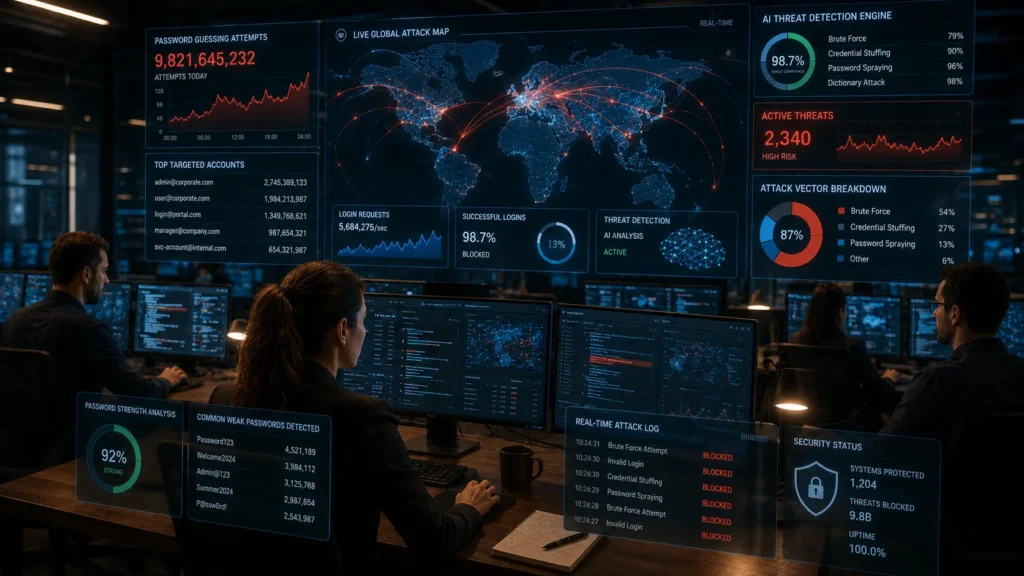
Specialized software can test enormous numbers of password combinations every second.
Instead of guessing one password, computers can rapidly compare millions of possibilities using dictionaries of common words, leaked passwords, keyboard patterns, names, dates, and predictable substitutions.
A single computer may attempt more passwords in one minute than a person could type in several lifetimes.
The Power Of Password Lists
One reason password attacks succeed so often is because enormous collections of leaked passwords already exist.
Whenever a company experiences a data breach, stolen login credentials sometimes become available within criminal communities.
These databases contain hundreds of millions of previously used passwords.
Instead of inventing new guesses, attackers simply test passwords that real people have already used elsewhere.
If you reuse the same password across multiple websites, one breach can place several accounts at risk.
This is one of the biggest reasons cybersecurity experts strongly discourage password reuse.
A Real World Example
Imagine Michael, who uses the password Football2025 for his email, streaming service, shopping account, and online banking.
Months later, an online forum suffers a security breach.
Although the forum itself contains nothing valuable, Michael’s email address and password are exposed.
Attackers immediately test the same combination across dozens of popular websites.
Within minutes, they successfully access his email account.
From there, they begin requesting password resets for other services.
The original breach was only the beginning.
Password reuse allowed criminals to unlock multiple accounts without ever guessing another password.
Why Short Passwords Fail So Quickly
Length matters more than many people realize.
Every additional character dramatically increases the number of possible combinations.
A short password containing only lowercase letters may be guessed very quickly.
Adding uppercase letters, numbers, symbols, and additional words creates exponentially more possibilities.
Modern security experts increasingly recommend using long memorable passphrases rather than short complicated words.
A phrase like CoffeeRiverMorningSun is both easier to remember and significantly harder for automated software to crack than a short password filled with predictable substitutions.
Artificial Intelligence Is Changing Password Attacks
Artificial intelligence has also entered the world of cybersecurity.
Attackers now use machine learning systems to identify common password creation habits.
Instead of generating completely random guesses, AI studies patterns found in real passwords and predicts combinations people are most likely to choose.
Fortunately, cybersecurity companies are also using artificial intelligence to detect suspicious login attempts, unusual behavior, and automated attacks before accounts are compromised.
Technology is advancing on both sides.
Multi Factor Authentication Adds Another Layer
Even a strong password should not be your only defense.
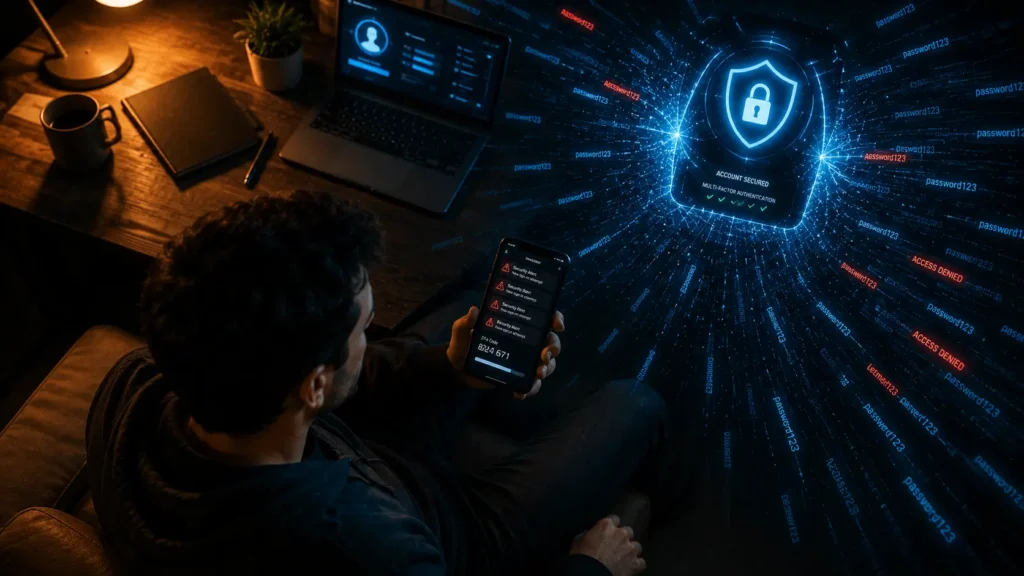
Multi factor authentication requires a second verification step before access is granted.
This might include a temporary code, a trusted device, or a biometric check such as a fingerprint or facial recognition.
If someone discovers your password but cannot complete the second verification step, the account usually remains protected.
That extra layer has prevented countless real world account takeovers.
Simple Habits That Make A Big Difference
Protecting your accounts does not require advanced technical knowledge.
Use a unique password for every important account.
Choose longer passphrases instead of short predictable words.
Enable multi factor authentication whenever available.
Avoid sharing passwords through messages or email.
Keep your devices updated with the latest security improvements.
Consider using a reputable password manager to generate and store strong passwords securely.
These small habits dramatically reduce the likelihood of becoming a victim.
The Bigger Picture
Password attacks are no longer personal.
They are automated.
Computers work around the clock testing leaked credentials, predictable words, and common password patterns against millions of accounts every day.
The good news is that modern security recommendations are based on years of real world research.
A unique long password combined with multi factor authentication can stop the overwhelming majority of automated attacks.
The next time you create a password, remember that you are not competing against another person.
You are competing against computers capable of making millions of guesses every second.
Choosing a stronger password today could prevent a serious security problem tomorrow.
Read Also
Read also: https://aiwalanews.com/how-websites-recognize-you-even-without-cookies/
Read also: https://aiwalanews.com/what-happens-inside-googles-data-centers-when-you-search/
© AiwalaNews | Global Tech & Privacy Edition | April 2026
