
This article is based on peer-reviewed cybersecurity research, published security reports from IBM, Darktrace, SecurityWeek, and Fortinet, and documented findings from the 2026 threat landscape. This is for informational and educational purposes only.
You opened an email at 11 PM. You clicked a link that looked slightly urgent. You paused on a product page for 47 seconds before closing it.
To you, these were three unremarkable moments. To an AI system analyzing your behavior, they were data points pieces of a profile being assembled in real time, revealing exactly how, when, and under what conditions you make decisions. And in 2026, both the platforms serving you ads and the threat actors targeting you are running the same fundamental technology to build that profile.
The difference is what they do with it.
The Clickstream: Every Move You Make Is Data
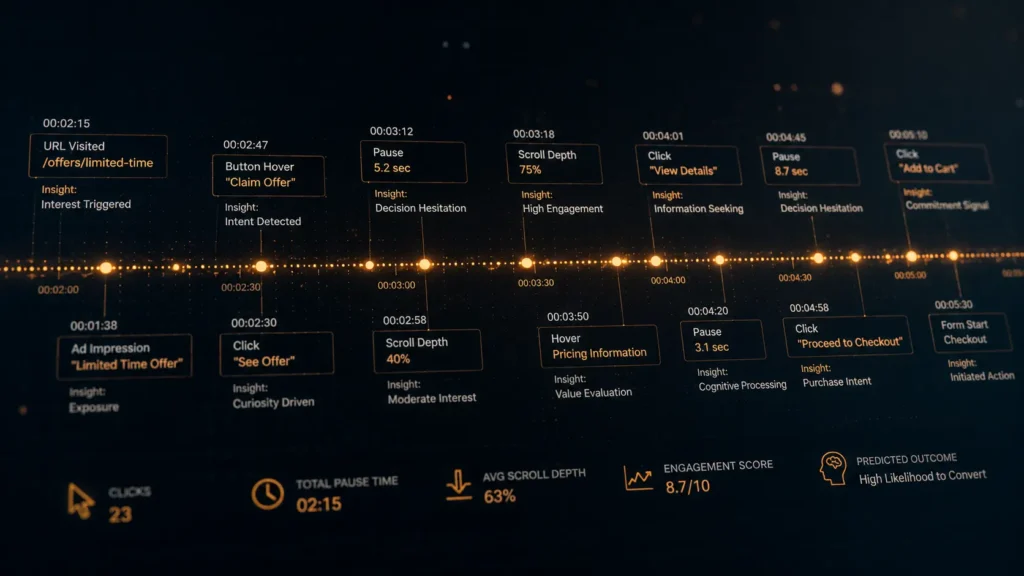
Every interaction you have with a website, app, or digital platform produces what researchers call a clickstream a continuous record of every click, scroll, pause, hover, and navigation event, time-stamped to the millisecond.
AI systems analyze clickstream data by applying multiple machine learning models to each behavioral variable across different time frames building composite scores that predict future behavior with measurable accuracy.
Deep learning models trained on mobile click behavior achieve 71% accuracy in predicting a user’s next click based on prior behavioral patterns meaning the system knows where you’re going before you consciously decide to go there.
That prediction capability has two very different applications. For a legitimate platform, it powers personalization showing you the product you were going to search for anyway. For a malicious actor, it powers manipulation identifying the exact moment and framing most likely to make you click something you shouldn’t.
What Specifically Gets Learned
The behavioral signals AI systems extract from a few clicks are more revealing than most people expect.
Decision speed. How long you pause before clicking reveals confidence and uncertainty. A user who pauses 40 seconds on a security warning before clicking “proceed anyway” is displaying a behavioral pattern one that can be exploited by presenting similar-looking warnings in malicious contexts.
Time of day patterns. By analyzing behaviors, detecting patterns, and adapting to new data, AI builds a profile of when users are most distracted, most impulsive, and most likely to make errors. Late-night clicks. Post-deadline fatigue patterns. Pre-meeting speed. Each signals a different vulnerability window.
Urgency response. Whether you respond to time pressure countdown timers, “only 2 left” messages, “expires tonight” subject lines is measurable and consistent. Users who respond reliably to artificial urgency are specifically targeted with it.
Authority compliance. Using data gathered from social media, breaches, and online behavior, AI systems craft attacks that look legitimate and exploit very specific psychological vulnerabilities. If your click history shows you consistently open emails from senders with titles like “IT Department” or “Account Security Team,” that pattern is a documented weakness.
The Attacker’s AI: Learning Faster Than Defenders
Here’s where the picture gets genuinely concerning. The same AI capabilities used by platforms to understand user behavior are now being deployed by threat actors — and the 2026 threat landscape reflects how far that capability has advanced.
AI-enabled malware now learns, blends in, and modifies its behavior based on environmental signals without a human operator ever touching the keyboard. Attackers are using AI to automatically generate reconnaissance scripts and adversary toolkits that adapt to defense systems in real time essentially “vibe-hacking,” using generative AI to better mimic authentic behavior and refine social engineering lures.
The EchoLeak vulnerability found in Microsoft 365 Copilot demonstrated that a zero-click prompt injection could access and silently exfiltrate enterprise data an attack that required no user action beyond normal usage patterns.
From 2026 onward, AI will find and exploit vulnerabilities with greater stealth, considerably faster, and in greater volumes than we have seen before. It is not inventing new threats it is executing existing ones at a scale and speed no human attacker could match.
The Personalized Phishing Problem
The most immediate consequence for ordinary users is the death of generic phishing.
Traditional phishing was easy to spot: wrong logo, bad grammar, generic “Dear Customer” opening. The new version is different.
AI crafts attacks that look completely legitimate by combining data from social media, data breaches, and behavioral profiles creating messages that reference your actual employer, your actual colleagues, and your actual recent activity.
92% of security professionals are now concerned about AI agents being used for attacks because these systems learn directly from behavioral data, identifying patterns that deviate from normal operations and adapting their approach accordingly.
A phishing email that knows your name, your manager’s name, the project you’re currently working on, and the exact time you typically check emails isn’t guessing. It’s the output of an AI system that assembled your profile from publicly available data, breach records, and behavioral signals and timed its delivery for your highest-vulnerability window.

What You Can Actually Do
AI-powered cybersecurity strengthens defense through behavioral analytics and phishing detection but effective protection requires understanding that AI systems learn from normal behavior to identify deviations. The most effective defense is making your behavior less predictable and your profile harder to assemble.
The practical steps that matter most in 2026:
Slow down on anything urgent. Urgency is the primary manipulation lever AI-powered attacks use. A genuine IT department does not need you to click something in the next 60 seconds. A real bank does not require immediate action on a text message.
Separate your behavioral environments. Use a dedicated browser for sensitive accounts banking, email, financial platforms. The behavioral profile assembled from your shopping and social media browsing should not be linkable to your banking behavior.
Treat unsolicited contact as compromised. If someone contacts you by email, text, or call claiming to be from a company you use, go directly to that company’s website rather than responding to or clicking the contact you received.
Assume your data has been breached. Data gathered from social media and breaches is already being used to craft targeted attacks against you specifically. Behave accordingly use unique passwords, enable two-factor authentication, and treat any message that references personal details as a higher-risk interaction.
The AI building your profile doesn’t need much to work with. A few clicks, a few data points, a few patterns and it knows more about your vulnerabilities than you do.
The defense isn’t to stop clicking. It’s to click consciously.
© AiwalaNews | Global Tech & Privacy Edition | May 2026
Read Also:
- 🔗 How Your Bank Knows It’s Not You Within 0.3 Seconds of Login
- 🔗 The Deepfake That Stole $25 Million in a Single Day
