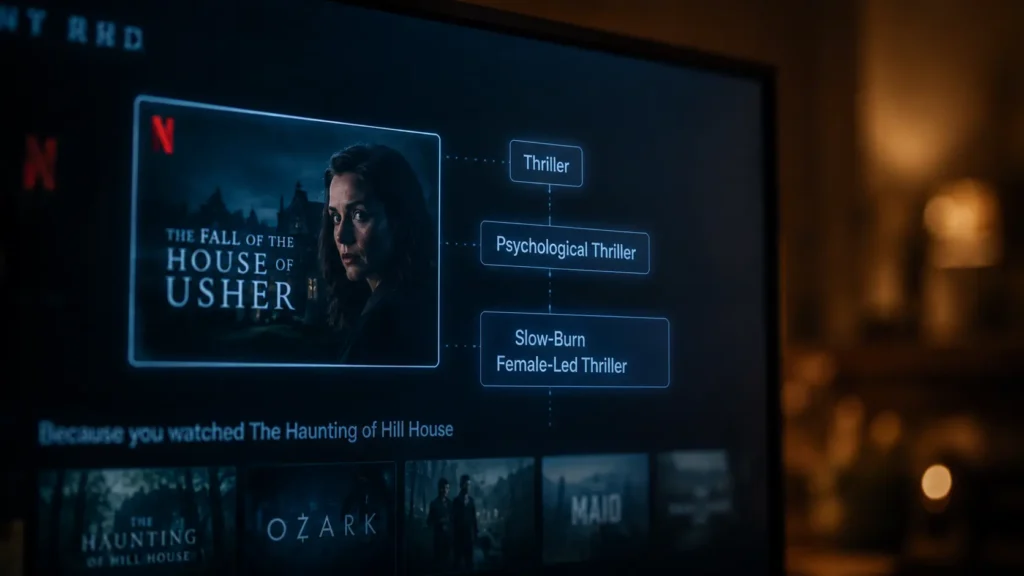
You open Netflix. Within two seconds, a row appears: “Because You Watched.” Beneath it, a title you have never heard of, with a thumbnail showing a tense facial expression you find oddly compelling. You click it. You watch the whole thing that night.
You believe you made a choice. What actually happened is more precise: a system that has been studying your behaviour for years selected this exact title, ranked it above thousands of alternatives, and chose from ten or more possible thumbnail images for that same show the one specific image statistically most likely to make you click, based on patterns it learned from millions of people who behave like you.
More than 80% of what people watch on Netflix comes from its recommendations not from searching. The algorithm is not a feature of Netflix. It is the product.
You Are Not One Category. You Are 76,000 of Them
The foundational misunderstanding about Netflix’s system is that it sorts people into broad genres comedy fans, thriller fans, documentary fans. It does not.
Netflix has built an extensive library of over 76,000 “micro-genres” hyper-specific classifications like “Romantic Independent Movies” or “Action Thrillers Featuring a Strong Female Lead” allowing for incredibly nuanced and precise recommendations.
You are not “a thriller viewer.” You are a viewer of slow-burn psychological thrillers with female leads, watched late on weeknights, usually finished within 48 hours, frequently rewatched at the midpoint scene. That granularity is the actual unit of analysis and it is built entirely from behaviour you never explicitly stated.
The system captures not just explicit signals like thumbs-up/down ratings and search queries, but a rich tapestry of implicit behavioural data: what you’ve watched, rewatched, or skipped, the time of day and device used, and even micro-behaviours like how long you pause on a title’s artwork, or which specific scenes you rewind.
Netflix examines playback controls pause, rewind, fast-forward frequency to identify exactly which narrative elements captivate or disengage you. The system does not just know what you watched. It knows the scene where you leaned in, and the scene three minutes later where you reached for your phone.
The Thumbnail You See Is Not the Thumbnail I See
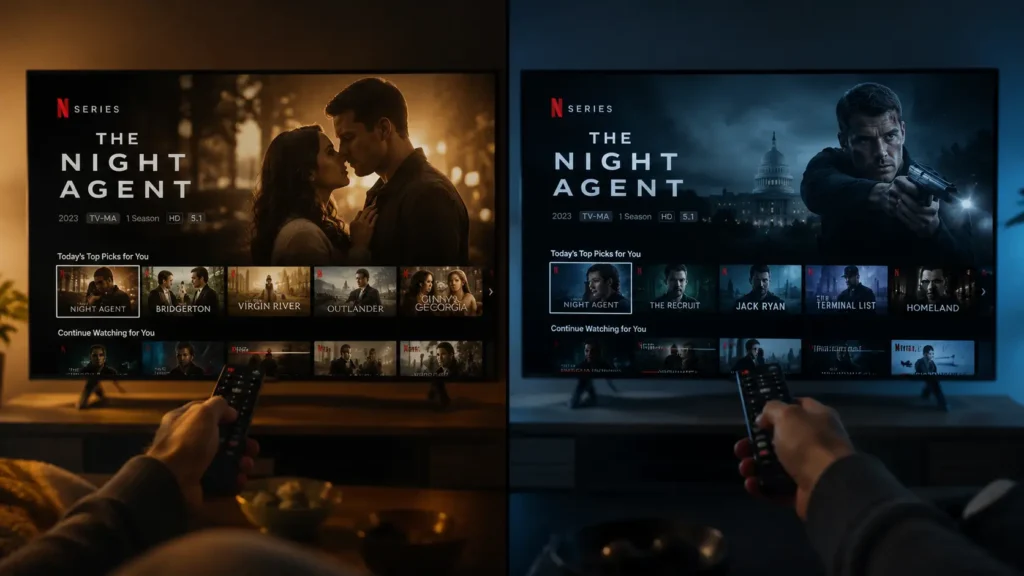
Here is the detail almost nobody clocks: the exact same Netflix title can look like a completely different piece of content depending on who is looking at it.
Netflix creates multiple thumbnail versions for every show and movie sometimes ten or more variants per title each deliberately designed to appeal to a different audience segment.
If you frequently watch romantic comedies, you might see a “Stranger Things” thumbnail featuring the show’s relationship dynamics. Someone who loves sci-fi action will see an image highlighting the supernatural elements. A fan of strong ensemble casts might see a group shot. Same show. Same Netflix account type. Entirely different visual pitch, calibrated to your specific viewing fingerprint.
According to Netflix, thumbnails account for over 80% of viewing decisions. The algorithm is not just predicting what you will like it is actively constructing the first impression most likely to make you click, using psychological principles including familiarity bias (an actor you recognise from other shows), emotional expression (thumbnails showing laughter, fear, or anger perform better), and visual contrast.
Personalised thumbnails increase click-through rates by 30%. That percentage represents millions of decisions that felt entirely like free will and were, in fact, the output of a controlled visual experiment run on you specifically.
The Algorithm That Learns From Millions Running at Once
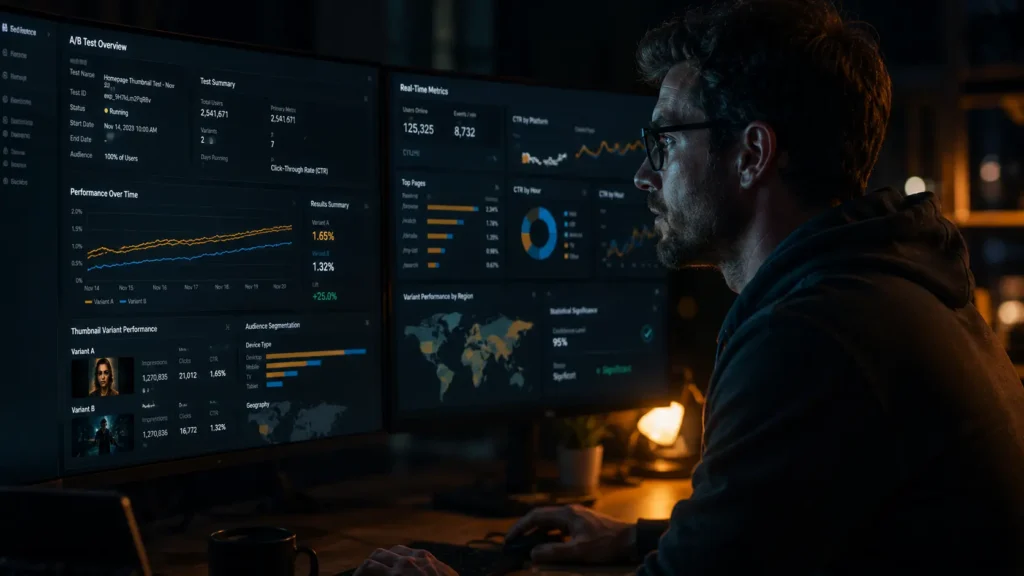
Netflix does not test thumbnails or recommendations one at a time. It employs multi-armed bandit algorithms a form of reinforcement learning that balances exploration (showing you something new) with exploitation (recommending what it’s confident you’ll love) running continuous experiments across the entire interface.
The contextual features feeding these models include viewing history, inferred genre preferences, time of day, device type, and even eye-tracking data gathered from user studies.
Netflix tests artwork, colours, faces, and even tiny changes in copy just to see what makes you pause for that extra second running millions of these tests quietly in the background, because a better thumbnail means a higher chance you’ll watch, and watching means retention.
The system is, in a literal technical sense, running a continuous experiment on every subscriber simultaneously and using the results to refine the experiment in real time. Netflix’s recommendation system isn’t one algorithm it’s a sophisticated ensemble of multiple machine learning models working together, including collaborative filtering, deep neural networks, and graph-based models.
Why It Knows You Better Than You Know Yourself
The system learns patterns you have never consciously articulated: that you might prefer light comedies on Sunday afternoons but gravitate toward intense thrillers late on Friday nights. It knows whether you’re more likely to finish a series if you watch Episode 2 within 24 hours of Episode 1.
This is the genuinely uncanny part. You did not tell Netflix that your Friday-night mood differs from your Sunday-afternoon mood. You simply behaved that way, repeatedly, and the system noticed the correlation between day-of-week and genre selection before you would have articulated it yourself if asked directly.
If you often stop watching action movies halfway through but finish romantic comedies, the system notices and it then suggests more romantic comedies and fewer action movies, adapting in real time the moment you give a thumbs up to something.
The Business Case Behind the Magic
This is not personalisation as a courtesy. It is personalisation as a financial strategy with a precise, calculated value.
Netflix’s personalisation algorithms save over $1 billion each year by keeping subscribers from cancelling. With Netflix spending $18 billion on content in 2025 alone, the company needed to understand precisely which content types would resonate with specific audience segments to optimise that investment. The recommendation engine is not a feature bolted onto the content library. It is the mechanism that makes the size of that library financially justifiable ensuring every subscriber is steered toward the small fraction of the catalogue statistically calibrated to keep them subscribed.
Netflix’s machine learning recommendation engine is the result of work by hundreds of engineers and data scientists over the past two decades beginning with the Netflix Prize in 2006, a contest offering $1 million to anyone who could improve the recommendation system by just 10%.
What This Means the Next Time You Open the App
When you scroll Netflix tonight, you are not browsing a static catalogue. You are looking at a homepage constructed in real time, specifically for you, by a system running thousands of simultaneous experiments on the order of rows, on the thumbnail design, on the exact moment a particular title surfaces based on your day-of-week behaviour, your device, and the scenes you have rewound in the past month.
The show you pick tonight will feel like your choice. In a meaningful sense, the system has already made most of that decision for you by deciding what you would see, in what order, with which image, calibrated against everything it has learned about people who pause where you pause and finish what you finish.
You are not choosing from a library. You are choosing from the slice of the library the algorithm has already decided you are most likely to want.
📌 Read Also:
- The Dark Technology Behind Every “Recommended for You” — How Big Tech Controls What You See
- The AI Watching Your Mouse Cursor Right Now to Predict What You’ll Buy
© AiwalaNews | Global Tech & Privacy Edition | April 2026
