I want to be honest with you upfront.
I was skeptical. I’d heard the AI hype for two years straight every podcast, every LinkedIn post, every conference talk promising that artificial intelligence would transform your business. I’d tried ChatGPT a few times, gotten some mediocre blog post drafts, and moved on. I had a real business to run.
My business: a boutique social media agency in Austin, Texas. Four full-time employees. Eleven clients. Annual revenue just under $400,000. Real payroll. Real deadlines. Real consequences if something went wrong.
In January, I decided to stop dabbling and go all in. For 30 days, I would use AI tools to handle every possible business function marketing, client communication, hiring, finance, operations, strategy. I documented everything.
Week 1: The Setup – Messier Than Expected
Days 1-7
I started by mapping every single task I did in a typical week. The list was 47 items long. Everything from writing client reports to responding to vendor emails to creating content calendars to reviewing employee work.
Then I matched each task to an AI tool:
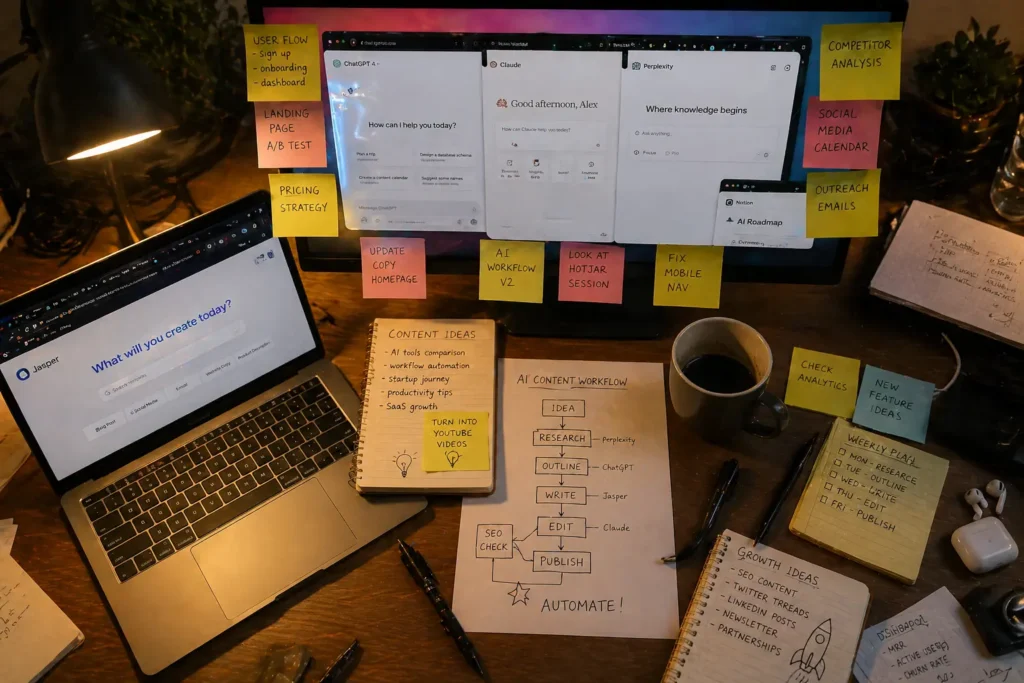
Claude handled all long-form writing proposals, reports, strategic documents, client communications. ChatGPT managed brainstorming, quick copy, and ideation. Notion AI organized my project management and meeting notes. Zapier with AI automated repetitive email responses and task routing. Durable AI monitored basic website analytics and flagged anomalies.
Week one was genuinely chaotic. Setting up the workflows took longer than I expected. I spent 14 hours in the first three days just building the systems — connecting tools, writing prompts, testing outputs, fixing errors.
My honest take after week one: frustrated, behind schedule, questioning everything.
But the infrastructure was built. And what happened next surprised me completely.
Week 2: The First Signs of Something Rea
Days 8–14
The workflows started clicking. And the time savings became impossible to ignore.
Client reporting — which previously consumed six hours every Monday morning dropped to 90 minutes. I fed Claude our performance data, our client’s goals, and a template I’d created. It produced first drafts that needed maybe 20 minutes of personalization and editing per client. What used to ruin my Mondays became a task I finished before my second coffee.
Email management was the second revelation. I used Zapier AI to categorize incoming emails by urgency and draft initial responses for my review. I went from spending 2.5 hours daily on email to 45 minutes. That’s 1 hour and 45 minutes returned to my day every single day.
My team noticed something was different. The briefs they received were clearer. The feedback on their work was more detailed. The project timelines were more realistic. All because I suddenly had the mental bandwidth to think instead of just react.
My honest take after week two: something real is happening here.

Week 3: Where AI Genuinely Shocked Me
Days 15-21
Week three is where the experiment stopped feeling like an experiment.
I had a new business pitch on Day 17 a potential client worth $48,000 annually. Normally I’d spend two full days preparing the proposal. Instead, I spent 3 hours working with Claude to build the strategy, ChatGPT to sharpen the messaging, and Canva AI to design the presentation.
We won the client.
The prospect told me it was the most thorough proposal she’d received from any agency. She specifically mentioned the strategic depth of the document. That document was built with AI assistance in less time than I’d normally spend just outlining a proposal.
But week three also revealed the first serious limitation.
One of my employees was underperforming consistently missing deadlines and delivering substandard work. I asked Claude to help me structure the performance conversation. The framework it produced was technically correct clear, professional, legally sound.
But the conversation itself required something AI fundamentally doesn’t have. Reading the room. Noticing when he was about to shut down emotionally. Knowing when to pause. Understanding the personal context behind his performance dip. The AI gave me a script. The human moment required improvisation.
I had the conversation. It went well because I knew when to put the script down.
My honest take after week three: AI is extraordinary at everything that happens on a screen. It has zero ability to replace what happens between people.
Week 4: The Numbers Don’t Lie
Days 22-30
By the final week, the systems were running smoothly enough that I started measuring everything precisely.
Time saved per week: 22 hours That is not a typo. Twenty-two hours returned to me every single week time previously consumed by writing, reporting, email, research, and administrative tasks.
New business impact: With my reclaimed time, I reached out to 34 potential clients during the month more outreach than I’d done in the previous quarter combined. We converted three new clients, adding $67,000 in annual recurring revenue directly attributable to having more time to sell.
Cost of AI tools used: Claude Pro: $20/month. ChatGPT Plus: $20/month. Notion AI: $16/month. Zapier: $49/month. Total: $105 per month.
Revenue generated from freed-up time in 30 days: $67,000.
That is the number that ended my skepticism permanently.

What AI Did Better Than Me
Writing. First drafts, proposals, reports, emails AI produced better first drafts faster than I do. Every time. My job became editing and personalizing, not creating from scratch.
Research. Competitive analysis, market research, industry trends tasks that used to take half a day now take 20 minutes with the right prompts.
Consistency. AI doesn’t have bad days. It doesn’t get frustrated. It doesn’t produce worse work on Friday afternoon than Monday morning. The quality is relentlessly consistent.
Ideation. Brainstorming with Claude felt like having a strategist available 24 hours a day who never gets tired, never runs out of ideas, and never judges a bad suggestion.
What AI Could Not Do
Read a room. No AI tool could replace the human judgment required in emotional conversations with employees, difficult clients, or partners under pressure.
Build real relationships. Three of my best client relationships deepened this month because I had more time for actual human interaction. AI created that time. It could not replicate what I did with it.
Make final judgment calls. AI gave me options, frameworks, and recommendations. Every significant decision still required a human specifically me to own it.
Understand context it wasn’t given. AI only knows what you tell it. The institutional knowledge, the unspoken client preferences, the team dynamics none of that transfers automatically. Building effective AI prompts requires deeply understanding your own business first.
The Honest Verdict
Thirty days. $105 spent. $67,000 generated. 22 hours saved weekly.
I went in skeptical. I came out convinced but not in the way the hype promised.
AI did not replace my business. It did not replace my team. It did not make decisions for me or build relationships or lead people through difficult moments.
What it did was clear the debris. All the writing, reporting, researching, formatting, organizing, and administrative friction that consumed the majority of my week gone. Or dramatically reduced.
What remained was the work that actually moves a business forward: strategy, relationships, judgment, leadership.
For the first time in four years of running this company, I spent the majority of my week doing the work only I can do.
That is what nobody tells you about AI in business. It doesn’t replace the human. It finally gives the human room to show up.
📌 Read Also:
- How to Make $1,000/Month Using Free AI Tools (Real Methods)
- Why Americans Are Deleting Their Apps and Going ‘Digital Minimal’
© AiwalaNews | Global Tech & Privacy Edition | April 2026
