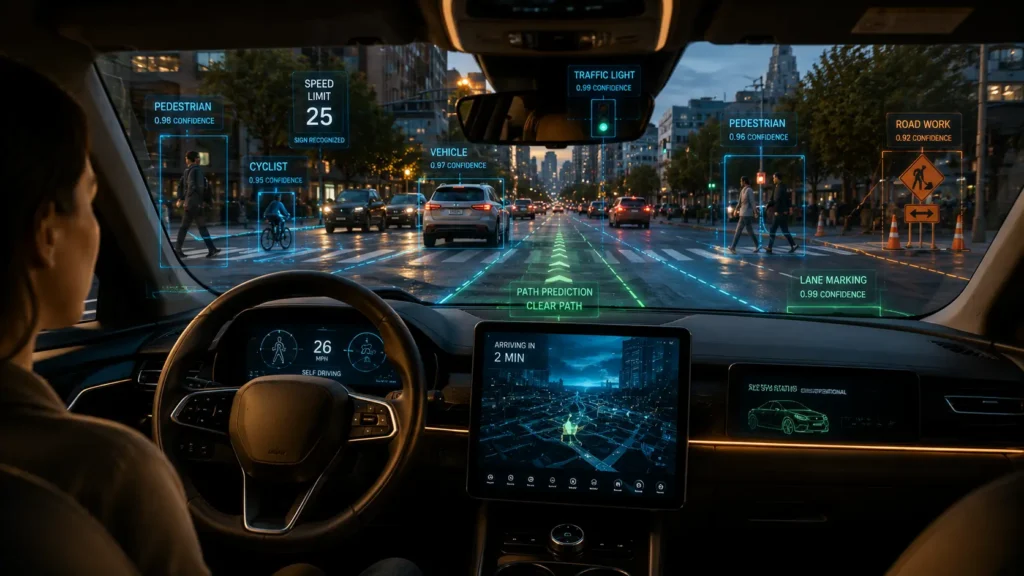
Imagine sitting in a car with no one touching the steering wheel.
The vehicle approaches a busy intersection.
A cyclist appears from the left.
A child runs toward a crosswalk.
Traffic lights change.
Another car suddenly brakes.
Yet within a fraction of a second, the vehicle slows down smoothly, keeps a safe distance, and continues safely down the road.
To most passengers, it feels almost magical.
In reality, thousands of complex calculations are happening every single second.
A self driving car is not simply following a digital map.
It is constantly observing the world, predicting what might happen next, and making driving decisions faster than most humans can react.
Understanding what happens inside this digital brain reveals why autonomous driving has become one of the most advanced engineering challenges of our time.
The Car Never Stops Looking Around
Human drivers mainly rely on their eyes.
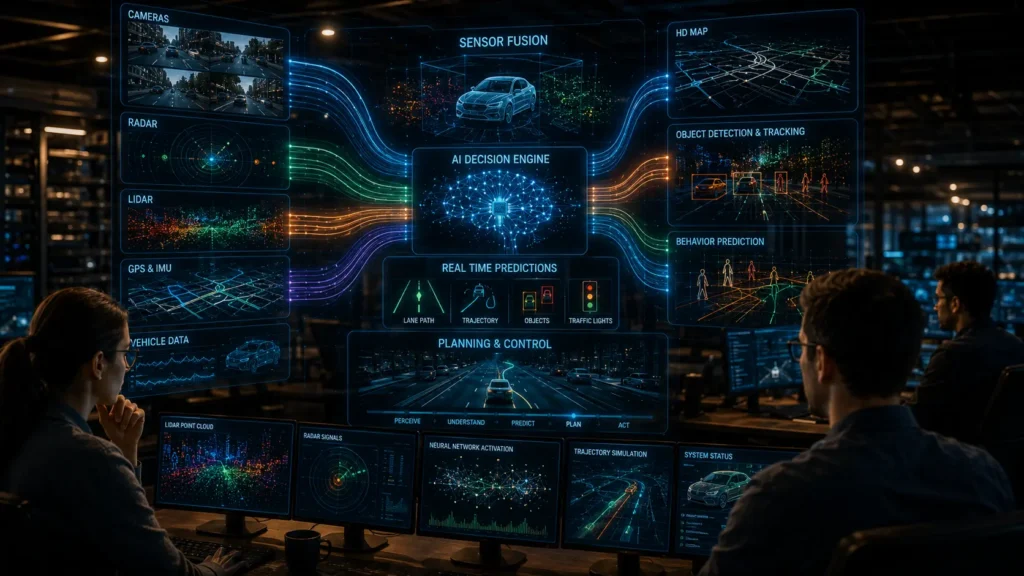
A self driving car relies on an entire team of electronic senses working together.
Several high resolution cameras continuously monitor the road ahead, nearby vehicles, traffic signs, road markings, pedestrians, cyclists, and traffic lights.
Radar measures how fast surrounding vehicles are moving, even during heavy rain or fog.
Many autonomous vehicles also use lidar, which sends millions of laser pulses every second to build an incredibly detailed three dimensional map of the environment.
Ultrasonic sensors help during slow speed manoeuvres such as parking by detecting nearby objects only a short distance away.
None of these sensors is perfect on its own.
Together they create a far more complete picture of the road.
Artificial Intelligence Is The Driver
Collecting information is only the beginning.
The real challenge is understanding it.
Every camera image passes through powerful artificial intelligence systems trained to recognise objects.
The software identifies cars, buses, motorcycles, emergency vehicles, bicycles, traffic cones, road signs, animals, and even temporary construction barriers.
Instead of seeing colourful images like humans do, the computer transforms every object into data.
It estimates size, speed, distance, direction, and possible future movement.
Within moments, the vehicle knows far more than simply what is nearby.
It begins predicting what could happen next.
Every Journey Is A Constant Prediction
Driving is largely about anticipating the unexpected.
Suppose a football rolls into the road.
An experienced human driver immediately becomes more cautious because a child may follow.
Modern autonomous systems attempt to make similar predictions.
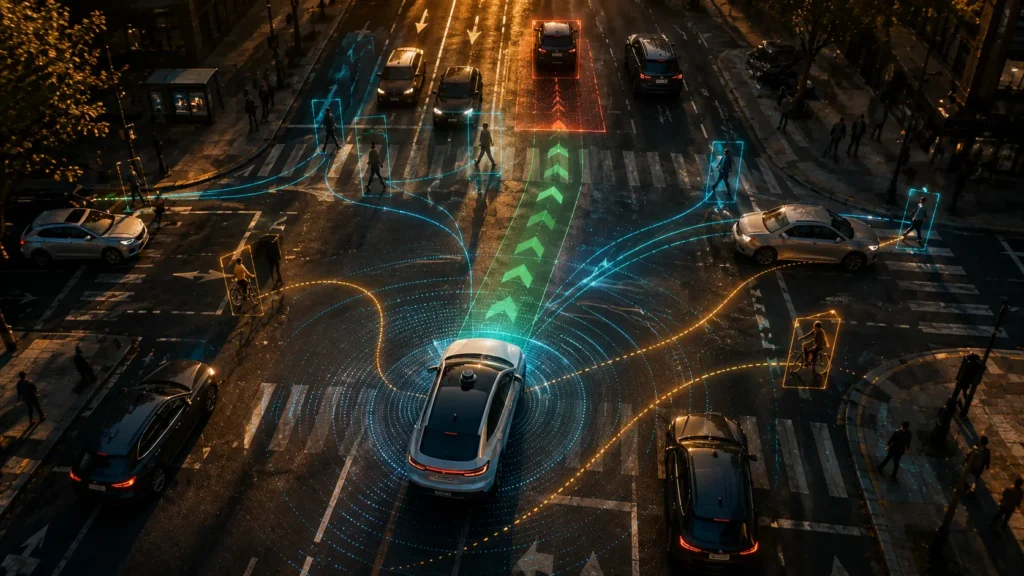
If a cyclist signals before turning, the vehicle prepares for that movement before it actually happens.
If another driver slowly drifts toward your lane, the system predicts a possible lane change and adjusts its own position early.
Rather than reacting only after something happens, the vehicle continuously estimates thousands of possible future situations every second.
A Real World Example
Imagine a family travelling through downtown Phoenix, Arizona.
Their autonomous vehicle approaches a busy pedestrian crossing.
One pedestrian hesitates near the kerb.
Another begins crossing while looking at a mobile phone.
A delivery van blocks part of the view.
The vehicle immediately combines camera images, radar information, lidar measurements, GPS positioning, and digital maps.
Artificial intelligence predicts that the distracted pedestrian may continue walking unexpectedly.
Before any danger develops, the vehicle gently reduces speed and prepares to stop.
To passengers, the braking feels natural.
Behind the scenes, hundreds of software systems have quietly reached the same conclusion almost instantly.
High Definition Maps Are Only Part Of The Story
Many people believe self driving cars simply follow digital maps.
Maps are certainly important.
They provide information about road layouts, speed limits, lane markings, and intersections.
However, maps cannot predict temporary roadworks, fallen trees, parked delivery trucks, or unexpected accidents.
That is why autonomous vehicles constantly compare map information with real time sensor data.
The road itself always has the final say.
The Vehicle Makes Hundreds Of Decisions Every Minute
Driving involves countless small choices.
Should the car overtake?
Should it slow down?
Should it change lanes?
Should it wait for another vehicle?
Planning software evaluates these decisions continuously while keeping passenger comfort, traffic laws, and safety as the highest priorities.
Every movement is calculated to remain smooth rather than sudden whenever possible.
Learning From Millions Of Miles
Unlike human drivers who learn mainly from personal experience, autonomous driving systems improve using enormous amounts of driving data.
Engineers analyse millions of miles collected during testing.
Rare situations such as unusual weather, unexpected pedestrian behaviour, or complex intersections help improve future software updates.
Simulation plays an equally important role.
Before new software reaches public roads, virtual vehicles may drive through millions of computer generated scenarios that would take decades to experience naturally.
Safety Comes From Redundancy
Commercial aircraft rely on backup systems.
Many autonomous vehicles follow the same philosophy.
Several independent computers monitor each other.
Critical sensors overlap.
Power systems include backups.
If one component stops working correctly, another can often continue providing essential information.
This layered design helps improve reliability under demanding conditions.
The Road Ahead
Fully autonomous driving is still evolving.
Engineers continue improving how vehicles handle extreme weather, complicated city traffic, temporary road changes, and unusual human behaviour.
Some roads are relatively simple.
Others remain extraordinarily challenging.
The goal is not simply building a car that can drive.
The goal is creating one that can make consistently safe decisions across millions of unique situations.
That requires advances in artificial intelligence, robotics, mapping, computing, and transportation working together.
The Bigger Picture
A self driving car is far more than a vehicle with advanced navigation.
It is a moving supercomputer that constantly watches, measures, predicts, and learns from the world around it.
Every journey involves billions of calculations performed almost invisibly.
While passengers enjoy a comfortable ride, artificial intelligence quietly analyses roads, recognises hazards, predicts behaviour, and chooses the safest possible path.
The next time you see an autonomous vehicle driving through traffic, remember that its real engine is not only beneath the bonnet.
Its most remarkable component is the digital brain making thousands of intelligent decisions every single second.
Read Also
Read also: https://aiwalanews.com/how-websites-recognize-you-even-without-cookies/
Read also: https://aiwalanews.com/what-happens-inside-googles-data-centers-when-you-search/
© AiwalaNews | Global Tech & Privacy Edition | April 2026
