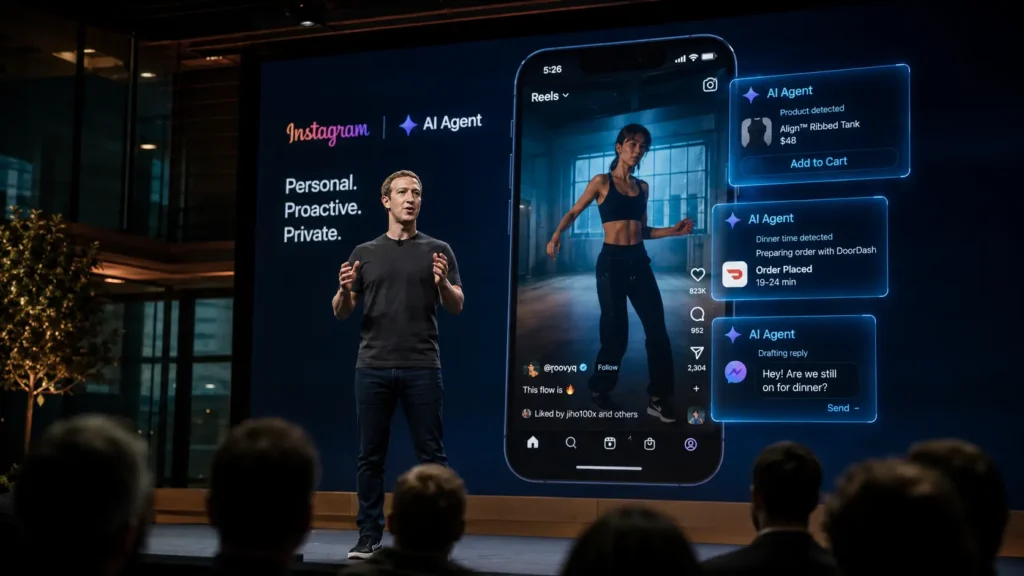
Scrolling Instagram has always been a passive experience. You see. You like. You move on. Occasionally you buy something, if the algorithm caught you at exactly the right moment.
That’s about to change fundamentally.
Meta is building something it’s calling Hatch. And if the leaks are accurate, it’s not just another chatbot feature tucked into a settings menu. It’s an autonomous AI agent designed to live inside Instagram, think on your behalf, and act without waiting for you to tell it what to do next.
The social media feed, as you’ve known it for the last decade, is being rebuilt from the ground up.
What Exactly Is Hatch?
Meta is working on a new AI agent for consumers, called Hatch. The main idea is to make Meta’s apps more active letting AI handle tasks for users instead of just showing content.
The project is part of Meta’s broader push into advanced AI systems and autonomous assistants. Hatch is described as a personalised “agentic” AI system that could eventually handle activities such as research, shopping, content generation, and other day-to-day tasks automatically.
The key word in all of that is agentic. A regular AI assistant answers questions when you ask them. An AI agent takes initiative it reasons about what you need, decides what steps to take, and executes them without requiring a prompt at every turn. It’s the difference between a search engine and a personal assistant who actually handles things.
Hatch is Meta’s attempt to build a consumer-focused AI agent inspired by OpenClaw the autonomous AI system that gained attention for carrying out complex digital tasks with minimal human intervention.
Mark Zuckerberg described OpenClaw as exciting but said it was too hard for most people to use. The company now wants to make this easier. Hatch is that attempt OpenClaw’s ambition, packaged for two billion everyday Instagram users.
The Instagram Shopping Revolution
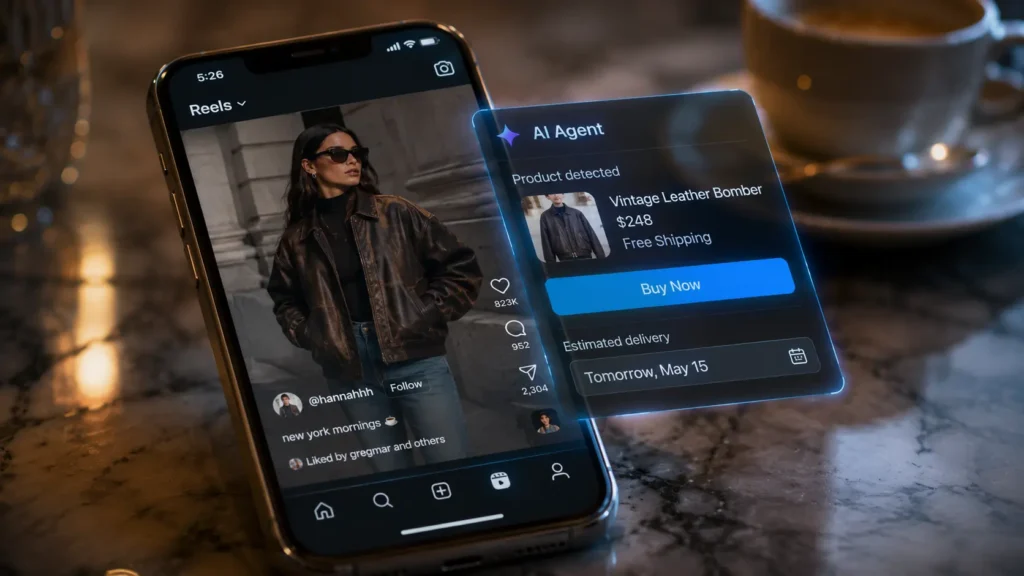
The most immediately visible impact of Hatch will land in one specific place: Instagram Reels.
The Hatch agent is being designed to enhance shopping experiences on Instagram, allowing users to purchase items encountered in Instagram Reels directly, without leaving the platform.
Think about what that means in practice. You’re watching a Reel. Someone is wearing a jacket you like, or using a skincare product that catches your attention, or cooking with a pan you’ve been looking for. Today, that path from desire to purchase involves screenshots, Google searches, brand websites, and checkout flows across multiple apps.
The most consequential component of Hatch is a shopping integration tied directly to Reels that will let users buy products they see in video without leaving the platform a structural change to how Instagram commerce works.
Separately, Meta also intends for Hatch to help the company compete directly with TikTok Shop Instagram users would be able to use the agent to more easily buy items they see in Instagram Reels.
This isn’t feature-adding. This is Meta attempting to own the entire path from discovery to purchase and cutting everyone else out of that chain.
Beyond Instagram: The Apps It’s Already Been Tested On
Here’s what makes Hatch genuinely different from every other AI feature Meta has announced: it’s not just being built for Meta’s own ecosystem.
Hatch is reportedly being tested on simulated versions of DoorDash, Reddit, and Outlook so it’s meant to work with apps outside of Meta, not just its own.
Meta has created closed mock environments that mimic sites like Reddit, Etsy, and DoorDash for training purposes. The implication is clear Hatch isn’t just a social media feature. It’s being positioned as a general-purpose assistant that happens to live inside Instagram, but can reach outward into the broader digital life of its users.
Order food from DoorDash while watching a Reel. Browse Etsy for a product someone mentioned in a comment. Schedule something in Outlook without switching apps. If Hatch works as described, Instagram becomes the control layer for your entire digital life not just the place you go to waste twenty minutes.
The Brain Behind Hatch: Muse Spark
Every agent needs a model and Hatch’s is one Meta is keeping close to its chest.
Hatch is being developed using Meta’s latest multimodal reasoning AI model called Muse Spark, which comes from the company’s Superintelligence Labs division.
But there’s a detail in the leaked reports that reveals just how high the stakes are internally. The current development phase of Hatch is supported by Anthropic’s models, including Claude Opus 4.6 and Claude Sonnet 4.6 though this is only a transitional solution. When Hatch officially launches, it will fully transition to Meta’s own Muse Spark model.
That’s a telling detail. Meta is confident enough in its own AI capabilities that it’s using a competitor’s model as a scaffold while it finishes building its own. It’s not a sign of weakness it’s a sign of how seriously the company is taking the timeline.

The Timeline: Closer Than You Think
According to The Information, Meta plans to complete internal testing for Hatch by the end of June 2026. A separate AI-powered shopping assistant could be integrated into Instagram by the end of 2026.
The Instagram shopping agent is targeted for launch before the fourth quarter of 2026.
That’s not a vague roadmap. That’s a concrete schedule and it suggests that what’s been described as a secret internal project is, in reality, a product that is nearly ready for the world.
What This Does to Your Feed And Your Privacy
Let’s be direct about something the press releases won’t say plainly: an AI agent that can act on your behalf inside Instagram requires an unprecedented level of access to your behaviour, your preferences, your purchase history, and your intent.
For Hatch to work well, it needs to know what you want before you’ve fully decided you want it. That means deeper behavioural tracking than anything Meta has deployed before. It means the agent learning from every scroll, every pause, every abandoned cart, every DM.
Meta has positioned Hatch as an autonomous reasoning system and the merchants that adapt their catalog structure, pricing, and customer service operations to work cleanly inside the agent will see substantial revenue lift relative to those that try to maintain the existing manual flow.
Whether your interests are equally well represented is a question worth asking loudly before Hatch arrives and starts answering on your behalf.
The Bigger Picture
Meta isn’t alone in this race. OpenAI, Google, and Anthropic have all shipped agent products in 2025 and 2026. But there’s a critical difference.
OpenAI, Anthropic, and Google have all shipped agent products, but each operates as a horizontal layer that customers must integrate into their own applications. Meta’s advantage is distribution two billion people already inside its apps, every single day.
That distribution moat is enormous. You don’t need to convince people to download a new AI app when the AI is already living inside the app they open forty times a day.
Hatch isn’t just Meta’s answer to OpenClaw. It’s Meta’s answer to the question of what social media becomes in the age of AI and the answer, apparently, is an agent that doesn’t just show you the world but starts making decisions inside it.
The scroll is becoming a transaction. The feed is becoming an assistant. And Instagram, the app a billion people built their self-expression on, is quietly becoming something else entirely.
© AiwalaNews | Global Tech & Privacy Edition | May 2026
Read Also:
- 🔗 TikTok Shop vs Instagram Shopping: Who Wins the Social Commerce War?
- 🔗 AI Agents Are Here — And They’re Changing Every App You Use
