Important disclosure: This article is for informational and educational purposes only. It does not constitute financial advice. All investing involves risk of loss. Past performance of any tool or platform does not guarantee future results. Consult a licensed financial advisor before making investment decisions.
For most of stock market history, the edge belonged to institutions. Goldman Sachs, Renaissance Technologies, Citadel firms with billions in compute, PhDs in quantitative finance, and proprietary data feeds ordinary investors could never access.
That gap is closing fast. And the tools doing the closing are, in several cases, free.
According to eToro’s Retail Investor Beat, 30% of US retail investors now use AI tools for portfolio decisions up 75% year-over-year. In 2026, with tariffs, geopolitical conflict, and a 20%+ tech selloff creating more noise than ever, AI tools are adding the most value by removing emotional bias and processing thousands of data points in seconds.
Here’s what the tools actually are, what the numbers actually say, and critically what they still cannot do.
The Tool With the Most Documented Track Record: Zen Ratings
Zen Ratings by WallStreetZen is among the most comprehensive free AI-driven stock prediction platforms available to retail investors. It evaluates over 4,600 stocks through 115 distinct factors proven to drive stock growth ranging from value metrics and growth potential to momentum indicators and proprietary AI measurements.
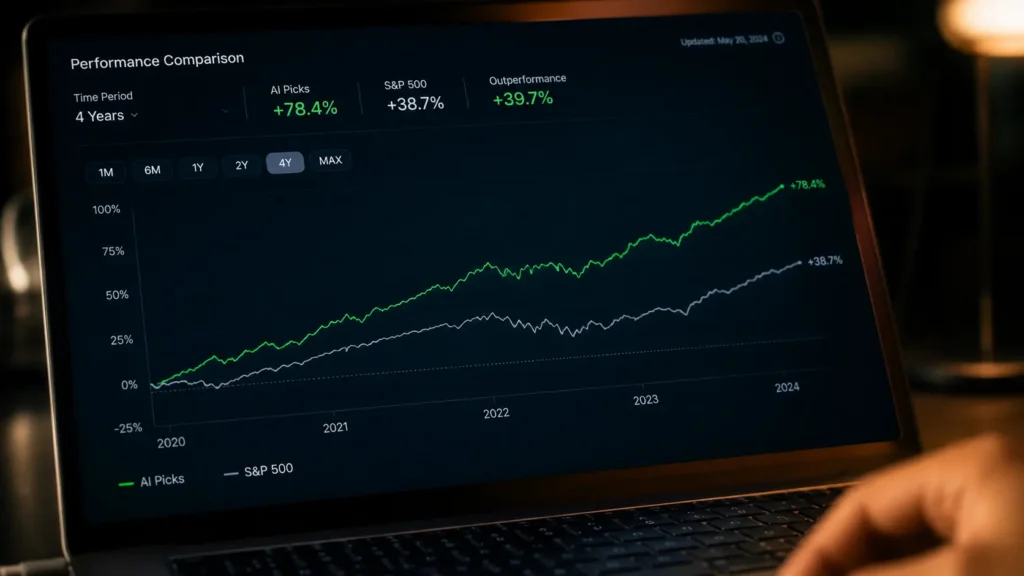
The documented performance: a 4-year average beat of the S&P 500 of 67%. In 2025, individual picks won versus the S&P 500 at a 60% rate, beating the index by 63% annualized.
What makes Zen Ratings different from most AI tools is the combination of algorithmic scoring with human analyst integration. Stocks rated “Buy” by top analysts in WallStreetZen’s database beat the S&P 500 by 98.4% last year a figure that combines AI screening with verified analyst consensus rather than relying on the model alone.
The free tier gives access to the full Zen Ratings score for any ticker, making it genuinely usable without a subscription.
The Institutional-Grade Free Option: Kavout Kai Score
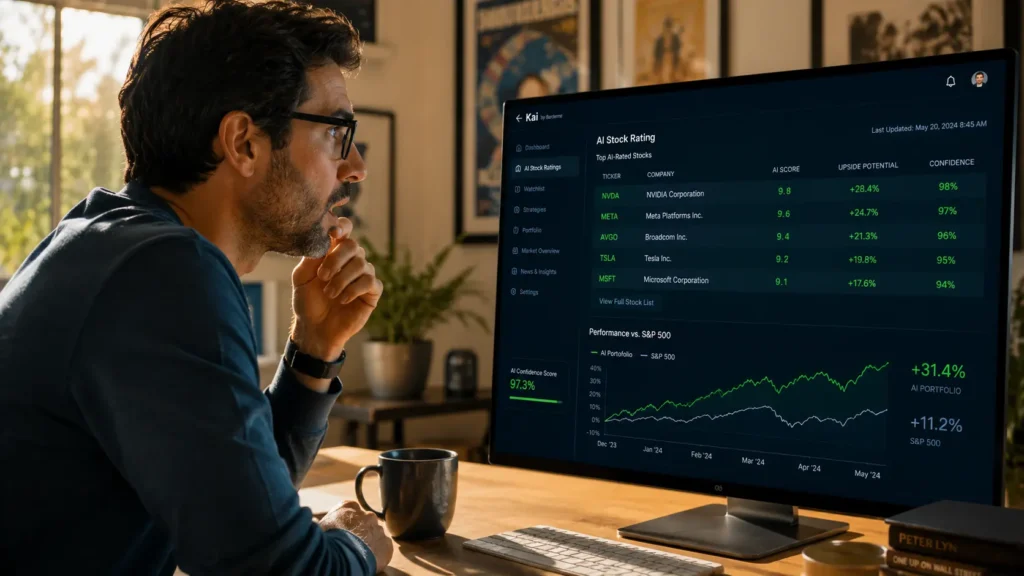
Kavout is the closest thing to a Wall Street quant shop that retail investors can access for free. The platform runs seven specialized AI research agents that analyze stocks, crypto, forex, and ETFs across 20+ global markets. Its flagship product the Kai Score aggregates billions of data points including SEC filings and satellite imagery into a simple 1 to 9 rating. High scores have historically outperformed the market. Low scores have historically underperformed.
Kavout’s free tier gives access to Kai Score ratings and basic stock analysis tools solid for longer-term position selection and for retail investors who want institutional-grade filtering without institutional-grade fees.
The “Most Agreed” feature introduced in 2026 identifies stocks where Value, Momentum, and Quality AI models all simultaneously signal Buy what Kavout calls “Golden Trades,” representing the highest-conviction signals the platform generates.
The Newcomer With Striking Numbers: Prospero.ai
Prospero.ai has generated close to 5,000 picks since its 2023 inception, with a 54% win rate versus the S&P 500 and 27% better average returns than the benchmark. In 2025, picks beat the S&P by 81% annualized and beat it by 76% in 2024.
Prospero’s approach is signal-based it analyzes institutional money flows, market sentiment, and trend data to identify stocks before institutional moves become publicly visible. The platform provides real-time insights into market-moving institutional actions, helping retail investors reduce losses and accelerate wins.
The free tier provides daily signal updates and basic stock ranking access.
What These Tools Are Actually Doing
All three tools share the same fundamental architecture they’re processing data at a scale and speed no human analyst can match.
By processing millions of data points from financial statements and technical indicators to satellite imagery and social sentiment these platforms aim to give retail investors an edge once reserved for institutional quant desks.
Only four of ten platforms tested consistently outperformed a simple buy-and-hold SPY position in a rigorous 60-day test. The rest were either overfit to historical data, too vague to be actionable, or simply repackaging publicly available information with an AI label.
The pattern in the tools that actually work: they combine multiple data types, they maintain explainable scoring systems, and they don’t claim certainty they claim probability.
The Honest Truth About What AI Can’t Do
This section matters as much as everything above it.
No AI stock picker beats the market consistently over all timeframes. Academic research confirms machine learning models show alpha in specific market regimes but decay during transitions. Accuracy percentages are misleading without context a 60% win rate against the S&P 500 in a bull market looks very different from a 60% win rate during a correction.
The one truth across all platforms: AI stock picking works best as a filter, not an oracle. Use it to narrow your universe, identify setups you’d otherwise miss, and quantify conviction. Then apply your own framework for execution and risk management.
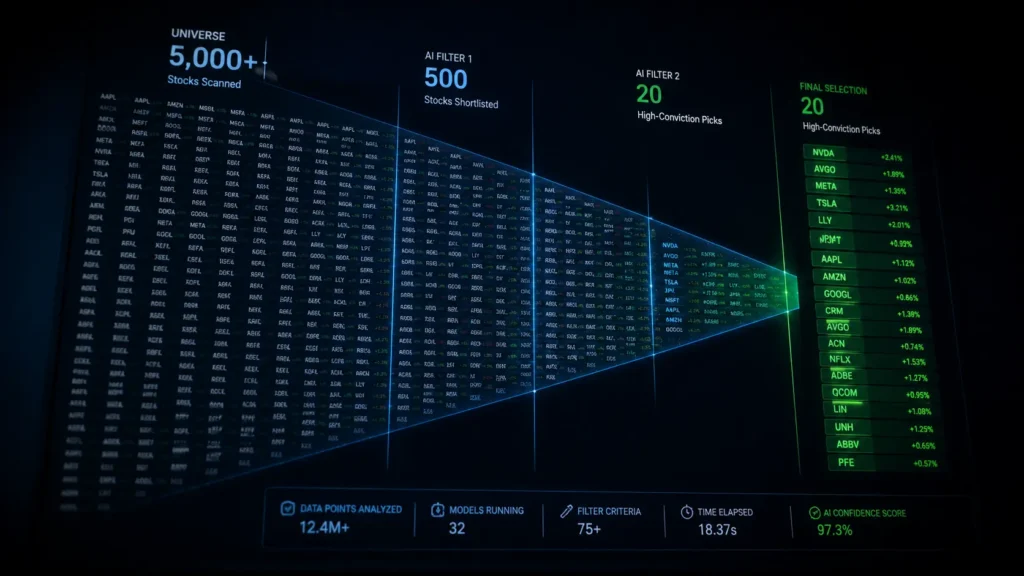
The tools that got the best results from retail investors who reported using them weren’t used as automatic buy signals. They were used as a first-pass filter the AI narrows 5,000 stocks to 20 worth researching, and the human makes the actual decision.
The Free Stack That Actually Works
Three tools. Zero monthly cost. Fifteen minutes of setup:
Zen Ratings for fundamental AI scoring across 115 factors start here for any long-term position idea. Kavout for institutional-grade Kai Score filtering and highest-conviction “Most Agreed” signals. Prospero.ai for institutional flow signals and daily market sentiment analysis.
These free tools are solid starting points before committing to any paid platform and for many retail investors, they cover the full research workflow without requiring an upgrade.
The hedge fund advantage in 2026 isn’t access to better data. It’s access to more data, processed faster. These tools close that gap significantly for free.
What they can’t replace is judgment, patience, and risk management. Those still belong to you.
Disclaimer: This article is for educational purposes only and does not constitute financial advice. All investing involves risk. The performance figures cited reflect documented platform claims and independent testing; they do not guarantee future results. Always conduct your own research and consult a qualified financial advisor before investing.
© AiwalaNews | Global Tech & Privacy Edition | May 2026
Read Also:
- 🔗 The $0 AI Stack That Replaced My $500/Month SaaS Tools
- 🔗 How Americans Are Making Real Money From AI Tools They Already Have
