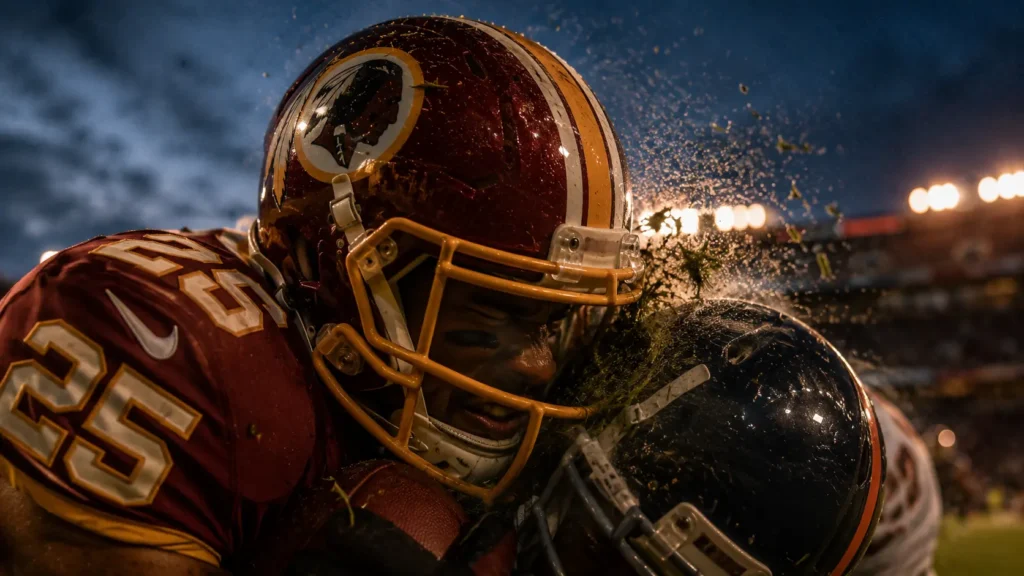
When a linebacker drives his helmet into a running back, the crowd sees a violent collision. What they do not see is the quiet stream of data already leaving that helmet before the whistle even blows. Tucked between the padding of nearly every modern NFL helmet sits a small network of accelerometers and gyroscopes, silently recording how hard, how fast, and in which direction the head just moved.
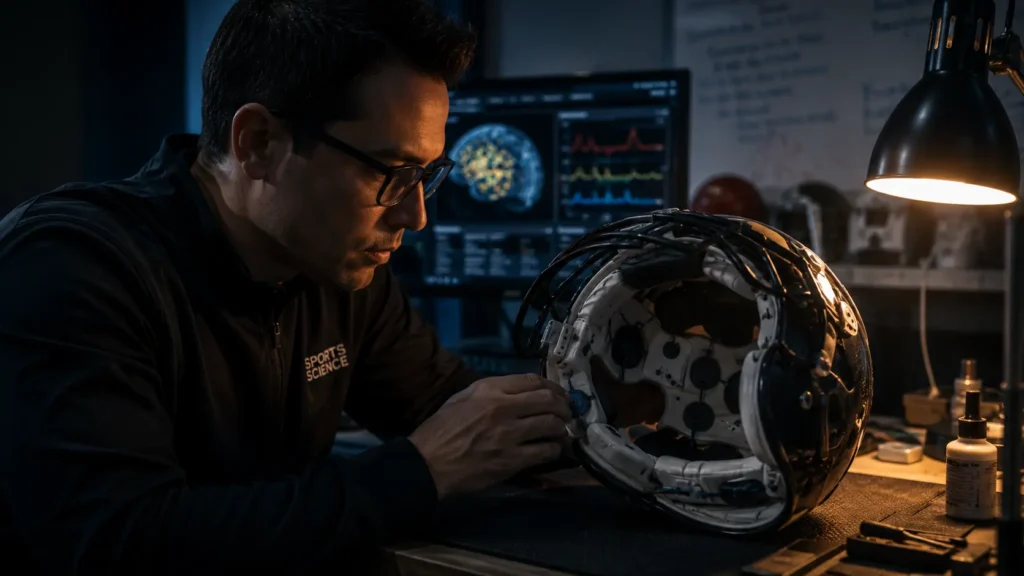
What Is Actually Inside the Helmet
Modern helmet sensor systems, including the widely referenced Head Impact Telemetry (HIT) System, work by measuring linear acceleration and rotational acceleration every time a player’s head experiences a jolt. These numbers are expressed in units of g force, the same measurement used in crash testing. A hard tackle can register anywhere from a few g to well over a hundred g, and the sensor captures it instantly, without waiting for a player to say he feels off.
Riddell’s Insight system, one of the more recognized designs, uses a five zone sensor pad built directly into the padding to track impact location alongside force. Other systems, like Shockbox, are calibrated to flag anything above roughly 20g as a potential risk event, since research has shown that around 86 percent of impacts during a typical game fall below 50g, while concussion causing hits tend to concentrate in the 70 to 100g range.
Why This Data Matters So Much
This is not a novelty gadget. According to the Centers for Disease Control and Prevention, the United States sees an estimated 1.7 to 3.8 million sports related concussions every year, and football remains one of the most closely studied sports for this exact reason. The NFL itself has reviewed more than 1,000 concussion causing impacts, breaking each one down across roughly 150 separate variables including pose, play type, speed, and equipment, all in an effort to understand exactly how these injuries happen.
That level of detail is only possible because of sensor data. Instead of relying purely on a player’s own description of symptoms, which can be unreliable or deliberately downplayed, engineers and medical staff now have an objective, second by second record of what the brain actually experienced during a play.
From Helmets to Mouthguards
Interestingly, researchers have found that helmet mounted sensors are not always perfectly accurate on their own, since the helmet can shift slightly on the head during impact. This has pushed newer research toward instrumented mouthguards, which sit directly against the teeth and track head motion with far less independent movement. Recent field studies comparing helmet based systems with mouthguard based systems have found meaningful differences in recorded impact data, suggesting that the future of concussion monitoring may rely on multiple sensor types working together rather than the helmet alone.
Some university labs have gone even further. Testing conducted at the University of Cincinnati in 2026 found that newer helmet designs perform noticeably better in reducing impact severity, though players remain most vulnerable to hits at the back of the head, and certain position specific helmets actually underperformed more general models in lab conditions.
The Bigger Scientific Push
Beyond a single game or season, this data feeds into long term research on repetitive head impact exposure. Scientists studying chronic traumatic encephalopathy (CTE) have used helmet accelerometer data to estimate what researchers call a cumulative head impact index, essentially a running total of how many hits, and how severe, a player has absorbed across an entire career. This turns a single Sunday afternoon into one data point inside a much larger, decades long picture of brain health.
Not every experiment has stuck around. Some early electronic helmet sensor programs were quietly phased out after only a couple of seasons of league wide use, a reminder that the technology, while promising, is still evolving rather than finished.
What This Means Going Forward
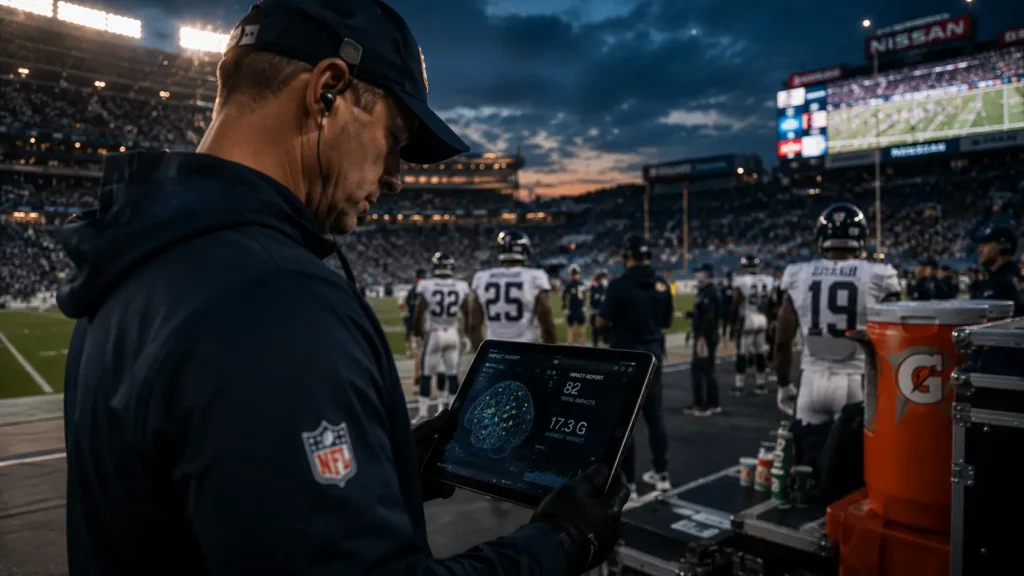
For players, coaches, and parents watching from the stands, the takeaway is simple. Every impact on the field is no longer just something you witness, it is something measured, logged, and studied. Sensor systems will not eliminate concussions, but they are steadily replacing guesswork with actual numbers, giving medical staff a genuine window into what is happening beneath the helmet in real time.
As helmet manufacturers, universities, and league engineers continue refining these systems, one thing is becoming clear. The next generation of player safety will not come from a single dramatic invention, but from thousands of quiet data points collected one hit at a time.
Read also: How Wearable Sensors Are Changing Modern Sports Medicine
Read also: Inside the Science of Concussion Detection Technology
© AiwalaNews | Global Tech & Sports Science Edition | April 2026
