This article is based on Army Recognition’s verified January 2026 reporting on the RQ-170 Sentinel, Potomac Officers Club’s 2026 counter-UAS analysis, declassified stealth design principles from New Prairie Press, and Hall Lidar’s April 2026 acoustic detection research. This is an educational explainer based on unclassified information.
On January 3, 2026, a US Air Force drone was spotted returning to Puerto Rico after a night over Venezuela. It had been loitering silently above 15,000 meters nearly 50,000 feet for hours. Venezuelan radar systems never detected it. And by the time it landed, the mission it had supported was already complete.
The drone was the RQ-170 Sentinel. And what it did that night is a real-world demonstration of stealth physics operating at their most consequential.
Here’s exactly how an aircraft becomes invisible to radar and why making a drone invisible is simultaneously simpler and harder than doing the same to a fighter jet.
How Radar Works And Why Shape Defeats It
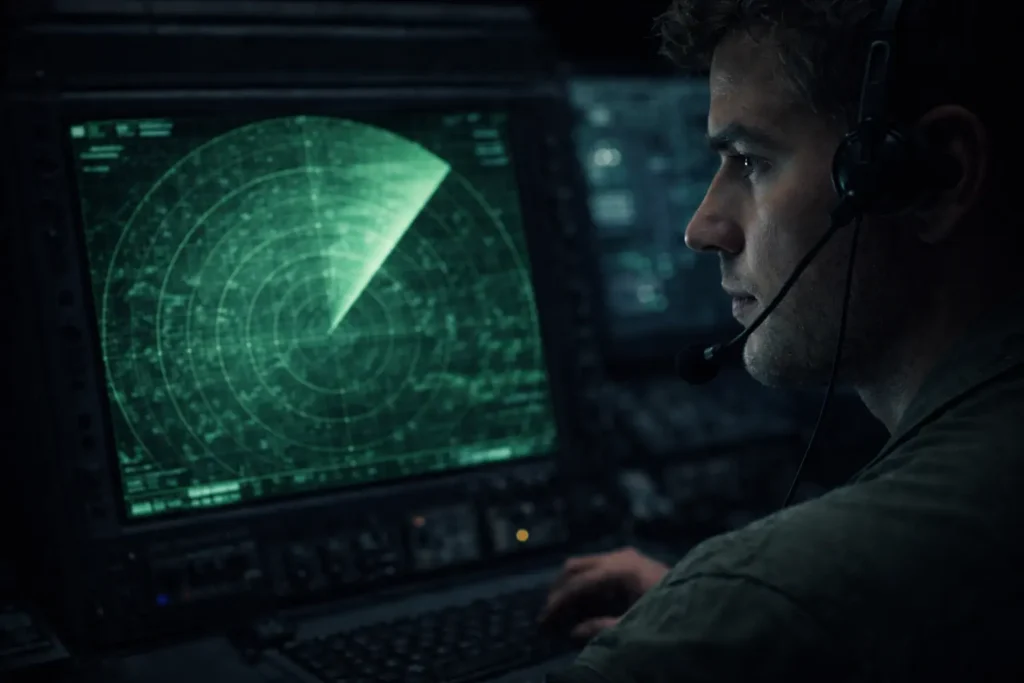
Radar works by sending out a radio wave pulse and listening for what bounces back. The stronger the return signal called radar cross-section (RCS) the more visible the object. A commercial airliner has an RCS roughly the size of a truck. An F-22 Raptor has an RCS roughly the size of a marble.
Stealth technology doesn’t make aircraft invisible to radar. It makes the return signal so small that it disappears into the background noise of the radar receiver — indistinguishable from a bird, a weather artifact, or electronic interference.
Four engineering principles achieve that reduction.
Shape: Eliminating Corner Reflectors
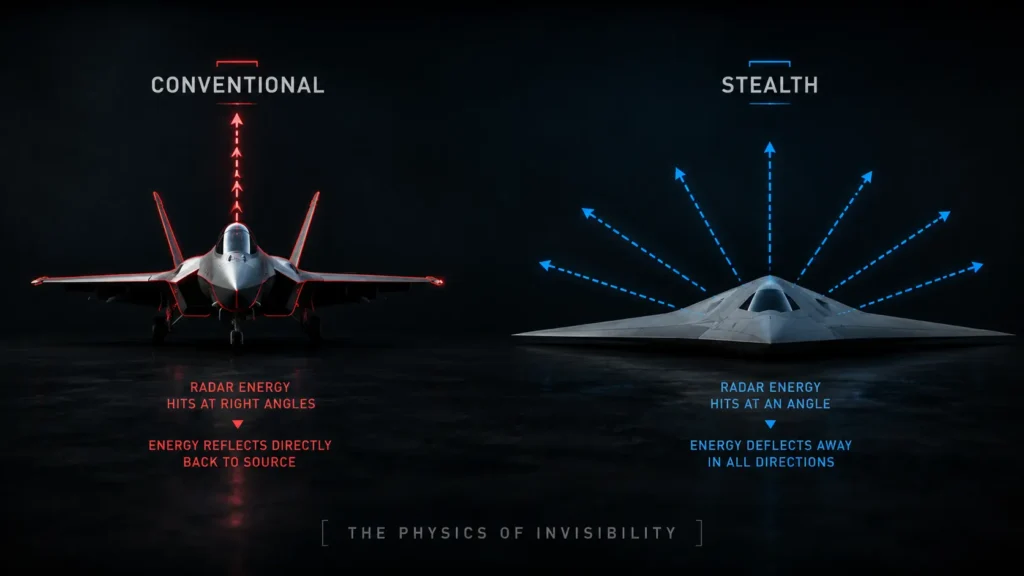
It is a fundamental design goal to avoid surfaces meeting at 90 degrees these act as radar “corner reflectors” that give extremely strong radar returns.
When two flat surfaces meet at a right angle, they create a geometric trap that bounces radar energy directly back toward the transmitter like a retroreflector on a bicycle. Every right angle on an aircraft dramatically amplifies its RCS.
Stealth aircraft are designed with continuous curved surfaces, angled facets, and blended transitions between components all specifically chosen to deflect radar energy away from the transmitter rather than returning it. The RQ-170’s flying-wing shape has no vertical tail, no protruding engine nacelles, no right-angle joints anywhere on its exterior. Every surface angle was chosen computationally to redirect radar energy in directions where no receiver is listening.
Radar-Absorbent Materials
The skin of a stealth aircraft isn’t aluminum. It’s a composite structure incorporating materials that absorb radar energy rather than reflecting it converting the electromagnetic energy into heat through molecular friction in the material’s structure. These radar-absorbent materials (RAM) are applied to the aircraft’s surface and embedded in its composite skin, working in conjunction with the shape design rather than independently.
Engine Inlet Shielding
The compressor blades of a jet engine are a stealth designer’s worst nightmare. Spinning metallic blades create a strong, distinctive radar return and the engine inlet is a direct line of sight to them. Stealth aircraft use S-curved engine inlets specifically to break that line of sight the radar pulse enters the inlet, bounces off the curved duct walls, and dissipates before reaching the compressor face.
Emission Control
Unlike conventional reconnaissance aircraft that may emit radar or communications signals, the RQ-170 operates in total emission control mode EMCON. This enables it to collect signals intelligence and electronic intelligence while emitting no detectable signals itself.
A drone that emits radio signals is trackable even when it’s visually and radar-invisible. EMCON means the aircraft collects signals passively receiving everything, transmitting nothing making it undetectable to both radar and radio frequency sensors simultaneously.
Why Drones Have Specific Stealth Advantages
The RQ-170’s ability to remain in-theater for extended durations, combined with its low observable profile, provided ISR coverage that would have been impossible for manned platforms or conventional UAVs. By loitering at altitudes above 15,000 meters, it evaded radar systems while continuously mapping defensive positions, SAM sites, troop concentrations, and electronic emitters.
Drones have a structural stealth advantage over manned aircraft: no cockpit. The cockpit canopy of a manned aircraft is one of its strongest radar reflectors curved glass over a metallic instrument panel creates a significant RCS contribution. Removing the pilot removes the cockpit, and with it a major source of radar return.
Unmanned aircraft can also be built with different weight trade-offs. Without life support systems, ejection seats, and the structural reinforcement required around a human pilot, the airframe can be designed more purely around stealth geometry and materials.
The Counter-Stealth Arms Race
The other side hasn’t been standing still.
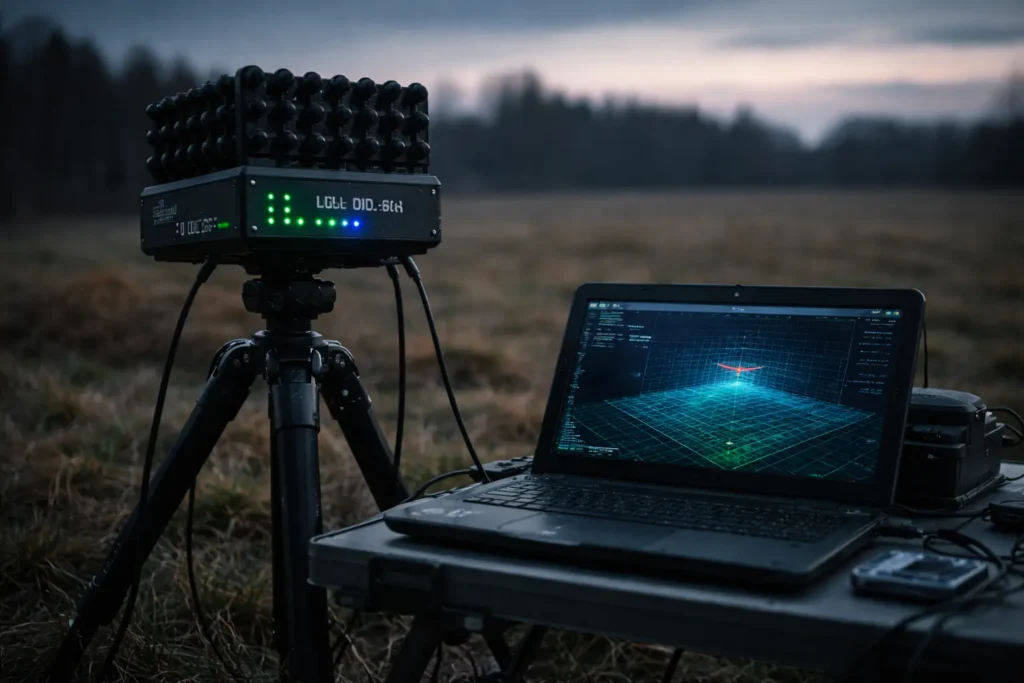
US-based developer Hall Lidar introduced the UDL-64 in April 2026 an AI-driven acoustic drone detection system that addresses a growing gap in counter-UAS technology where traditional radar, radio frequency, and optical systems face limitations. By relying on the physical sound signatures produced by drone rotors, the system operates independently of GPS availability, visual conditions, or radio signals.
Stealth defeats radar. It doesn’t defeat sound. A drone flying at 50,000 feet produces no audible signature at ground level but a drone operating at low altitude, regardless of its radar cross-section, produces acoustic signatures that advanced microphone arrays and AI signal processing can now detect and locate precisely.
Thermal imaging cameras are excellent for detecting small, fast-moving objects at low altitudes detecting heat signatures of a drone’s motors and batteries, enabling tracking even in challenging conditions.
The pattern that emerges: stealth technology excels at high altitude, where acoustic and thermal signatures are undetectable and radar is the primary sensor. At low altitude where small commercial drones operate the physics shift. Sound, heat, and optical detection become viable even against radar-invisible platforms.
The January 2026 Mission What It Demonstrated
Venezuela’s legacy radar systems were optimized for mid-altitude threats and lacked the sensor fusion capabilities to detect stealth aircraft operating at extreme altitudes. The Sentinel’s persistent, undetected ISR coverage provided intelligence that would have been impossible for manned platforms or conventional UAVs mapping the operational environment completely before any visible action began.
The Venezuela operation demonstrated something important about how stealth UAVs are actually used: not as strike weapons, but as persistent, silent intelligence collectors that remove uncertainty before any kinetic action begins. The drone doesn’t need to fire anything. It needs to see everything without being seen.
That’s the real capability stealth provides. Not invisibility as a weapon. Invisibility as a prerequisite for perfect information.
Note: This article covers unclassified stealth design principles and publicly reported military operations. Classified specifications of US stealth systems are not discussed. This is for educational purposes only.
© AiwalaNews | Global Tech & Privacy Edition | May 2026
Read Also:
- 🔗 How a Nuclear Submarine Never Sees the Sun — And Still Knows Exactly Where It Is
- 🔗 How One Small Country Controls 90% of the World’s Most Critical Tech Component
