
You made a deliberate choice. You never signed up for Facebook. Maybe you deleted your account years ago. Maybe you decided from the start that the privacy trade-off wasn’t worth it. You gave Mark Zuckerberg nothing.
Except you did and you had no say in it.
Right now, Meta almost certainly holds a data profile on you. It contains your phone number, your email address, an estimate of your age and location, a map of your social connections, and a record of websites you have visited. It was assembled without your knowledge, without your consent, and without you ever touching a Facebook login screen.
It is called a shadow profile. And it is one of the most consequential privacy mechanisms in the history of consumer technology.
What a Shadow Profile Actually Is
A shadow profile is a hidden collection of personal information that a company builds about someone who did not directly provide that data. The key idea: even if you never create an account or if you limit what you share other users and apps can leak your information into a company’s database. Platforms then combine that with public records, metadata, and behavioural inferences to create a parallel identity a ghost version of you that feeds algorithms behind the scenes.
Facebook does not use the term “shadow profile” but that has become the common term for information collected on people who are not Facebook users. In 2018, Mark Zuckerberg admitted in a congressional hearing that Facebook collects information on people who are not Facebook users.
The senator asking the question looked visibly surprised. The answer should not have been surprising at all. The system had been documented by researchers for years. Zuckerberg simply confirmed it in public, under oath and the conversation largely moved on.

The Three Pipelines That Built Your Profile
Pipeline 1 – Your Friends’ Contact Lists
Suppose you don’t have a Facebook account. One of your friends, however, makes an account on Facebook. Facebook offers them a service where they can import their contacts to find friends already on the service. Your friend thinks this is a great idea, so they import their contacts list to Facebook. Facebook now has your phone number and email address and stores them against your name.
This is not a bug. It is a feature Contact Importer that has existed since Facebook’s earliest years. Every time any of your contacts synced their phone to Facebook, your details went with them. You had no opt-out mechanism. You were never asked.
When a user shares their contact list with the platform, the provider can identify which email addresses do not have an associated account and generate a full shadow profile for these non-users. If those non-users appear in many contact lists of other users, data mining techniques can be used to infer their home location, age, and gender.
The more friends you have who use Facebook, the richer your shadow profile becomes built entirely from data your contacts handed over.
Pipeline 2 – The Facebook Pixel
This is the mechanism most people have never heard of, and it is the most technically powerful collection tool in Meta’s non-user surveillance architecture.
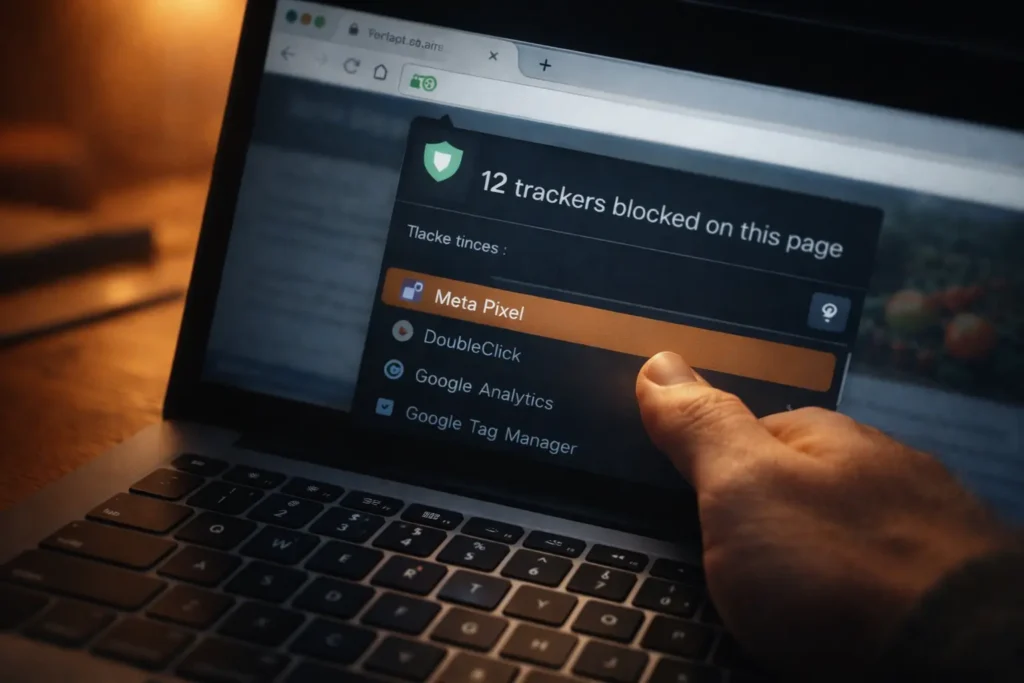
The Meta Pixel is one of the most widely used tracking tools on the web. By default, it fires on page load not after consent, on page load. This means the pixel collects and transmits data about every visitor before they’ve had any opportunity to agree to it.
The Pixel is a small piece of code installed on millions of websites online shops, news sites, health platforms, government portals, medical providers. Every time you visit a page carrying the Pixel, Facebook receives a signal: your IP address, your browser fingerprint, what page you visited, what you clicked, how far you scrolled, and if you filled in any form potentially your name and email.
The pixel records which pages the visitor views, what they click, how far they scroll, and what events have been configured add to cart, checkout, lead form submission. This builds a detailed behavioural profile. If the visitor is logged into Facebook, Meta can link their on-site behaviour to their Facebook identity. Even if they’re not actively logged in, Meta uses browser fingerprinting, device identifiers, and cookie matching to make the connection.
You were never on Facebook. You visited a pharmacy website, a pregnancy forum, a mental health resource, a financial hardship support page. Meta received a signal from every one of them.
Pipeline 3 — Photo Tags and Mentions
When someone tags you in a photo or message, the platform links your name to that context. Location metadata, cookies, or web beacons may reveal your movements or browsing behaviour even without a login. So even if you’ve never been “on” the platform, the platform might still be on you.
Every photograph you appear in that a Facebook user uploads, every mention of your name in a post, every event you are tagged in without having an account all of it feeds the profile. The facial recognition system Meta ran until 2021 could identify faces across uploaded photos and link them to named individuals including non-users identified through the contact pipeline.
What the Profile Is Used For
Your shadow profile is not sitting idle. It has a specific commercial function.
Advertisers can upload a list of contact information from their own databases to create targeted advertising campaigns on Facebook. Your email address or phone number collected from a friend’s contact list, never provided by you can be used to show you targeted advertising the moment you do create a Facebook account, or to target people statistically similar to you without you ever signing up.
This is the mechanism behind the uncanny experience millions of people have reported: creating a Facebook account for the first time and immediately being shown friends it could not possibly know about because it already knew about them. Your shadow profile was waiting.
As Professor Priya Nair of the University of Toronto framed it: “A shadow profile is what happens when inference becomes identity. Once the system predicts who you are with high enough confidence, the distinction between ‘given’ and ‘collected’ data disappears.”
The Legal Consequences And Why They Weren’t Enough
Regulators have not ignored this. The problem is that the fines, while headline-grabbing, have not changed the underlying architecture.
In May 2023, Ireland’s Data Protection Commission fined Meta €1.2 billion the largest GDPR fine in history for transferring EU user data to the US without adequate safeguards.
In August 2025, Swedish authorities fined pharmacy chains €15 million for improperly using the Facebook Pixel without obtaining proper user consent before the pixel fired shifting compliance responsibility squarely onto website owners, not Meta.
The fines are real. The data collection continues. Meta’s annual revenue exceeds $160 billion the largest GDPR fine in history represents less than one week of revenue. The commercial incentive to maintain the shadow profile infrastructure vastly outweighs the regulatory cost of operating it.
What You Can Actually Do
The honest answer is that short of living entirely offline, eliminating your shadow profile is not possible. But you can meaningfully reduce it.
Block the Pixel. Browser extensions including uBlock Origin and Privacy Badger block the Meta Pixel from firing on websites you visit. This cuts off the most powerful non-user data collection pipeline at the browser level.
Ask contacts not to sync. If your closest contacts disable Facebook’s contact sync or deny the app access to their contacts your details stop flowing in through that pipeline. One conversation with five people you trust closes a meaningful portion of the exposure.
Use an email alias. Services like Apple’s Hide My Email and similar alias tools mean your real email address never enters the contact import pipeline in the first place.
In the EU – request deletion. Under GDPR Article 17, you have the right to request erasure of data Meta holds on you as a non-user. The process is not easy Meta does not advertise it but it is a legal right that European regulators have confirmed applies to shadow profiles.
The profile exists. It was built without you. The question is not whether Facebook has data on you it almost certainly does. The question is how much you want to add to it going forward.
That choice, at least, is yours.
📌 Read Also:
- The $300 Billion Industry Built Around Your Personal Data
- Why Incognito Mode Is a Lie — What Your ISP, Employer, and Router Still See
© AiwalaNews | Global Tech & Privacy Edition | April 2026
