Start with something small.
You type a 100-word question into ChatGPT. You get an answer in four seconds. Somewhere in a building you will never visit, in a county whose name you do not know, 519 millilitres of water evaporates into the atmosphere.
Not used. Not recycled. Evaporated permanently removed from the local water supply in exchange for your answer.
Now multiply that by the billions of queries processed globally every day. This is the hidden resource cost of the internet one the industry disclosed reluctantly, that most users have never considered, and that is accelerating faster than the solutions designed to address it.
Why Computers Need Water at All
The connection between servers and water is not intuitive. The link is heat.
Every computation generates it. A single modern GPU chip running AI inference can consume 700 watts of power and generate enough thermal output to melt its own circuit board within seconds without active cooling. A data centre housing tens of thousands of these chips generates heat at a scale comparable to an industrial furnace.
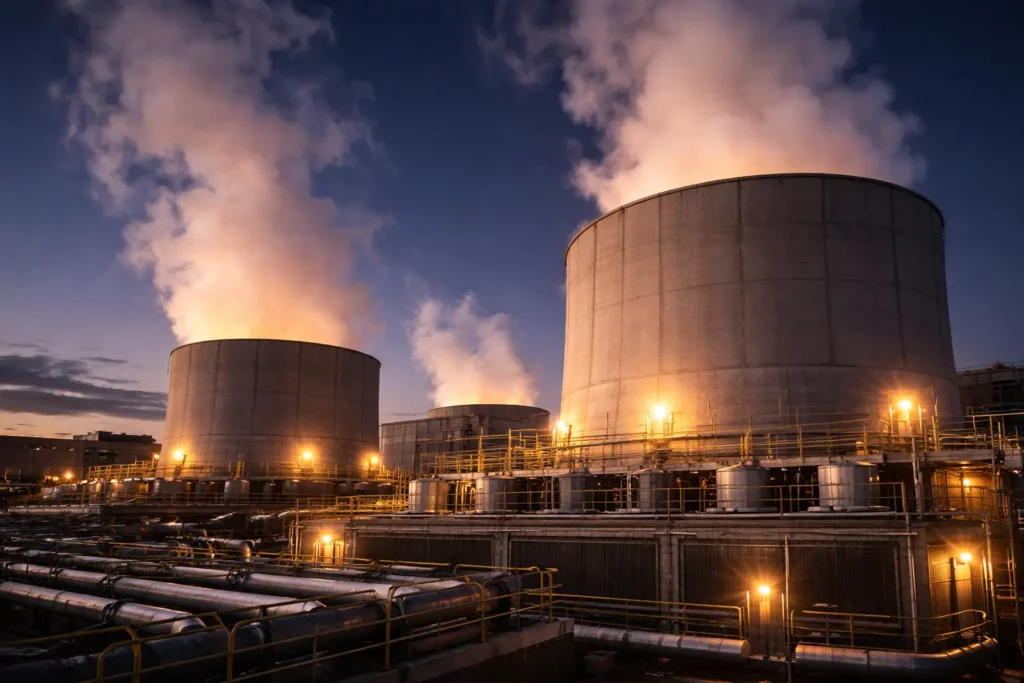
The most cost-effective removal method is evaporative cooling the same thermodynamic principle behind sweating. Water absorbs heat from warm air circulating through server halls, then evaporates, carrying that thermal energy away. Inside a data centre, this happens through cooling towers structures on the roof or exterior that circulate hot water through ambient air. As water evaporates, it cools. The cooled water recirculates. The evaporated portion typically 80% of the water drawn is gone permanently from the local supply.
Most data centres use potable water, chemically treated to prevent corrosion in cooling systems. Once cycled through, it is rendered unsuitable for human consumption or agriculture effectively removed from the local water cycle entirely.
The Numbers Tech Companies Bury in Footnotes
The scale that has emerged from voluntary corporate disclosures the only data source that exists, since no federal reporting requirement applies is significant.
In 2023, Google operations consumed 6.4 billion gallons of water globally, with 95% used by data centres. Meta consumed 813 million gallons, also with 95% going to data centres. Amazon data centre water use reached 2.5 billion gallons in 2025 a figure that excludes indirect water consumed by the power plants supplying electricity to those same facilities.
The Lawrence Berkeley Lab estimated that indirect water consumption from electricity use is 12 times greater than direct cooling use. The billions-of-gallons figure people cite is the visible fraction. The full water cost is an order of magnitude larger and almost entirely unreported.
A 2024 report from Lawrence Berkeley National Laboratory estimated that US data centres directly consumed 17 billion gallons through cooling in 2023, and projects that by 2028 those figures could double or even quadruple.

The AI Multiplier Nobody Prepared For
Traditional data centres were already significant water consumers. AI data centres are categorically different.
AI data centres consume 10 to 50 times more cooling water than traditional server farms. The reason is density. AI training and inference run on GPU clusters packing far more heat into the same physical footprint. A rack of AI training hardware can exceed 100 kilowatts of power demand, compared to 5 to 10 kilowatts for a standard enterprise server rack.
The training cost of large models has become a documented benchmark for this problem. Researchers at UC Riverside found that training GPT-3 in Microsoft’s US data centres used approximately 5.4 million litres of water enough to supply 5,400 households for a day. Training GPT-5 is projected to require 500 million litres enough to fill 200 Olympic swimming pools.
These are one-time training costs. The inference draw every query, every generated response adds continuous daily consumption on top.
A study from the Washington Post and the University of California, Riverside found that writing a 100-word email using ChatGPT’s GPT-4 model consumes 519 millilitres of water four times more than originally thought.
Where the Water Actually Goes Virginia
National aggregate figures obscure what is happening at the local level.
In Virginia’s “Data Center Alley,” data centre water usage surged nearly 66% from 2019 to 2023. Loudoun County which hosts the largest concentration of data centre capacity on Earth processes an estimated 70% of the world’s internet traffic. Its water authority has repeatedly raised concerns about long-term aquifer sustainability.
The problem is not only volume. It is location. Data centres draw water continuously from municipal systems sized for residential and agricultural use. When a hyperscale facility opens in a water-stressed region Arizona, Nevada, northern Chile it competes directly with existing users for a finite resource. At the projected 2027 scale, global AI could consume as much water as a third of California’s annual farm water supply.
The Engineering Response And Its Limits
Three technologies represent the current frontier of water reduction:
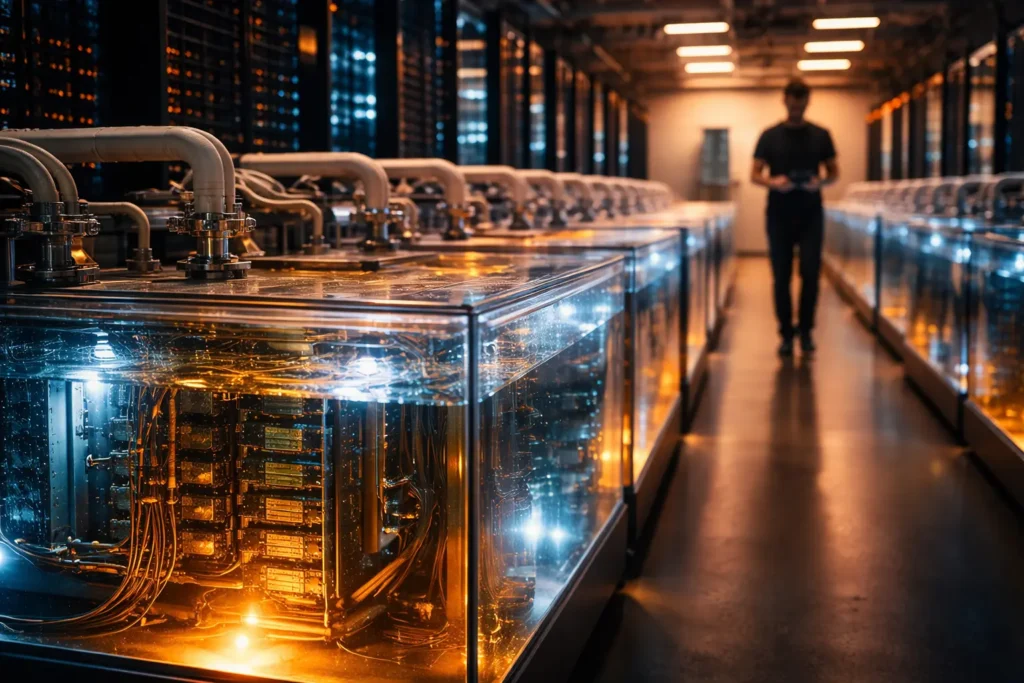
Direct-to-chip liquid cooling routes coolant through cold plates mounted directly on processor surfaces, removing heat at the source before it enters the air dramatically reducing the volume of air, and therefore water, needed for cooling.
Immersion cooling submerges entire server boards in non-conductive dielectric fluid. The fluid absorbs heat directly, eliminating air cooling entirely. The liquid cooling market for data centres grew 60% year-over-year in 2025, driven by the thermal demands of GPU-dense AI clusters.
Closed-loop zero-evaporation systems are the most radical shift. Microsoft is deploying closed-loop, zero-water evaporation cooling eliminating evaporative water and reducing usage by 125 million litres per facility annually. Once filled at construction, the system recirculates coolant continuously. By late 2027, zero-water evaporation is expected to become the standard across Microsoft’s new data centres.
The hard limit of these solutions is speed. The pipeline of new AI infrastructure being commissioned globally hundreds of billions in announced investment across 2024 and 2025 — is outpacing water-efficient cooling adoption significantly. Efficiency per query is improving. Total query volume is growing faster.
The Community Nobody Asked
The water is consumed in Iowa, Virginia, Arizona in places where local residents, farmers, and municipal water systems now share their supply with infrastructure running the world’s AI. They did not vote for it. The data centre arrived, drew permits, and started drawing water.
The general trend across the major companies that disclose water usage shows increasing direct water use each year. Researchers attribute this trend to data centres.
Every query evaporates water. Every model trained evaporates millions of litres. The engineering solutions exist and are genuinely improving. The question is whether they will be deployed at the speed the growth demands or whether the gap between consumption and sustainability commitments will be measured, eventually, in empty reservoirs.
The 519-millilitre figure attached to a ChatGPT response is not a reason to stop using AI. It is a reason to understand that cloud computing has a physical address and that address has a water bill attached to it that the community around it is quietly paying.
📌 Read Also:
- Your ChatGPT Conversation Is Being Used to Train the Next AI — Here’s Exactly How
- Why the US Government Just Banned This Chinese App’s Core Technology
© AiwalaNews | Global Tech & Privacy Edition | April 2026
