
In January 2025, a Chinese AI app called DeepSeek appeared from nowhere and became the most downloaded app in America overnight. It was faster than ChatGPT, free to use, and shockingly capable. Silicon Valley went into a quiet panic. Marc Andreessen called it “AI’s Sputnik moment.”
Within days, the US government started banning it agency by agency, state by state. Not the app. Not the interface. The core technology underneath it.
Here is exactly what they found and why it matters to every American who has ever typed a question into an AI chatbot.
What DeepSeek Actually Is
DeepSeek is an artificial intelligence large language model built by a Chinese company High-Flyer Capital Management and released publicly in January 2025. On the surface, it functions identically to ChatGPT or Google Gemini: you ask questions, it answers intelligently, it writes code, summarises documents, holds conversations.
DeepSeek gained attention in early 2025 when it released a large language model that matched the capabilities of leading platforms like ChatGPT while using a fraction of the computing power.
That efficiency story was the headline. The data story underneath it was something else entirely.
What the Security Researchers Found
Within weeks of DeepSeek’s launch, independent cybersecurity researchers began pulling the app apart. What they found was not typical for a commercial AI product.
A third-party analysis found that DeepSeek’s chatbot app can capture login information and share it with China’s largest state-owned mobile firm China Mobile which has already been banned from operating in the United States.
Research from Feroot Security indicated that DeepSeek’s operations were funnelling American user data back to China via infrastructure linked to China Mobile, characterised as “military-related.”
This was not an accidental data leak. It was hardcoded behaviour deliberately built into the application’s architecture. When you typed a question into DeepSeek, the app was doing something else simultaneously: capturing your keystrokes, login credentials, and device identifiers and routing them through servers with direct ties to the Chinese state.
South Korea’s National Intelligence Service warned that DeepSeek differs from other generative AI platforms by not only storing user chat records but also collecting keyboard input patterns which could potentially identify individuals with data transmitted to Chinese servers.
Why “Stored on Chinese Servers” Is the Critical Line
Most apps store data somewhere. The difference with DeepSeek comes down to one law: China’s National Intelligence Law of 2017.
Under that law, any Chinese company regardless of where it operates is legally required to cooperate with Chinese state intelligence agencies upon request. There is no judicial review. There is no refusal. If Beijing asks a Chinese company for its user data, the company must hand it over.
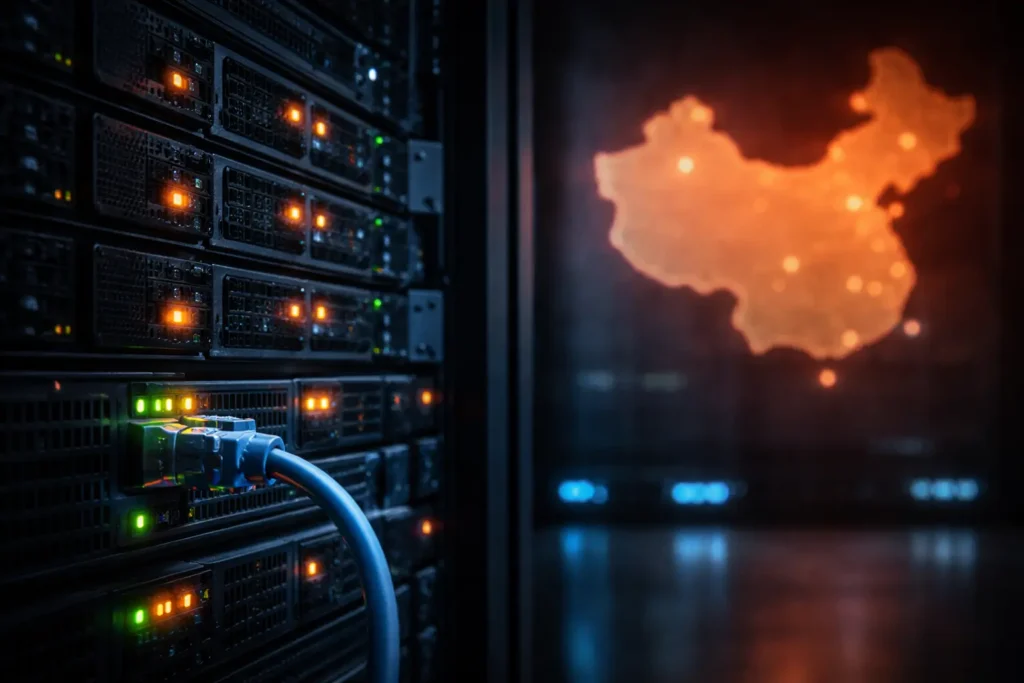
Security experts raised privacy and security concerns about DeepSeek, noting that all data it collects is stored on servers in China, potentially exposing it to surveillance by the Chinese government under that country’s data laws.
This means every document you uploaded, every question you asked, every login you made through DeepSeek was legally and technically accessible to Chinese intelligence. Not theoretically. By design of Chinese law.
The Government Response How Fast It Moved
The speed of the US government’s reaction was unusual. Washington rarely moves fast on technology. On DeepSeek, it moved in weeks.
Several federal agencies, including the Department of Commerce and the Navy, banned the use of DeepSeek on government devices. Multiple states including New York, Tennessee, and Virginia took similar steps.
The Commerce Department sent a mass email to staffers stating: “Do not download, view, or access any applications, desktop apps or websites related to DeepSeek.”
Bipartisan legislation followed immediately. Representatives Darin LaHood and Josh Gottheimer both members of the House Permanent Select Committee on Intelligence — introduced the No DeepSeek on Government Devices Act, saying DeepSeek’s technology presents an espionage risk and that “the national security threat that DeepSeek poses to the United States is alarming.”
A coalition of 21 state attorneys general urged Congress to pass the legislation. As of early 2026, DeepSeek has been banned or restricted by Italy, Australia, Taiwan, South Korea, India, the Czech Republic, and at least 17 US states.

This Is Not Just About One App
The DeepSeek case is the clearest illustration yet of a strategy that US intelligence officials have warned about for years: technology as a collection vector.
The pattern is consistent. A Chinese-owned application offers genuine utility it is fast, free, impressive. It achieves mass adoption before scrutiny arrives. Then researchers find the data pipeline. By that point, hundreds of millions of users have already handed over their behavioural data, documents, and credentials.
A congressional committee labelled DeepSeek “a profound threat” to US national security, stating that the app “siphons data back to the People’s Republic of China, creates security vulnerabilities for its users, and relies on a model that covertly censors and manipulates information.”
TikTok established the template a Chinese-owned platform with enormous US user penetration and unresolved questions about data routing to Beijing. TikTok faced a nationwide ban from January 2025 due to US government concerns over potential user data collection and influence operations by the Chinese government, with the situation only resolving when TikTok’s US operations were divested into a new American-held entity in January 2026.
DeepSeek is the same architecture but instead of videos, the data being harvested is your thoughts, your questions, your private documents, typed directly into a chat interface.
What You Should Actually Do
If DeepSeek is installed on any device personal or professional delete it. The concern is not hypothetical: the data collection infrastructure has been forensically verified by multiple independent security firms.
More broadly, before using any AI tool, check where its data is stored, which country’s laws govern it, and whether those laws include mandatory state intelligence cooperation. That question whose law applies to my data? is now one of the most important questions in consumer technology.
The US government did not ban DeepSeek because it was bad at answering questions. It banned it because it was exceptionally good at answering a different question entirely: who are you, what do you know, and who do you work for?
📌 Read Also:
- Your Deleted WhatsApp Messages Are Not Deleted — Here’s Where They Actually Go
- The Dark Technology Behind Every “Recommended for You” — How Big Tech Controls What You See
© AiwalaNews | Global Tech & Privacy Edition | April 2026
