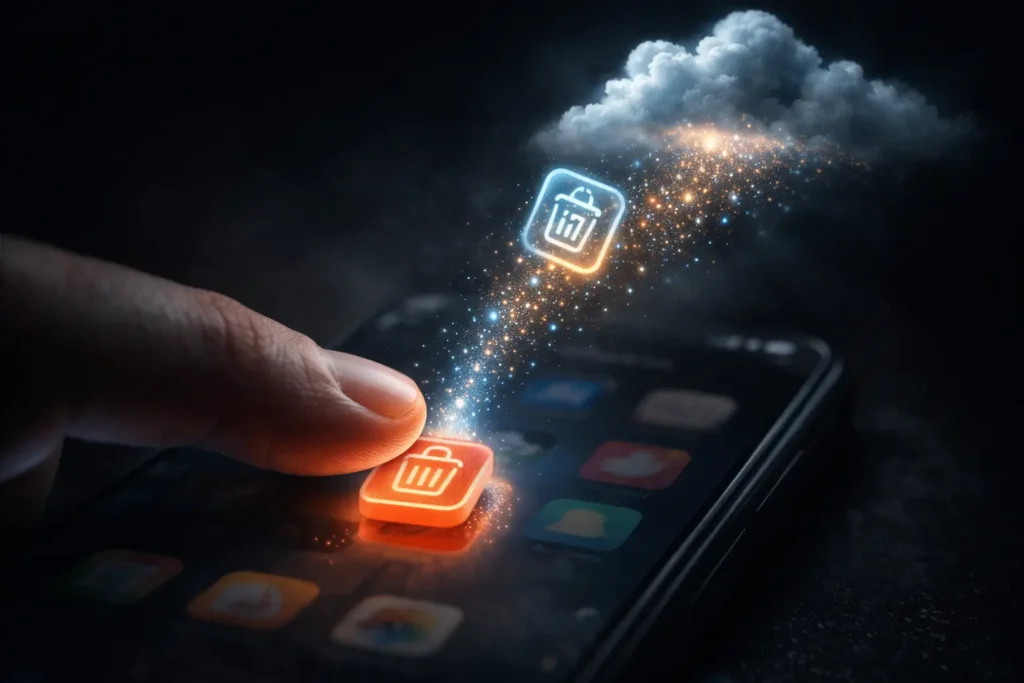
You deleted the app. You felt clean. You felt in control. But somewhere on a server you’ll never see, everything that app ever knew about you is still very much alive. And it’s being used right now.
Deleting an app feels satisfying. One press, a little wobble, and it’s gone. In the US, UK, and India billions of apps get deleted every year by people who believe they just reclaimed their privacy.
They didn’t.
Deleting an app from your phone removes the icon. It removes the software. It does absolutely nothing to the data that app already collected, uploaded, and stored about you.
That data has a life of its own. And where it goes next is something every smartphone user on the planet needs to understand.
What Happens The Moment You Delete
The second you install an app – any app – it begins collecting. Location. Contacts. Browsing patterns. Device ID. Usage habits. Sometimes microphone access. Sometimes camera metadata.
By the time you decide to delete it, that app has already sent everything it collected to remote servers. The deletion happens on your phone. The data lives somewhere else entirely.
Think of it like this. You invited someone into your home, they memorised everything they saw, and then you asked them to leave. They left. But they kept the notes.

Where Your Data Actually Goes
Cloud servers indefinitely.
Most apps store user data on third-party cloud infrastructure Amazon Web Services, Google Cloud, Microsoft Azure. When you delete the app, the company’s obligation to remove your data from those servers depends entirely on their privacy policy a document almost nobody reads.
Some companies delete your data within 30 days of account deletion. Others retain it for “legitimate business purposes” for up to 7 years. Some never delete it at all.
Data brokers within hours.
Many free apps games, weather tools, flashlight apps, fitness trackers exist specifically to collect and sell user data. Their business model was never the app itself. The app was the trap. Your data was always the product.
Within hours of collection, that data is packaged and sold to data brokers companies like Acxiom, Experian, and LexisNexis who build detailed consumer profiles and sell them to insurers, employers, advertisers, and political campaigns.
In India, where data broker regulation is almost nonexistent, this market operates largely in the shadows. In the UK and US, it is a multi-billion dollar industry operating entirely legally.
Advertising ecosystems permanently.
Once your behavioural data enters the advertising ecosystem, it is nearly impossible to remove. It gets copied, resold, merged with other datasets, and referenced indefinitely. The specific app you deleted becomes irrelevant. Your data profile lives on across hundreds of systems you will never interact with directly.

The Apps Most People Never Suspect
It’s not just the obvious ones social media, dating apps, shopping platforms. The most aggressive data collectors are often the ones you’d never think twice about.
Free VPNs – ironically, many free VPN apps log and sell your browsing data. The very tool people use for privacy is often the biggest violation of it.
Keyboard apps – third-party keyboard apps have access to everything you type. Every password. Every private message. Every search. Several popular keyboard apps have been caught transmitting keystroke data to overseas servers.
Kids’ games – in the US and UK, multiple children’s gaming apps have been fined for collecting data on minors. In India, this space is almost entirely unregulated.
Period and health tracking apps – following the overturning of Roe v. Wade in the US, period tracking app data became a serious legal concern. Health data you entered privately has been shared with third parties in ways users never anticipated.
What You Can Do Right Now
Delete the account before the app. Most people delete the app but leave the account active. The account is where the data lives. Go into settings, find account deletion, and remove it properly before uninstalling.
Check app permissions before installing both iOS and Android now show what data each app requests. If a flashlight app wants your contacts and location that is a red flag, not a coincidence.
In the UK and EU, exercise your Right to Erasure under GDPR. Email the company directly requesting complete deletion of your personal data. They are legally required to comply within 30 days.
In the US, use your CCPA rights if you’re in California you can request data deletion and opt out of data sales. For other states, check whether your state has passed its own privacy legislation.
In India, the Digital Personal Data Protection Act now gives users the right to request data erasure. Most companies are not advertising this right. You have to claim it.
Use justdeleteme.com a directory that rates how easy or difficult it is to delete accounts from hundreds of popular services. If a service is rated “hard” or “impossible” that tells you everything about their data intentions.
The Uncomfortable Reality
The app economy was built on a simple lie that free means free.
It never did. Every free app, every free service, every free tool extracted payment in the only currency that matters in the digital age. Your data. Your behaviour. Your identity.
Deleting the app was never going to be enough.
Because they never needed the app to keep your data. They just needed you to install it once.
Know your rights. Claim them. Your data doesn’t have to live forever.
© AiwalaNews | Global Tech & Privacy Edition | April 2026
