
You didn’t tell Google you were anxious, lonely, or struggling financially. You didn’t have to. It already knew. And it knew before you did.
Every day, 8.5 billion searches are made on Google. In the US, UK, India, and across the globe, people type their most private thoughts into that search bar with a strange sense of safety as if the box is somehow confidential.
It is the least confidential thing you own.
What Google has built over the past 25 years is not a search engine. It is the most advanced human behaviour prediction system ever created. And right now, it knows things about you that you haven’t consciously admitted to yourself.
Here’s how deep it actually goes.
The Search Bar Is a Confessional
Think about what you type into Google that you’d never say out loud.
“Am I depressed or just tired” “How to know if my marriage is over” “Why do I feel empty” “How much debt is too much”
These are not searches. These are confessions. And Google stores every single one timestamped, location-tagged, and connected to your identity through your Google account, your device ID, or your IP address.
The search bar is the most honest place most people ever speak. Google has 25 years of that honesty archived, analysed, and actively monetised.
How Google Actually Predicts Your Behaviour
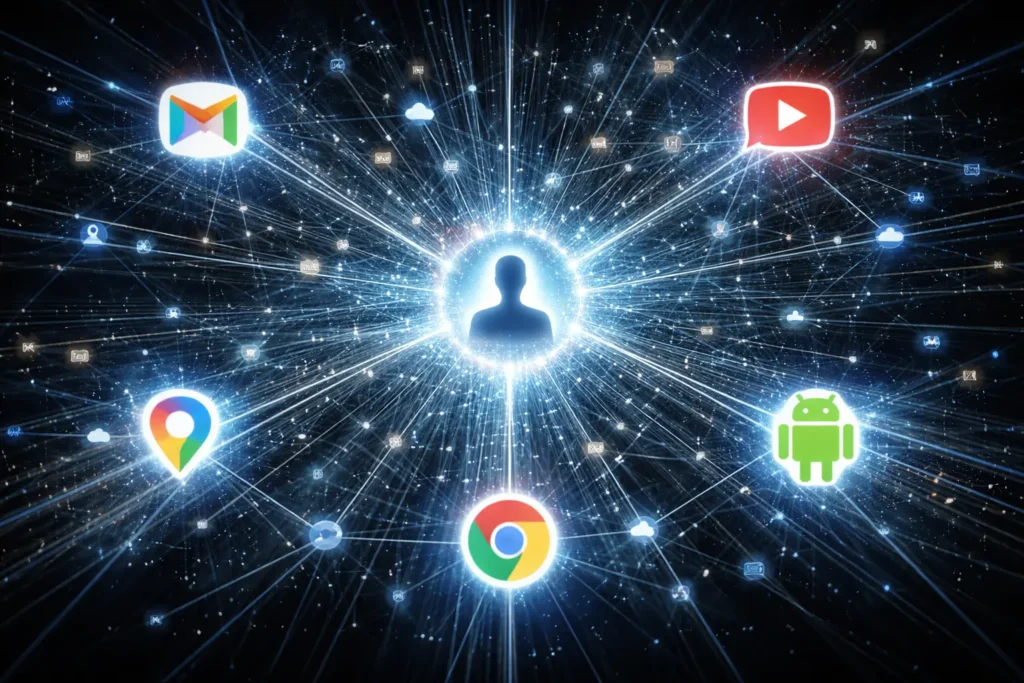
Google’s prediction engine works across seven interconnected systems simultaneously.
Search tells Google what you’re thinking. YouTube tells it what emotions you respond to. Gmail tells it who you communicate with and what about. Google Maps tells it where you go, how often, and at what hours. Chrome tells it every website you visit. Android tells it your physical movements, app usage, and even your sleep patterns if you use Google Fit.
Together, these seven systems build a profile so complete that Google’s advertising algorithm can predict a purchase decision up to 3 weeks before you make it.
This is not speculation. Google holds patents on predictive behavioural technology that explicitly describes using cross-platform data to anticipate user intent before it becomes conscious decision-making.
They patented mind-reading. They just didn’t call it that.
The Moment Google Knew You Better Than You Know Yourself
In 2023, a landmark study revealed that Google’s health-related search patterns could predict clinical depression with 85% accuracy weeks before a user sought professional help.
In 2024, researchers found that Google Search data could identify financial distress signals in users up to a month before they applied for loans or searched for debt advice directly.
In India, where Google has over 500 million users and is often the first and only digital touchpoint for millions of people, this data represents an unprecedented map of human vulnerability across an entire nation.
In the UK, Google’s DeepMind division is actively working with NHS data meaning the world’s most powerful data company has a growing window into the health behaviour of an entire country’s population.
In the US, Google’s advertising revenues crossed $237 billion in 2024. Every dollar of that was funded by behavioural prediction built on user data.

What Google Does With What It Knows
The data doesn’t just serve ads. It shapes what you see, what you believe, and what you decide.
Google’s search results are not neutral. They are personalised to your profile. Two people searching the same thing in the same city at the same time can receive meaningfully different results shaped by their individual behavioural histories.
This means Google is not just reading your mind. It is quietly influencing it.
What information you encounter first, which businesses appear at the top, which news stories surface all of it is filtered through a profile Google built about you without your meaningful consent.
What You Can Do Right Now
Delete your Search and YouTube history regularly go to myactivity.google.com and set auto-delete to 3 months maximum. This limits how deep the behavioural archive goes.
Turn off personalised ads go to myaccount.google.com → Data & Privacy → Ad Settings. Switching this off breaks the direct line between your behaviour and ad targeting.
Use alternative search engines for sensitive queries DuckDuckGo and Brave Search do not build user profiles or store search history. Use Google for directions. Use DuckDuckGo for everything personal.
Review your Google account data go to myaccount.google.com → Data & Privacy → My Activity. What you see will surprise you. Most people have no idea how comprehensive the record is.
In the UK and EU, request a data export under GDPR you are entitled to see everything Google holds. In India, use the DPDP Act to submit data access and deletion requests directly to Google India.
The Bigger Truth
Google’s technology is not malicious in the way a villain is malicious. It is indifferent which is somehow worse.
It doesn’t care about your anxiety, your marriage, your debt, or your loneliness. It cares about the advertising value those signals represent. Your most vulnerable moments are simply the most profitable data points in its system.
You have been searchingfreely for years, believing privacy was implied.
It was never implied. It was never offered. And it was never yours unless you claimed it.
The mind-reading technology is real. It has been real for years.
The only question now is whether you’re going to do something about it.
Your data is yours. Start acting like it.
© AiwalaNews | Global Tech & Privacy Edition | April 2026
