The Question Everyone Is Actually Asking
My neighbor in rural Kentucky hadn’t had real internet for eleven years. Not slow internet. Not bad internet. No internet just a mobile hotspot that died every time it rained hard. Then she got Starlink. Three months later, her daughter was taking online college classes from the kitchen table.
That story doesn’t make headlines. But it’s the real story behind the Starlink vs. 5G debate that tech writers keep framing as a speed competition. This isn’t just about megabits. It’s about who gets access, who gets left behind, and which technology is actually prepared to replace the home internet setup most Americans have tolerated not loved for decades.
So let’s talk about it honestly.
Speed: The Number That Wins Arguments But Misses the Point
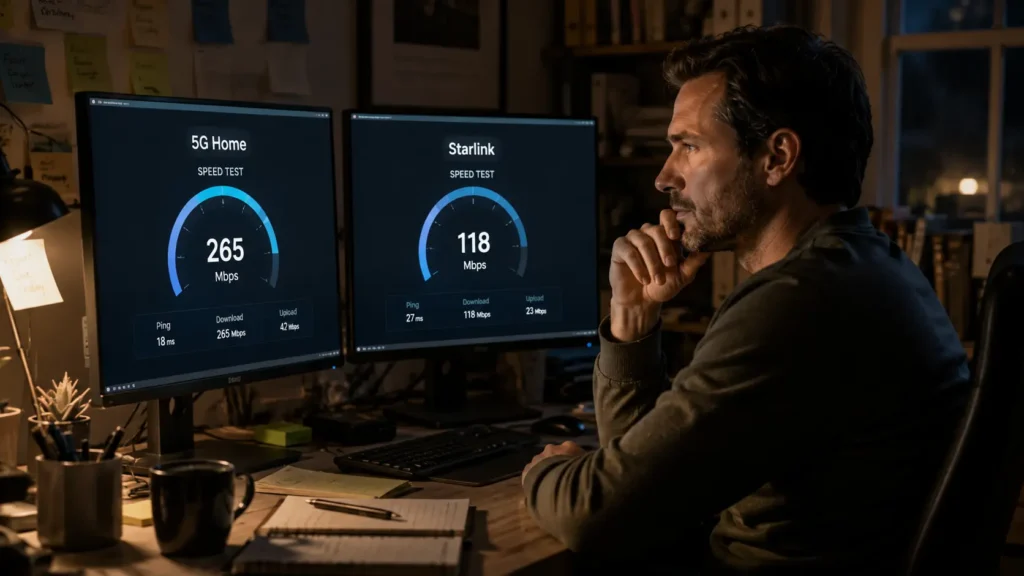
In a clean, controlled test where both signals are strong, 5G home internet is faster. T-Mobile’s midband 5G delivers a consistent 150–300 Mbps in well-served areas. Verizon’s ultra-wideband network, available in select dense urban zones, can push past 1,000 Mbps. These are real numbers. They’re impressive.
Starlink, meanwhile, promises up to 400 Mbps on its residential plan but delivers 80–150 Mbps for most US users in real-world conditions. That’s not a knock it’s still vastly better than anything satellite internet offered five years ago. But it’s not winning any speed trophies against solid 5G mid-band coverage.
Upload speed is the quiet weakness on both sides. Starlink users routinely see 5–20 Mbps upload, which becomes noticeable fast if you’re video calling all morning or sending large files. 5G is somewhat better, but neither technology is designed for heavy symmetric traffic.
Latency, though that’s where Starlink surprised everyone. Old satellite internet meant 600+ millisecond delays that made video calls feel like walkie-talkies. Starlink’s low-Earth-orbit architecture now sits at 25–60ms, which handles gaming, Zoom calls, and streaming without drama. 5G delivers 15–30ms. The gap exists, but it stopped mattering for most households.

Coverage: Where the Whole Debate Flips
This is the section that makes 5G marketers uncomfortable.
T-Mobile’s national coverage map looks extraordinary until you actually zoom in on it. The version of 5G that delivers real speed midband 5G is concentrated along suburban corridors, near population centers, and in areas that already had decent internet options. Addresses just a few miles outside those zones frequently fall back onto 4G LTE, which delivers a genuinely different experience: 25–50 Mbps on a good day, inconsistent on a bad one. T-Mobile doesn’t always advertise which connection type your address will receive before you sign up.
Starlink doesn’t have a fallback tier. If you can see sky, you have internet. Consistent, usable, broadband-class internet. In rural Wyoming, central Nebraska, across Appalachia, deep into the agricultural Midwest Starlink is the only real broadband millions of American households have ever seen. The FCC estimates roughly 21 million US households remain underserved. Starlink is already inside many of them.
That isn’t a niche advantage. That’s a structural one.
The Cost Conversation Nobody Wants to Have Straight
5G home internet is roughly half the monthly price of Starlink. T-Mobile runs $50–65/month with a free gateway and no annual contract. Starlink runs around $120/month with a one-time equipment cost of $349–$599 for the dish. On paper, that comparison looks brutal for Starlink.
But cost comparisons only mean something when both options actually exist for you. If you live somewhere 5G doesn’t reach which is most of rural and exurban America the alternative to Starlink isn’t 5G at $60/month. It’s legacy satellite internet, degraded DSL, or nothing at all. In that context, $120 a month for genuine broadband isn’t expensive. It’s the first real option you’ve ever had.
For urban and suburban users where midband 5G is confirmed and strong? Take the cheaper option. The math is simple and it favors 5G clearly.

The Coming Disruption: Starlink V3 Changes the Equation
Here’s what makes this conversation more complicated than a 2026 snapshot: SpaceX’s V3 satellite generation is beginning deployment this year via Starship, and the performance jump is genuinely significant. Each Starship launch adds roughly 60 terabits per second of new network capacity about 20 times more than a typical Falcon 9 mission. V3 satellites orbit lower, which cuts latency further. And V3 Direct-to-Cell variants are being built to deliver actual 5G-class connectivity from orbit.
Starlink isn’t just competing with terrestrial 5G. It’s building a space-based version of it.
That changes the three-year outlook considerably. A technology that today dominates rural America could become a legitimate speed competitor in suburban markets by 2028. The incumbents Comcast, Charter, AT&T fiber are watching this closely, and they should be.
So Who Actually Wins?
Neither technology is replacing cable in Boston or Los Angeles next year. The big incumbents have too much infrastructure, too many locked-in customers, and too much pricing power in dense markets to be quickly displaced.
But for the roughly 1-in-6 American households that cable and fiber have simply never reached? Starlink has already won. It happened without a product launch event or a press cycle. It happened because someone in rural Kentucky finally had internet that worked.
For the rest of America the suburban middle ground between cities and countryside 5G home internet is the smarter, cheaper, faster choice today, and it will only get stronger as midband towers multiply over the next few years.
The real answer was never about which technology is objectively better. It was always about which one works at your specific address. Look up your coverage. Do the math. And if you’re still waiting for fiber that was promised to your county in 2014 it’s time to stop waiting.
📖 Read Also:
- What Happens Inside a Data Center When You Hit “Send” on an Email
- How Google Decides What Shows Up First in Search – The Algorithm Nobody Fully Understands
© AiwalaNews | Global Tech & Privacy Edition | April 2026
