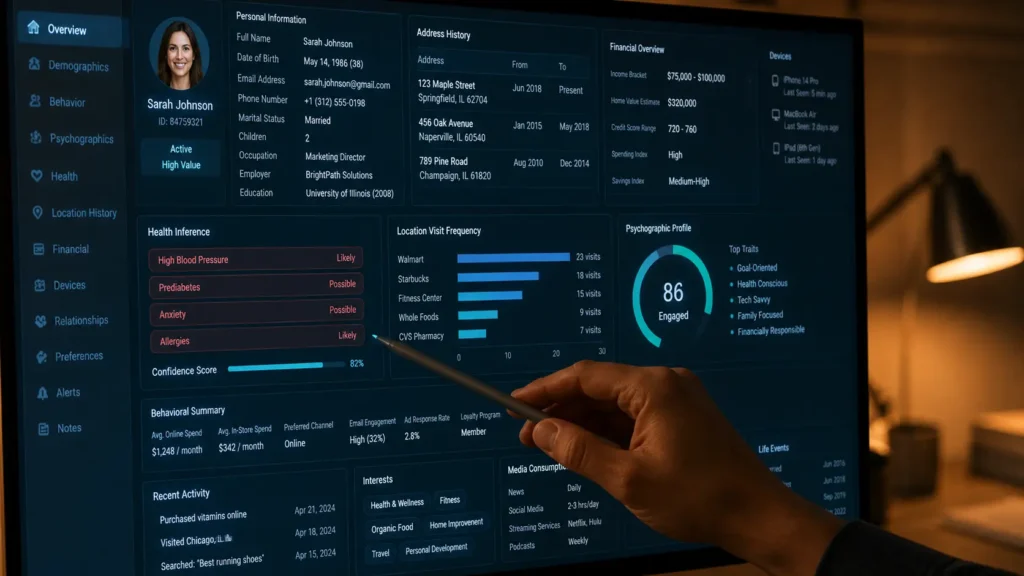
Somewhere in a database you have never seen, your home address sits next to your estimated annual income, your political affiliation, your health condition inferences, and a predictive score rating how likely you are to respond to certain types of advertising.
You did not give anyone this information. You signed no contract. You received no payment.
And every single part of it is completely legal.
This is the data broker industry a $317 billion ecosystem operating largely in the open, almost entirely without public awareness, and with minimal federal regulation. The companies involved are publicly traded, employ thousands, and count Fortune 500 corporations, political campaigns, law enforcement agencies, and foreign entities among their paying clients.
What Is a Data Broker and How Did They Get Your Information?
A data broker is a company whose business is collecting personal information about individuals, aggregating it into detailed profiles, and selling access to those profiles to paying clients.
They did not hack you. They did not need to.
Your data reached them through entirely legal transactions rooted in your own daily behavior. Every time you fill out a warranty card, use a loyalty program, make an online purchase, register to vote, or use a free app you generate a data record. Under the terms of service you agreed to, that record can be sold or shared with third parties.
Those third parties are data brokers. Acxiom maintains profiles on over 700 million people globally with an average of 1,500 data points per person. Spokeo, BeenVerified, and Intelius sell individual profile lookups directly to the public for a few dollars per search. These are not fringe operations they are mainstream, profitable American corporations.
What They Actually Know About You
The categories of data collected and sold are far more intimate than most Americans assume.
Identity and household data includes your full legal name, current and historical addresses, phone numbers, email addresses, household composition, and names and ages of family members enough to locate any American within hours.
Financial data covers estimated household income, net worth brackets, credit score ranges, bankruptcy history, property records, and spending behavior patterns inferred from purchase data.
Health inferences are among the most sensitive categories. Brokers infer health conditions from purchase behavior buying diabetes supplies, specific supplements, or mobility aids and sell condition-likelihood scores to pharmaceutical companies and insurance underwriters. These inferences are not medical records and fall entirely outside HIPAA protection.
Location history is built from mobile device data purchased from app developers. Six months of your location data can identify your home, workplace, doctor’s office, place of worship, and children’s school all without a warrant, all without your knowledge.
Psychographic profiles include inferred political affiliation, religious beliefs, and emotional vulnerability scores proprietary metrics rating how susceptible you are to specific types of persuasion, sold directly to political campaigns and advertisers.
Who Buys This Data
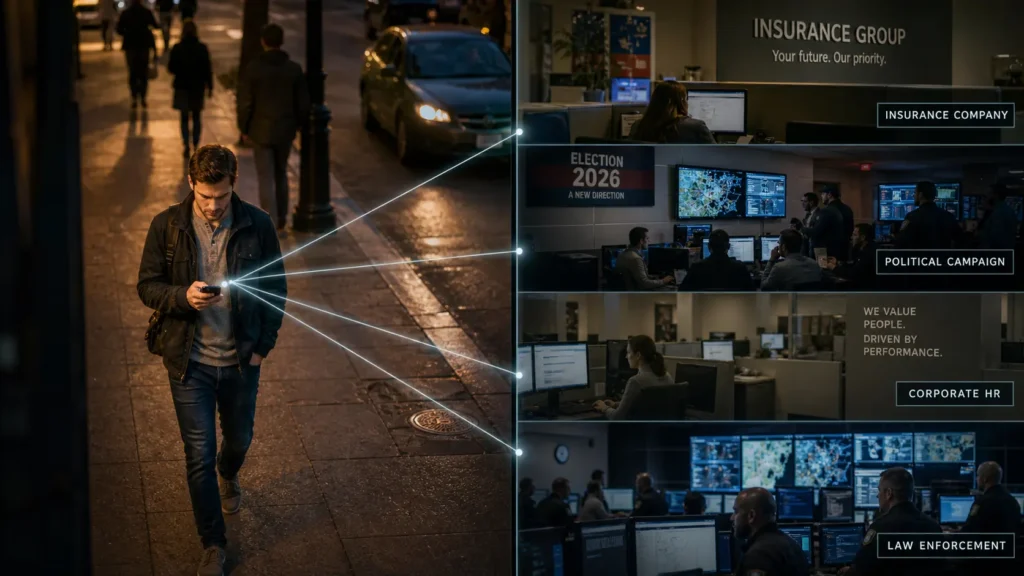
The client list spans virtually every sector of the American economy.
Advertisers are the largest buyers by volume. When an ad follows you across every website after a single search, data broker profiles are almost always the mechanism behind it.
Insurance companies purchase lifestyle and behavioral data to refine risk assessments legally, in most US states. Your daily routine, inferred health behaviors, and financial stress indicators can influence what you pay for coverage. The fitness app you use for free may be quietly contributing to your next insurance premium.
Law enforcement agencies at federal, state, and local levels purchase location data as a constitutional workaround. Because data was voluntarily shared with commercial third parties, courts have in many cases ruled no warrant is required to simply purchase it.
Political campaigns and foreign entities buy psychographic profiles to identify persuadable voters and engineer targeted messaging. The 2016 Cambridge Analytica scandal was a public exposure of a practice that remains widespread and largely legal today.

The Law That Is Supposed to Stop This and Doesn’t
The United States has no comprehensive federal data privacy law.
Unlike the EU’s GDPR, which grants citizens rights to access, correct, and delete their personal data, American consumers operate under a fragmented patchwork riddled with gaps. HIPAA protects medical records not health inferences from purchase behavior. FCRA regulates credit bureaus in certain contexts not the same data sold for non-credit purposes.
At the state level, California’s CCPA gives residents the right to opt out of data sales and request deletion. Virginia, Colorado, Texas, and Oregon have passed similar laws. The remaining states offer minimal to no protection.
Between 2019 and 2023, the data industry spent over $400 million on federal lobbying much of it directed at slowing comprehensive federal privacy legislation. The American Data Privacy and Protection Act (ADPPA) has been introduced and stalled multiple times.
How to Remove Yourself Right Now
Complete removal is not currently possible. But meaningful reduction is achievable.
Submit opt-out requests directly to Acxiom, Spokeo, WhitePages, BeenVerified, and LexisNexis all have opt-out processes, deliberately cumbersome but functional. Services like DeleteMe and Privacy Bee automate this for a monthly fee.
Audit your loyalty programs. Grocery and pharmacy loyalty cards are among the richest data sources feeding broker pipelines. The discount rarely justifies the exchange.
Freeze your credit with Equifax, Experian, and TransUnion. It does not stop data brokers entirely but it limits access to your most sensitive financial profile data.
Contact your state representative. If you live outside California, Virginia, or Colorado, your data has almost no legal protection. Constituent pressure is the most direct mechanism available to change that.
The data broker industry is not a secret. Its largest players publish annual reports and sponsor industry conferences. What remains secret by design is the individual transaction: the moment your home address, income estimate, health inferences, and daily routine change hands for a price you never negotiated and a purpose you never approved.
You are already in their database. You have been for years.
The only question is what you do with that knowledge now.
Read also: 🔗 Why “Free” Apps Are the Most Expensive Thing on Your Phone — AIwala News
🔗 The 6 Apps on Your Phone Selling Your Location While You Sleep — AIwala News
© AiwalaNews | Global Tech & Privacy Edition | April 2026
