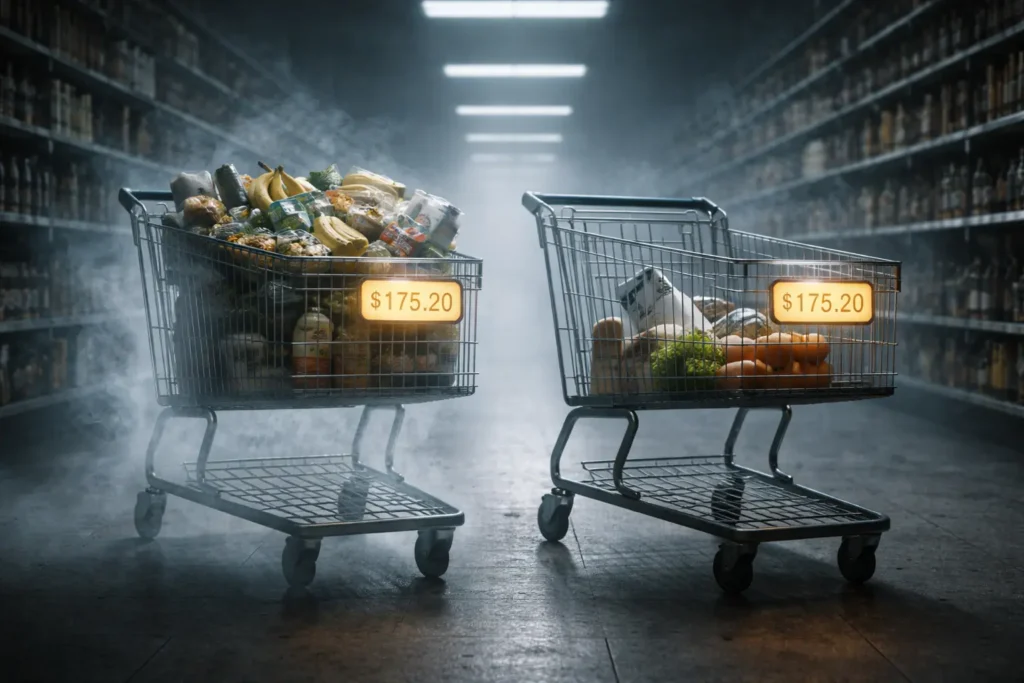
The headlines say inflation is cooling. Your grocery bill disagrees. You’re not imagining it and you’re not alone.
The Word Nobody Is Saying Out Loud
There’s a concept economists rarely explain in plain language: price stickiness.
When inflation rises, companies raise prices fast. When inflation falls? Prices don’t come back down. They plateau. They stabilize. They stick.
Inflation being “down” means the rate of increase has slowed not that prices reversed. Think of it like this: the mountain was climbed. Inflation cooling means we stopped climbing. We didn’t come back down. You are still standing at altitude, paying summit prices, while the news celebrates that we’ve stopped going higher.
That’s not a recovery. That’s just a pause.
The Number Behind the Feeling
Since 2020, cumulative price increases tell the story no monthly report captures:
- Groceries – up 25–30% cumulatively across the USA, UK, and India
- Rent – up 20 – 40% in major cities globally
- Dining Out – up 35%+ in the US alone
- Energy & Utilities – still 30 – 40% above pre-pandemic levels
- Healthcare – quietly compounding at 5 – 8% every year, unreported
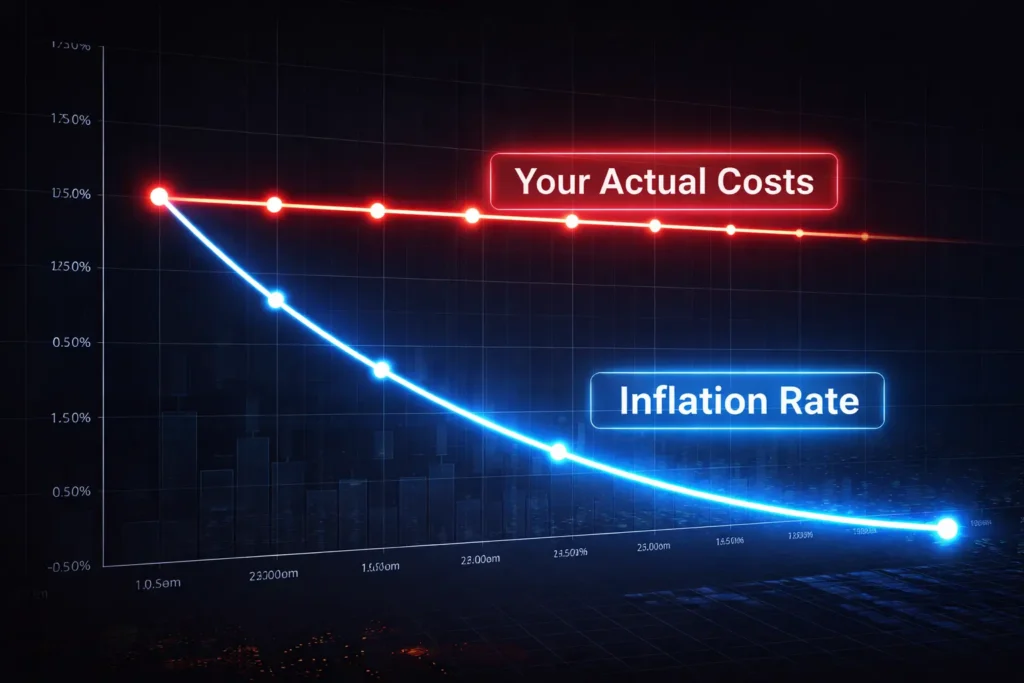
The official inflation rate measures how fast prices are rising right now. It does not measure how much more expensive life has become in total. These are two completely different things and that gap is exactly why the economic narrative and real human experience feel so disconnected right now.
“Inflation is not a price level. It’s a rate of change. When it falls, the damage is already done and it doesn’t undo itself.”
You’re Not Bad at Economics. You’re Just Remembering Correctly.
Purchasing power memory is why this hurts so specifically. Your brain benchmarks prices against what they used to be not against what inflation metrics suggest they “should” be. When eggs cost $1.50 in 2019 and $3.80 today, your nervous system registers that gap every single time.
The fact that egg prices rose “only 2% last month” is neurologically irrelevant to that feeling. You are correctly remembering the baseline and correctly noticing that nobody gave it back.
You are not being irrational. You are not anxious. You are doing accurate math.
The Shrinkflation Trap
Here’s the move that made inflation’s real impact even harder to see: shrinkflation.
Same packaging. Same shelf position. Same brand. Less product.
Your chocolate bar lost 15% of its weight. Your bag of chips is now 30% air. Your “family size” quietly became “large size.” Shrinkflation is stealth inflation it doesn’t show up cleanly in official calculations, doesn’t generate headlines, but compounds silently on top of everything else.
A 2023 study found over 2,500 UK supermarket products had their sizes reduced in two years while prices held or rose. And during this same period? Corporate profit margins hit record highs.
That’s not coincidence. That’s the other word people are finally starting to use: Greedflation.
The Wage Illusion
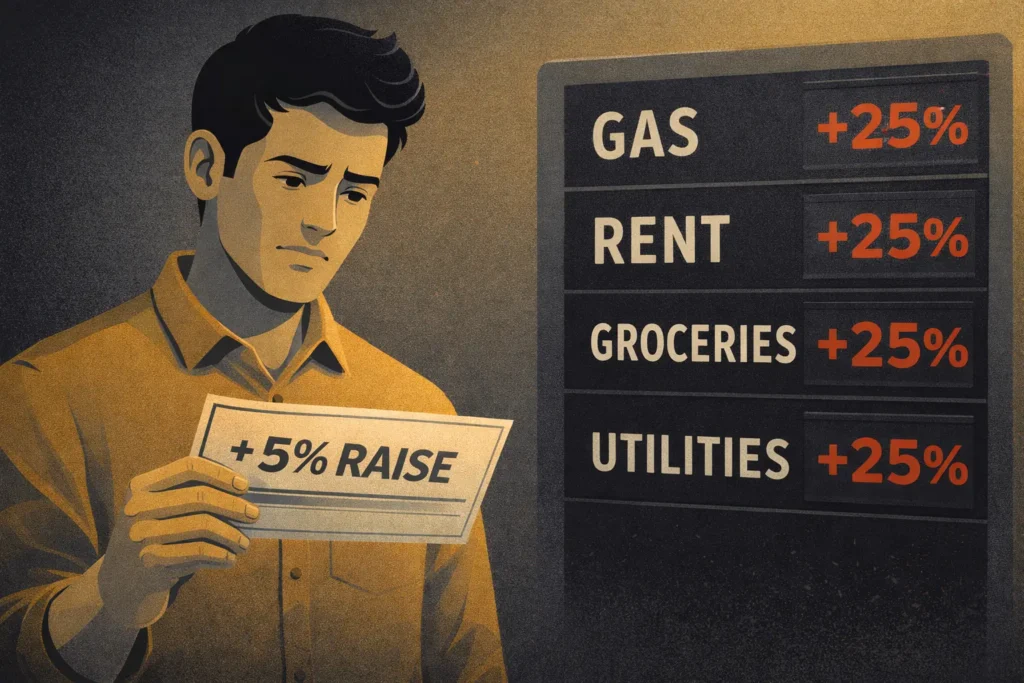
Many workers received raises over the past two years. A 5% raise sounds meaningful. But real wage growth measured against cumulative inflation, not just the annual rate — tells a different story.
When prices rose 25–30% cumulatively and wages rose 8 – 12% over the same period, the math produces a net purchasing power loss disguised as progress.
You earned more. You can buy less. And you’re supposed to feel grateful for the raise.
This is what economists keep calling a “consumer sentiment disconnect.” It isn’t a disconnect. It is clarity. Ordinary people are comparing what their income actually buys today versus three years ago and arriving at an accurate conclusion.
What’s Really Happening
The honest picture: inflation as a rate is genuinely cooling. Central banks in the US, UK, and India have made real progress slowing the pace of increases. That part of the headline is true.
But the price reset from 2020–2023 is permanent for most categories. The prices you paid in 2019 are not coming back. Policy tools are not designed to reverse that shift they are designed to prevent it from going further.
Cost of living pressure is structural now, not cyclical. It will not resolve when inflation hits 2% on a monthly report. It requires wage growth that genuinely outpaces cumulative price increases over years a slow, uneven process that benefits higher earners first and lowest-income households last.
What You Can Actually Do
Stop benchmarking against 2019. That baseline is gone. The sooner your financial planning accepts the new floor, the more clearly you can optimize within it.
Watch real wages, not nominal wages. When evaluating a raise or job offer, measure it against cumulative inflation in your specific cost categories your rent, food, commute, healthcare. Build your own personal inflation rate and negotiate against that number.
Use unit pricing. Price per gram, per ounce, per sheet not package price is the only honest comparison in a shrinkflation environment. Most UK and US supermarkets are legally required to display it. Use it every time.
And demand that the public conversation shift from rate to level. Inflation at 2% on top of 25% cumulative increases is not the same as 2% on a stable baseline. Anyone presenting them as equivalent is either confused or hoping you are.
