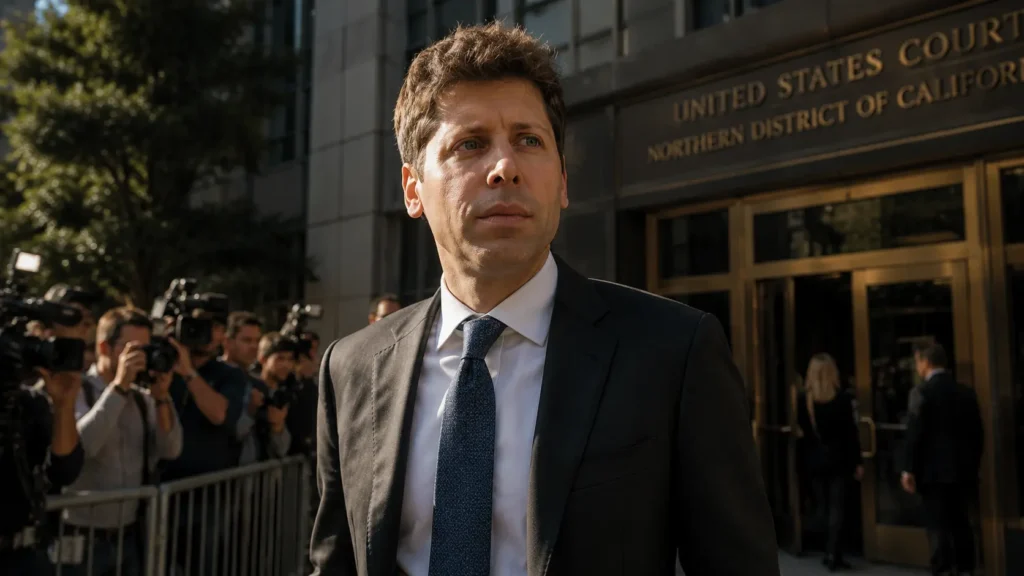
There are power moves, and then there are moments the kind that define entire industries for years to come. What happened between Sam Altman and Elon Musk over OpenAI wasn’t just a boardroom disagreement. It was a collision between two of the most consequential minds in tech, playing out in courtrooms, on social media, and in the global conversation about who gets to shape the future of artificial intelligence.
And right now, Altman is making very clear: that future is not for sale.
The Bid That Shook Silicon Valley
It started with a number that made headlines across every major tech publication: $97.4 billion. That’s what a consortium of investors, led by Elon Musk, reportedly offered to acquire the nonprofit entity that controls OpenAI. On paper, it looked like a serious play. In reality, it landed like a provocation.
Sam Altman’s response was blunt and immediate. Speaking to Reuters on the sidelines of an AI summit in Paris, he dismissed the offer entirely. “I have nothing to say. I mean, it’s ridiculous,” he said. He added, “The company is not for sale. It’s another one of his tactics to try to mess with us.”
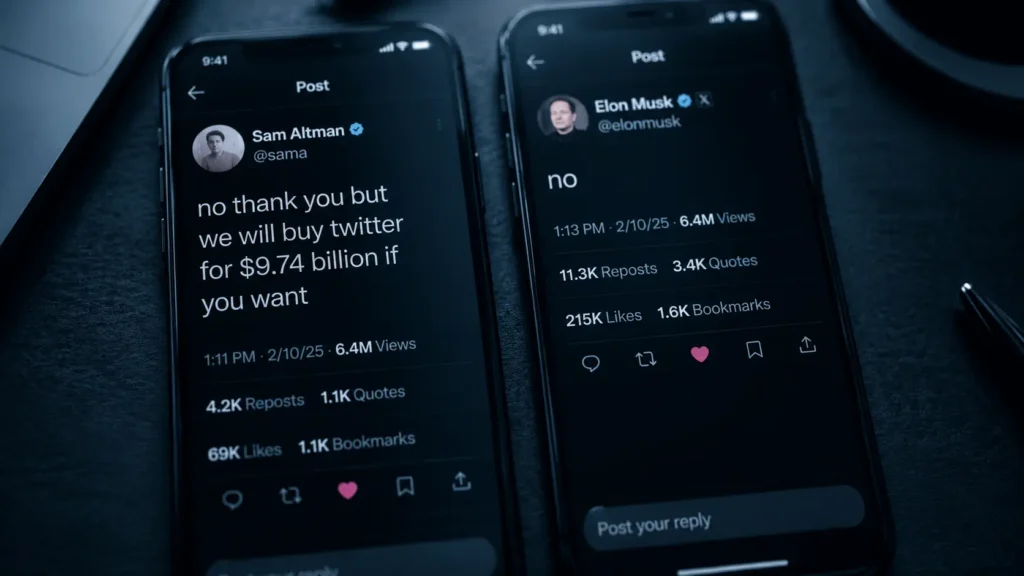
But Altman didn’t stop there. His reply on social media was even sharper and became one of the most-talked-about posts in Silicon Valley in months. He wrote: “No thank you, but we will buy Twitter for $9.74 billion if you want.” Musk’s response? A single word: “Swindler.”
The exchange said everything you need to know about where these two men stand.
A Rivalry With Deep Roots
To understand why this bid landed the way it did, you have to go back to the beginning. Musk co-founded OpenAI with Altman in 2015 as a nonprofit. He later parted ways with the company before its rise to prominence, and in 2023 launched his own AI venture, xAI.
Since then, the relationship between the two has deteriorated into what can only be described as a full-scale war. Musk filed a lawsuit in 2024 accusing Altman, OpenAI, Greg Brockman, and Microsoft of betraying OpenAI’s nonprofit mission. He has sought $150 billion in damages.
The crux of Musk’s case revolves around Altman’s decision to attach a for-profit company to OpenAI after Musk left, and then raise billions of dollars from investors — a decision that helped set off the global AI boom with the launch of ChatGPT. Musk has called it, plainly, stealing.
“It is not OK to steal a charity,” Musk said during his first day on the stand in the ongoing Oakland trial.
Altman Fights Back In Court and In Public
The trial, now in its third week as of May 2026, has ripped back the curtain on years of private text messages, board room power struggles, and billion-dollar decisions made in real time.
On the stand, Altman testified that the co-founders felt no single person should control AGI artificial general intelligence and that Musk was not a good fit for the company. Musk left the board in 2018, and Altman described that departure as a morale boost for employees who did not like his “hardcore” approach.
Perhaps the most damaging revelation to come out of Altman’s testimony was about Musk’s own ambitions inside OpenAI. Altman testified that Musk wanted complete control of the company and had pushed for it to become part of Tesla before leaving the startup he helped found.
Altman further testified that after Musk failed to convince OpenAI to give him a controlling stake in a for-profit subsidiary, the Tesla CEO ultimately walked away.
This directly contradicts the narrative Musk has tried to build that he was simply the conscience of the company, the man trying to keep AI safe and open. Earlier in the trial, Musk offered a competing narrative, casting himself as the defender of OpenAI’s original safety mission. But Altman’s testimony, backed by private communications, paints a very different picture.
The $97.4 Billion Question
So why did Musk even make the bid? Altman was direct: he called the bid “an attempt to slow OpenAI down,” noting that Musk “obviously is a competitor” who has raised significant money for xAI and is trying to compete technologically.
The acquisition attempt came as OpenAI was seeking a $40 billion investment round sponsored by SoftBank, which could value the company at up to $300 billion. Injecting a hostile takeover bid into that process wasn’t accidental it was designed to create chaos and uncertainty for investors.
The trial comes as OpenAI prepares for a potential IPO that could see it valued at $1 trillion a historically large sum. With those kinds of stakes on the table, every legal maneuver, every public statement, every leaked text message becomes a weapon.
What This Moment Actually Means
Strip away the legal drama, the social media one-liners, and the courtroom theatrics, and what you’re left with is a fundamental disagreement about something real: who owns the future of AI, and who gets to decide how it’s built?
Altman argued that Musk knew of the plans to develop OpenAI into a for-profit enterprise when he invested, and asserted that the company’s pivot was not a betrayal but a necessary evolution.
Altman has emphasized that OpenAI’s mission is not for sale and criticized Musk’s approach as that of a competitor who cannot win in the market.
For now, the jury is still out literally. But what’s already clear is that Sam Altman has no intention of backing down, selling up, or softening his stance. He built something that changed the world. He’s not handing it over.
Not for $97.4 billion. Not for any number.
© AiwalaNews | Global Tech & Privacy Edition | April 2026
Read Also:
- 🔗 The AI Power Wars: Who Really Controls the Future of ChatGPT?
- 🔗 OpenAI’s For-Profit Shift: Everything You Need to Know
