
Excerpt: Three years ago, America owned AI. Today, the gap is 2.7%. What happened and what comes next should keep every world leader up at night.
For years, the comfortable story went something like this: America builds the frontier. China copies it. The United States leads in artificial intelligence, and that lead is wide enough that the rest of the world needn’t worry too much about who’s catching up or how fast.
That story is over.
According to Stanford University’s 2026 AI Index, the US spent 23 times more than China on private AI investment last year $285.9 billion versus $12.4 billion and yet the performance gap between the best American and Chinese AI models has shrunk to just 2.7 percentage points. In May 2023, that gap sat somewhere between 17.5 and 31.6 points. Three years and hundreds of billions of dollars later, it’s almost gone.
Let that sink in for a moment. The world’s most heavily funded technology competition, backed by the full weight of American private capital, has been nearly closed by a country that’s been systematically cut off from the world’s best chips. That’s not just a data point. That’s a warning.
How We Got Here
The turning point has a name: DeepSeek.
In January 2025, DeepSeek a new and relatively unknown Chinese lab released a large language model called R1, reportedly trained with less powerful chips and at a fraction of the cost of Western models. The AI world didn’t know what to hit it. Here was a Chinese lab, operating under export restrictions, producing results that rivaled OpenAI. Not just competitive embarrassingly competitive.
DeepSeek wasn’t alone. Alibaba’s Qwen family tells an equally striking story. With 942 million total downloads as of March 2026 more than double the combined downloads of the next eight competitors Qwen has become the default open-source foundation for developers across Asia and the Global South. Qwen3.5 is up to eight times faster and 60% cheaper than its predecessor.
China also produced 30 notable AI model releases in 2025, second only to the US with 50. No other country came close South Korea had 5, France 1, the UK 1. This is no longer an also-ran. This is a genuine rival.
Two Races, Not One
Here’s where things get complicated and where most of the mainstream coverage misses the point.
The US and China are not racing toward the same finish line. Entrepreneurial America wants to maintain its qualitative advantage in AI and become the first to achieve AGI artificial general intelligence defined as machines or software that replicate human intelligence. For Beijing, the priority is far more practical: these nuts-and-bolts applications.
Beijing treats AI as infrastructure. Through top-down industrial policy and deep integration of design and production, China has rapidly deployed AI across manufacturing, ports, power grids, hospitals, and consumer products.
The contrast in public trust tells another uncomfortable story. The 2025 Edelman Trust Barometer found that 72% of people in China say they trust AI, compared with just 32% in the US and other Western democracies. When a country’s population is pulling in the same direction as its government on a technology this consequential, deployment accelerates in ways that open societies simply can’t replicate.
In 2024, Tsinghua University launched Agent Hospital the world’s first AI-powered medical facility, where virtual doctors diagnose and treat thousands of patients daily with 93% accuracy. By 2025, the model had moved into public deployment in Beijing’s hospitals. Meanwhile, Western nations are still debating AI safety frameworks.
The Chip War Nobody Is Winning
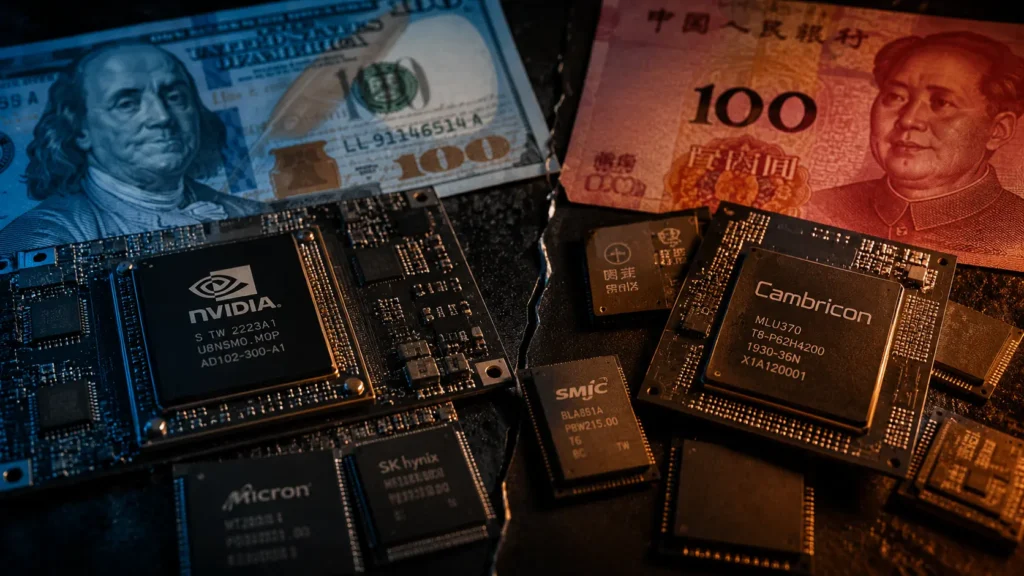
The United States has placed enormous faith in one specific lever: semiconductor export controls. The logic was clean keep the best chips out of Chinese hands, and you starve their AI development. It hasn’t gone according to plan.
Chinese domestic chips made up nearly 41% of China’s AI chip market in 2025, with approximately half of those sales coming from Huawei. This is a dramatic reversal from before 2023, when Nvidia held 90% or more market share in China’s AI chip market.
The paradox runs even deeper. US export restrictions have created a pricing paradox. The Ascend 950PR delivers 2.8 times the performance of NVIDIA’s H20 the only NVIDIA chip still legally sold in China. By restricting its own companies from selling top-tier chips to China, the US has inadvertently created a protected domestic market for Huawei’s alternatives.
Washington meant to slow China down. Instead, it may have accelerated China’s path to self-sufficiency.

Where the US Still Holds the Lead
None of this means America is losing. Not yet, and not on all fronts.
The hardware gap remains the US’s most durable structural advantage and it’s not close. US and partner manufacturing capacity for advanced AI processor dies is 35 to 38 times that of China’s, adjusted for quality.
The US remains the leader in building frontier models and in private capital deployment. OpenAI, Anthropic, and Google DeepMind still hold the frontier in raw model capability.
The US leads in AI monetization, and its companies have held their market share. The US is also the number-one destination for global AI talent.
But here’s the thing about leads built on money and talent: they erode. Especially when the competitor has state-directed capital, a massive domestic market, and a population that actually trusts what it’s being given.
The Part That Should Scare Everyone
Analysts suggest that artificial intelligence is the most transformative general technology since electricity brought light and power to average American households in the 1920s. And the two nations building it fastest are sprinting with fundamentally different values baked into their systems.
The great fear in Washington, according to Kyle Chan, an expert on China’s technology development at the Brookings Institution, is that China gets to AGI first. “In China, the priority really is much more on these nuts-and-bolts applications,” he adds but those applications are spreading everywhere, and fast.
The honest scorecard? The US is ahead today. The momentum belongs to China. And the gap between those two statements is closing faster than almost anyone predicted.
A near-tie in the most consequential technology race in human history isn’t just a geopolitical problem. It’s a civilizational one. Because whoever crosses the finish line first doesn’t just win a market they write the rules for how AI shapes economies, militaries, healthcare systems, and daily life for billions of people.
The scoreboard says 2.7%. That number should feel a lot bigger than it looks.
© AiwalaNews | Global Tech & Privacy Edition | May 2026
Read Also:
- 🔗 DeepSeek Changed Everything: Inside China’s AI Breakthrough
- 🔗 Who Controls the Future of AI? The Global Power Struggle Explained
