
You walk into a job interview. Before you say a single word, a camera has already scanned your micro-expressions, measured your blink rate, and assigned you an “emotional confidence score.” The hiring manager sees a number. You never do.
This isn’t a dystopian screenplay. This is Emotion AI and it’s already running inside some of America’s largest corporations, hospitals, insurance companies, and retail chains right now.
What Is Emotion AI and How Does It Actually Work?
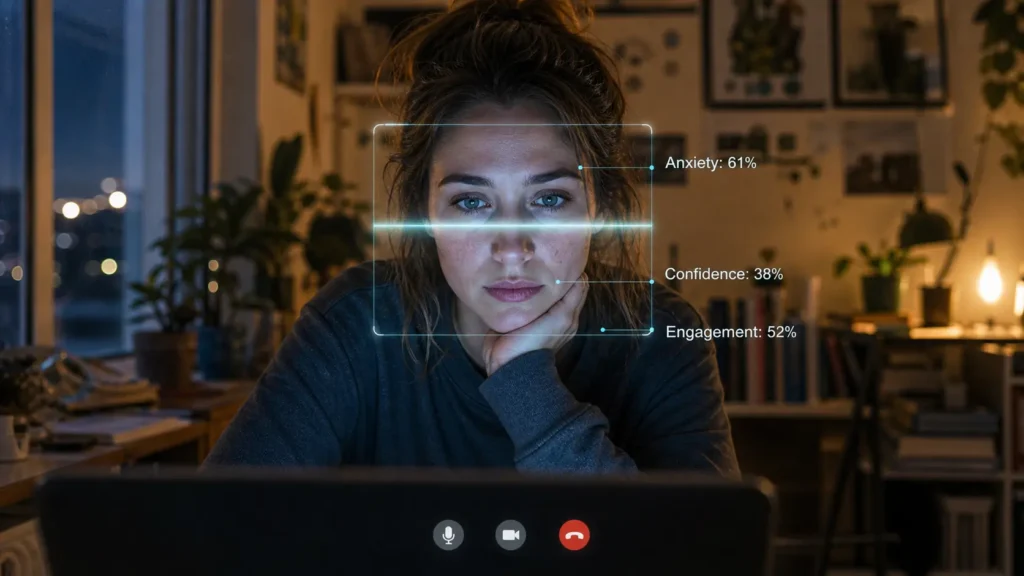
Emotion AI, also called affective computing, refers to software that analyzes human emotional states in real time using inputs like facial expressions, voice tone, body language, eye movement, and even physiological signals like heart rate variability through your phone’s camera.
The core technology works in layers. First, a computer vision model maps your face into hundreds of micro-landmark points the corner of your mouth, the tension around your eyes, the subtle raise of an eyebrow. These landmarks are then fed into a deep learning classifier trained on millions of labeled emotional responses. The output is a probability score: 73% frustration, 18% confusion, 9% neutral.
The second layer is voice affect analysis the same principle applied to your speech patterns. Pitch, pace, pauses, and tonal variation are decoded to infer stress, excitement, deception, or disengagement. Companies like Cogito, Affectiva (now part of SmartEye), and Beyond Verbal have been running these systems commercially for years.
The third and most invasive layer is physiological signal processing using your smartphone front camera to detect micro-changes in skin color caused by blood flow, estimating your pulse without touching you. This is called remote photoplethysmography (rPPG), and it’s already being quietly tested in telehealth platforms.

Who Is Already Buying This Data?
This is where it gets uncomfortable.
Insurance companies in the United States have begun exploring emotion data as a supplemental risk assessment tool. A pilot program linked to a major US health insurer studied whether elevated stress indicators during phone calls correlated with higher claim rates. They found it did and several firms have since quietly licensed affective analytics platforms for their customer service pipelines.
Retailers and advertisers have been early adopters. Companies like Walmart and Unilever have used emotion-scanning technology during focus groups and product testing to measure genuine consumer reactions reactions that people consciously hide when asked directly. The emotional response data is then used to redesign packaging, pricing displays, and even shelf layouts.
Hiring platforms are perhaps the most visible and controversial use. HireVue, used by over 700 companies including major US banks, uses AI-driven video analysis during pre-recorded interviews. Though the company has walked back explicit claims of emotion reading following regulatory pressure, the underlying technology assesses dozens of behavioral signals that correlate directly with emotional states.
The data brokerage market surrounding emotion AI is estimated to reach $13.8 billion by 2032, according to market research from Grand View Research. Unlike your browsing history or location data, emotional data is not yet clearly regulated under US federal law. That gap is intentional and companies are moving fast to lock in the data before regulation catches up.
The Consent Problem Nobody Is Talking About
Here is the part that should concern every person reading this.
When you use a customer service chatbot, you’re often told the conversation “may be recorded for quality purposes.” What you are not told is that the tone of your voice, your hesitation patterns, and your emotional escalation curve are being scored, stored, and in some cases sold.
When you attend a Zoom meeting or an online class, your webcam feed can legally be processed by third-party plugins for engagement and attention metrics without a separate consent screen beyond the platform’s buried terms of service.
Emotional data is uniquely dangerous because unlike passwords or credit card numbers, you cannot change your face. You cannot reset the way your voice sounds when you’re stressed. Once that data is breached, sold, or misused, it is irreversible.
The EU’s AI Act has classified real-time emotion recognition in public spaces as high-risk AI, placing strict guardrails around it. The United States has no equivalent federal law. A patchwork of state-level bills most notably Illinois’ BIPA (Biometric Information Privacy Act) offers partial protection, but enforcement remains inconsistent and litigation is slow.
What You Can Do Right Now
You are not powerless, but you need to act deliberately.
First, review the permissions on every app that accesses your camera or microphone. Go beyond the obvious fitness apps, virtual try-on tools, and customer service apps are among the most common collectors of passive facial data.
Second, if you live in Illinois, Texas, or Washington, your biometric data has legal protection. Know your rights and report violations to your state attorney general.
Third, treat video interviews differently. Emotion AI scoring is most aggressive in asynchronous video interviews. Speaking in a well-lit room, maintaining steady eye contact with the camera lens, and controlling your speaking pace are not just interview tips they are now calibration signals.
Fourth, demand transparency. When a company’s privacy policy mentions “behavioral analytics,” “engagement metrics,” or “voice analysis,” ask explicitly: is my emotional data being processed and stored?
The scariest part of Emotion AI is not its accuracy it’s often wrong in ways that disadvantage already-marginalized groups, with documented bias against people of color and non-native English speakers. The scariest part is its invisibility. It runs in the background of tools you trust, during moments when you are most vulnerable, and the data it generates about your inner life is being packaged and sold before most people even know the technology exists.
Your emotions are the last private thing you have. The market has already decided they’re worth billions.
Read also: 🔗 The 6 Apps Selling Your Location While You Sleep — AIwala News
🔗 How Data Brokers Legally Sell Your Home Address and Daily Routine in the US — AIwala News
© AiwalaNews | Global Tech & Privacy Edition | April 2026
