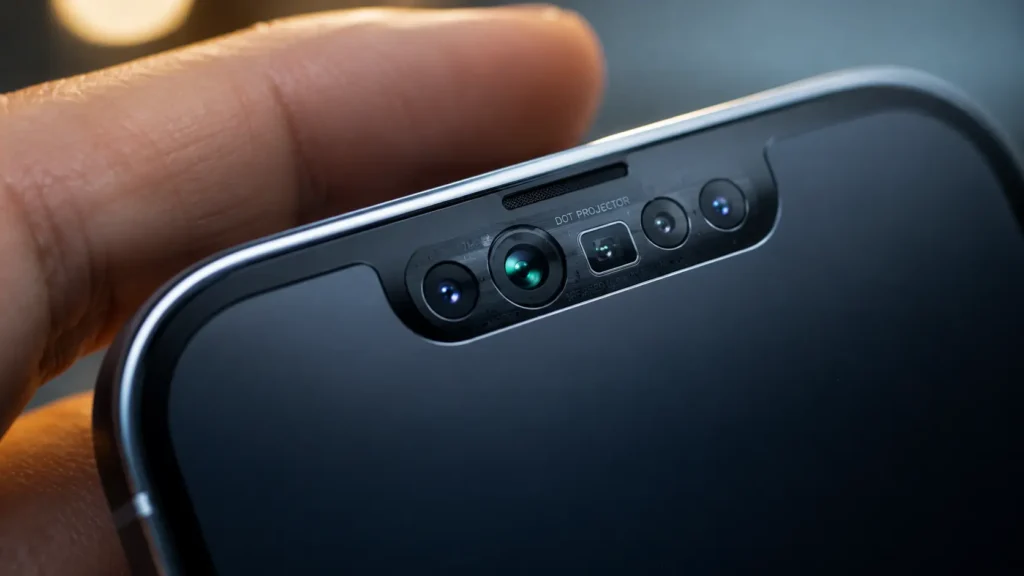
You have done it thousands of times without thinking. Lift the phone, it unlocks. No PIN, no password just your face, scanned and cleared before your eyes have adjusted to the light. In that single tenth of a second, an invisible infrared laser fires 30,000 dots at your face, builds a 3D map no photograph could replicate, and decides whether you are you.
It feels instant. It is, in fact, one of the most sophisticated pieces of engineering ever compressed into a phone notch.
The Three Components Doing the Work
The system is not a camera. It is three cameras and a laser, all working simultaneously. Every modern 3D facial recognition system Apple’s Face ID, Samsung’s Intelligent Scan, Google’s Face Unlock is built on the same core hardware stack:
The infrared dot projector fires 30,000 near-infrared dots in a fixed, known pattern across your face. You cannot see them they sit beyond visible light but the sensor sees every single one.
The infrared camera photographs those dots as they land. Where a dot lands off its expected position, the distortion reveals depth: how far that surface is from the lens. Flat surfaces scatter dots uniformly. A real human face distorts them in three dimensions and that distortion is the data.
The standard front camera captures a simultaneous 2D visible-light image. The neural engine fuses both data streams to confirm liveness ruling out a photo, a screen, or a printed mask held in front of the sensor.
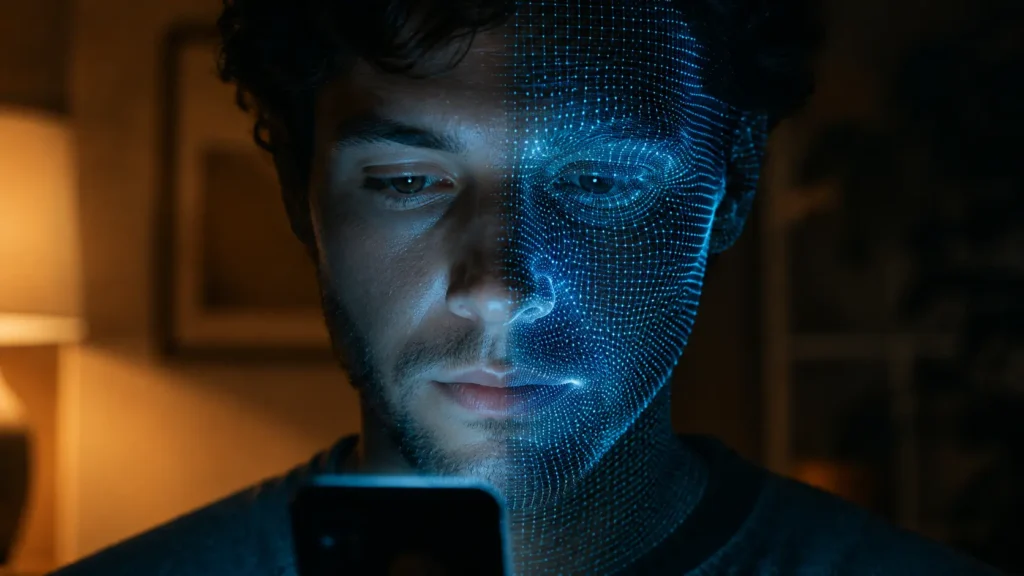
The result is a depth map: a precise 3D geometry of your face, accurate to a fraction of a millimetre.
Why 30,000 Dots — and Why Infrared?
Each dot is a data point. At 30,000 points, the sensor resolves the depth difference between your nose bridge and cheekbone, the curvature of your orbital socket, the exact contour of your brow features that are structurally unique to each individual and stable over time.
Infrared is used for three reasons. It functions in complete darkness, it is invisible so it does not disturb the user, and it defeats the most common spoofing attacks. A photograph of your face reflects infrared uniformly no depth, no distortion pattern. A 3D-printed mask would need sub-millimetre accuracy across the full geometry to return a convincing match. Apple’s published false-accept rate using a custom-crafted 3D replica: less than 1 in 1,000,000.
Key stat: A standard PIN has a 1-in-10,000 false-accept rate. Face ID is 100× more resistant to random guessing.
The 0.1-Second Pipeline
When you lift the phone, this is what happens across roughly 100 milliseconds:
0-15ms Flood illumination. The infrared flood illuminator activates, ensuring even dot-landing coverage regardless of ambient light or shadows.
15-40ms Dot projection and capture. The dot projector fires. The infrared camera captures the distorted pattern. Both cameras grab simultaneous frames.
40-70ms Depth map construction. The Secure Enclave processor a physically isolated chip that the main operating system cannot access calculates per-dot displacement and builds the 3D geometry model entirely on-device.
70-100ms Neural matching. The neural engine compares the live depth map against a stored mathematical template. Not a photograph. A set of numerical values representing geometric relationships between facial landmarks. Match confirmed. Phone unlocked.
Your Face Is Never Stored as a Photo
This is the most widely misunderstood aspect of the technology. No image of your face is stored not on the device, not in the cloud, not on any server. What is stored is a mathematical template: a compact numerical description of your facial geometry. It cannot be reverse-engineered into a photograph. It never leaves the Secure Enclave. Apple, Google, and Samsung have no access to it.
When you enrol, the system captures multiple depth maps across different angles and lighting conditions, extracts the geometric features, and discards the raw scans. Every subsequent unlock compares a new live depth map against this template entirely on-device, in isolation.
How It Adapts as Your Face Changes
The system uses on-device machine learning to update the stored template gradually. Grow a beard the template shifts incrementally with each successful unlock. Start wearing glasses the system incorporates the new geometry after a PIN confirmation. Gain or lose significant weight the template adapts over weeks of successful matches.
This continuous update loop is why accuracy stays high even as your appearance evolves naturally with age.
The Honest Limits
Identical twins remain the most documented vulnerability. Facial geometry in twins is structurally near-identical Apple explicitly acknowledges this in its security documentation. Very close family resemblances in children under 13 are similarly flagged.
There is also a legal and practical distinction worth understanding: a memorised PIN exists only in your mind and cannot be compelled without your cooperation in most legal frameworks. Your face, by contrast, is visible in public. Before relying entirely on biometric authentication, consider what that means in contexts of coercion, border control, or device seizure.
The Bottom Line
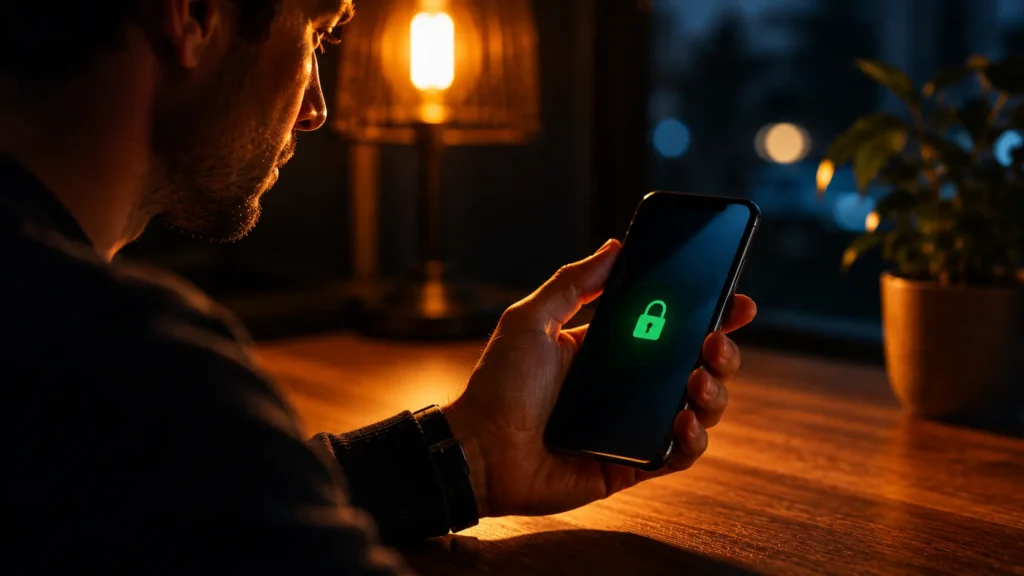
Face unlock is not a camera guessing who you are. It is an infrared laser, a depth sensor, and a dedicated neural processor working in concert firing 30,000 invisible dots, building a 3D mathematical model of your face, and clearing you in 100 milliseconds, without ever storing a photograph, without ever leaving the device.
That is the engineering behind the most natural gesture in modern computing: the lift of a hand, the recognition of a face, the opening of a world.
📌 Read Also:
- Your Phone Decides How Much Battery to Give Each App — And You Never Agreed to It
- How Credit Card Companies Know You’re About to Miss a Payment — Before You Do
© AiwalaNews | Global Tech & Privacy Edition | April 2026
